
A hospital system wants to scale an AI-powered patient-scheduling assistant across its 30 facilities. Which scaling methodology best follows the recommended approach of starting with short-term wins?
Select an answer to reveal the explanation.
Short Explanation
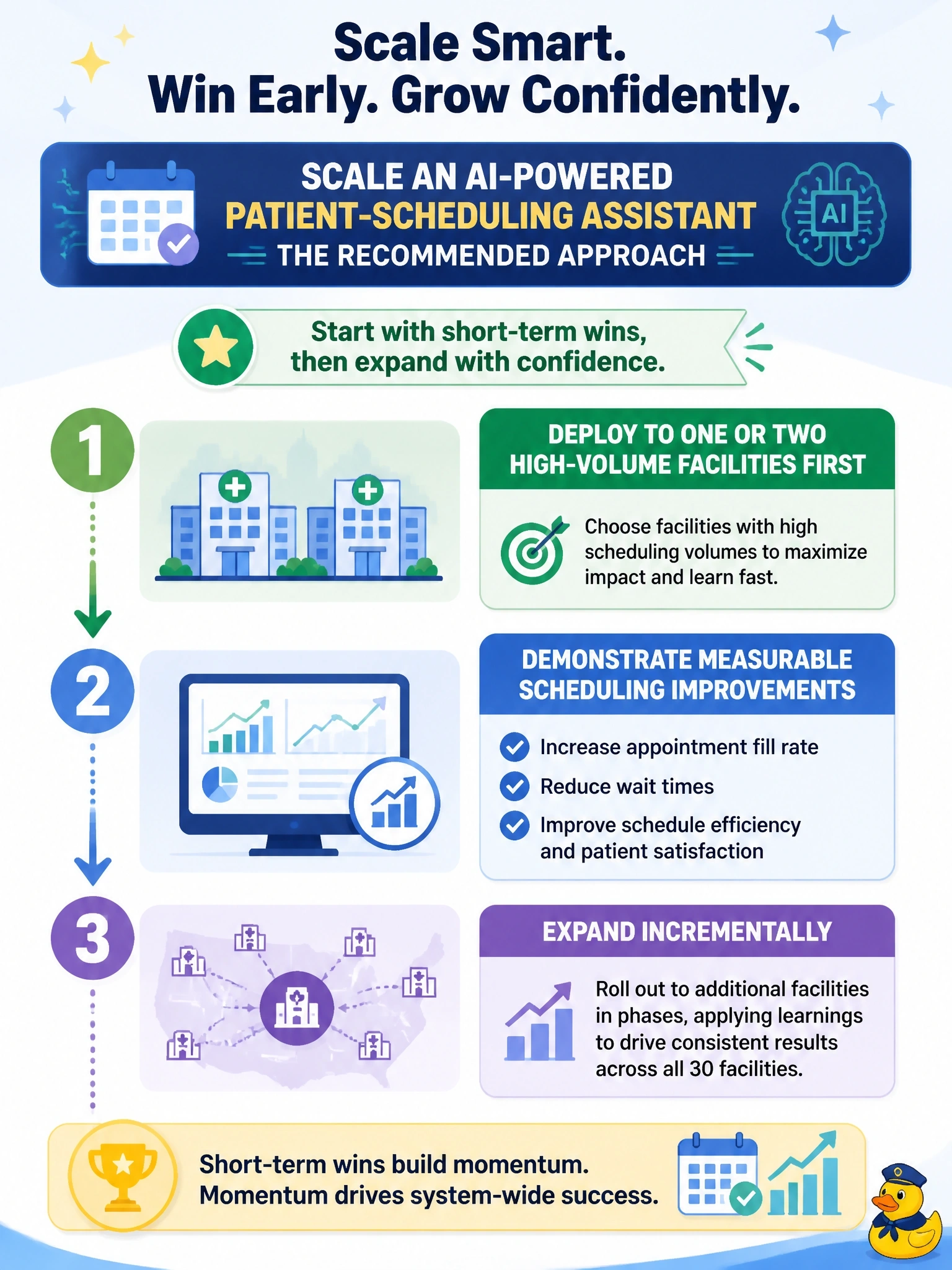
Think about how you'd pitch a new idea to a skeptical boss — you don't ask for a blank check, you show a small win first. Deploying to a couple of high-volume facilities first proves the tool works where it matters most, before asking the whole system to buy in. That early, visible win is what earns the confidence to expand.
Full Explanation
Starting with short-term wins means proving measurable value in a small, well-chosen scope before pushing toward the full enterprise, and deploying to one or two high-volume facilities first does exactly that — it puts the tool where impact will be most visible and measurable. Deploying to all 30 facilities simultaneously has no proven win to build organizational confidence from, and it carries far more risk, since any problem shows up everywhere at once instead of in a contained setting. Waiting until a facility-by-facility governance framework is fully finalized for all 30 sites before any deployment is overly cautious in the wrong direction — it delays the organization from ever capturing an early result to learn from, and governance can mature alongside a small initial deployment rather than blocking it entirely. Choosing facilities by IT budget size rather than scheduling volume optimizes for the wrong variable; a large IT budget says nothing about where scheduling impact or improvement would actually be greatest. The operating principle: scaling methodologies deliberately sequence a small, high-visibility success first, because that success is what builds the organizational confidence and funding needed for the harder work of enterprise-wide expansion. Operational check: does the first deployment target where impact will be clearest and most measurable, or just where it's most convenient to start?