
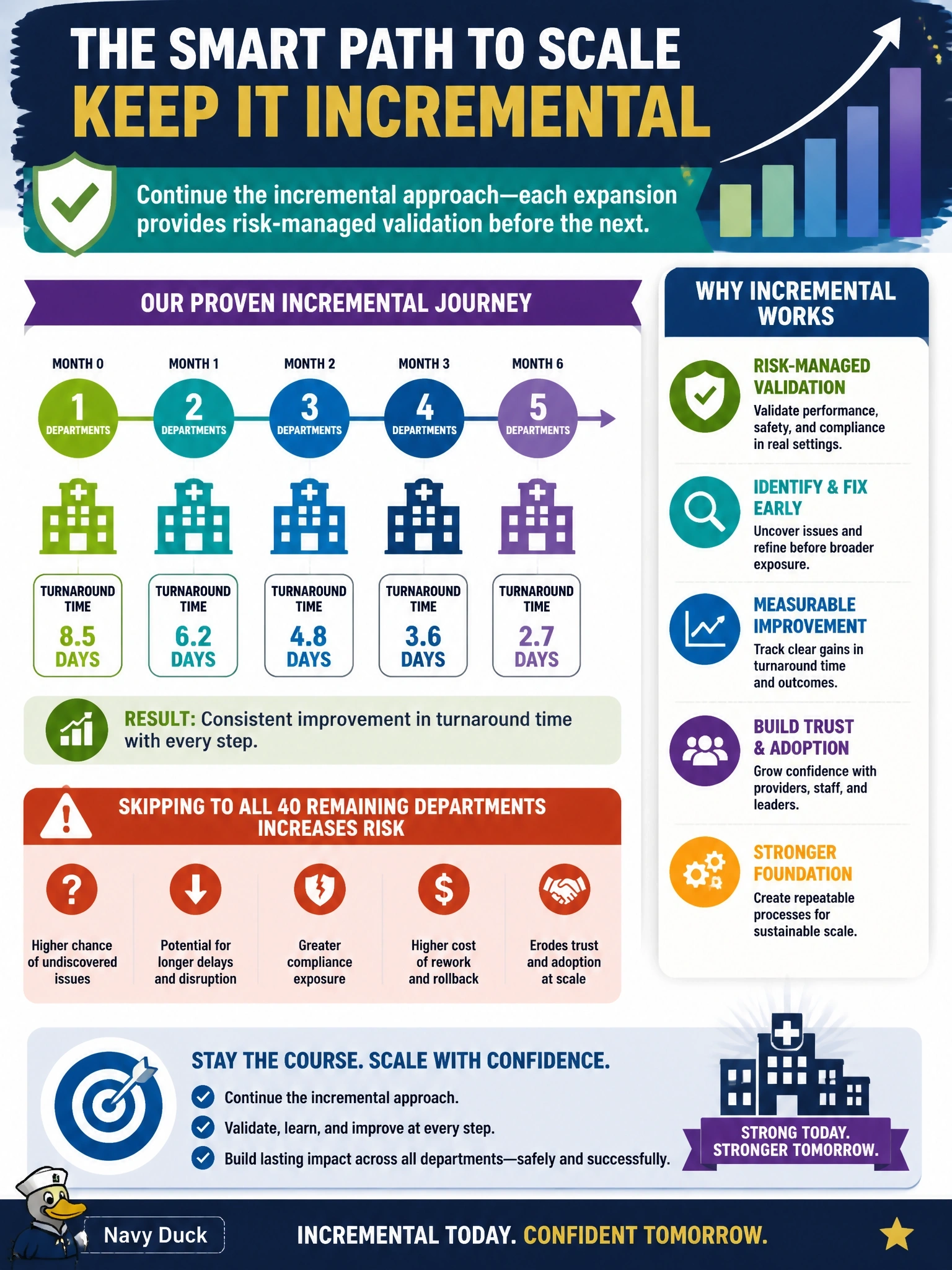
A healthcare payer scaled an AI prior-authorization assistant from one department to five departments over six months, with each expansion showing improved turnaround time. A department now requests skipping the incremental rollout and deploying directly to all remaining 40 departments. What should the AI transformation lead do?
Select an answer to reveal the explanation.
Short Explanation
Five wins in a row feels like plenty of proof, but you haven't tested the other 35 departments yet. Staying incremental keeps a checkpoint in front of you before each new commitment, even after a winning streak — momentum's great, it's just not a substitute for validation.
Full Explanation
Five consecutive successful expansions are encouraging, but they don't remove the value of continuing incrementally, since each new increment still tests the tool against conditions not yet seen and provides a checkpoint before the next commitment. Approving a full rollout because five wins feels like enough evidence is the tempting move, but it doesn't confirm how the tool performs across the varied conditions across the remaining 40 departments, and jumping straight to full rollout abandons risk management exactly when the remaining scope is largest. Halting scaling entirely until a single companywide metric applies uniformly is an unnecessary full stop — the organization has real, working evidence of value, and a metric-standardization issue can be resolved alongside continued incremental expansion rather than pausing everything over it. Delegating the rollout decision entirely to each department's local leadership removes the central coordination that made the first five expansions successful in the first place, risking the inconsistent governance that would undermine enterprise-wide scaling. The operating principle: a validated methodology should be sustained even after early wins accumulate, because incremental expansion is what keeps risk manageable as scope grows. Operational check: does the next expansion step still include a checkpoint before committing to the one after it?