
An engineering and construction firm wants to build company-wide AI literacy quickly but has limited training budget. Leadership is deciding between a multi-day formal training program for all staff or a series of small hands-on hackathon-style sessions where employees test AI tools on real project challenges. Given the budget constraint and the goal of building practical, sustained literacy, which approach is generally more effective as a starting point?
Select an answer to reveal the explanation.
Short Explanation
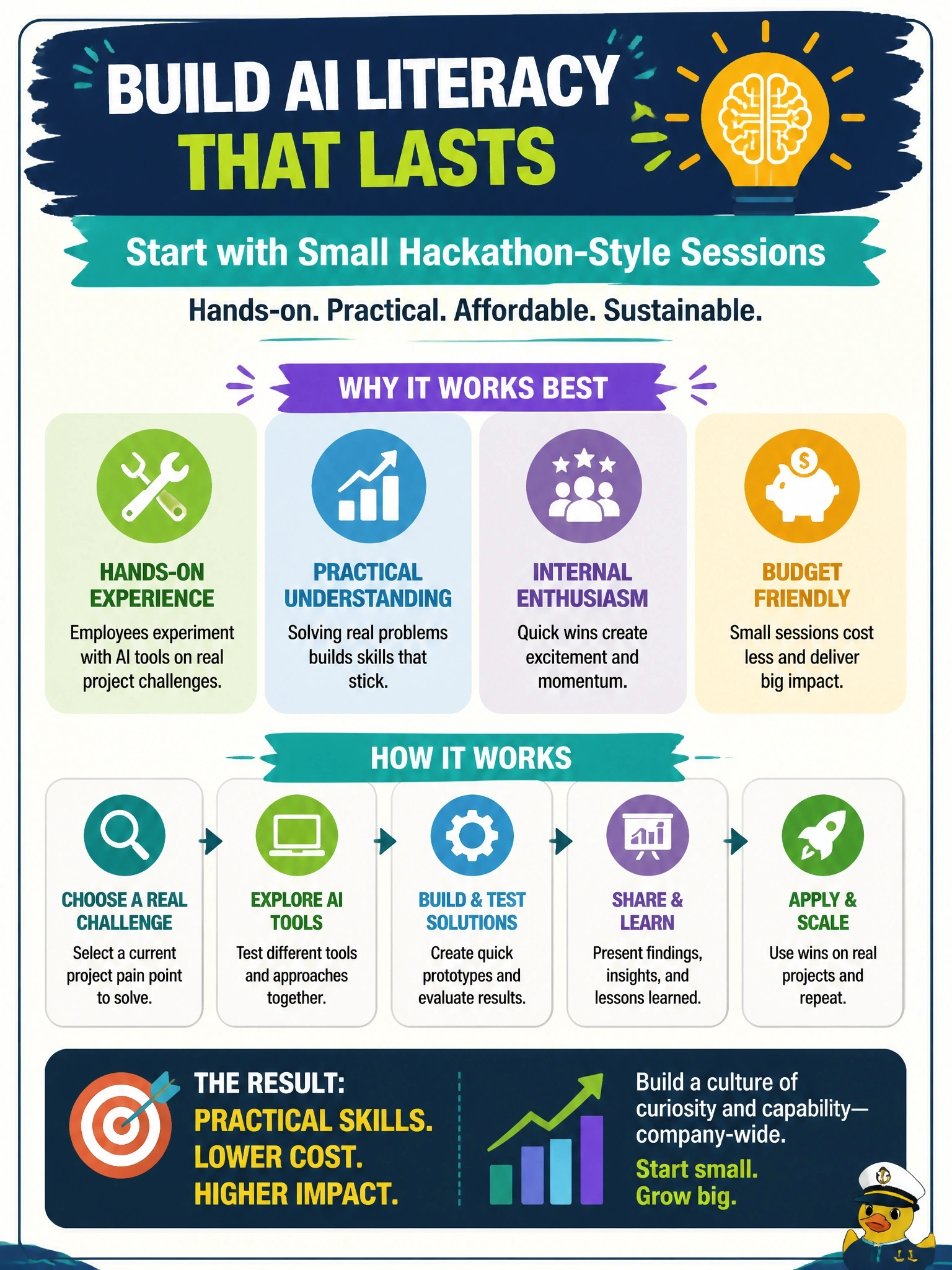
Think about how you actually learned the tools you use every day — probably not from a lecture, but from messing around with a real problem until it clicked. Hands-on hackathon sessions give employees that same real-problem experience at a fraction of the cost of a big formal program. That's what makes literacy stick, and it builds enthusiasm at the same time.
Full Explanation
With a limited budget and a goal of practical, sustained literacy, small hackathon-style sessions win because hands-on work on real project challenges builds understanding employees can actually use, and it does so more cheaply than a large formal program. A mandatory multi-day training program for all staff covers more material on paper, but one-time, lecture-style formats tend to produce weaker practical retention than applied, hands-on formats — and it's also the pricier option given the budget constraint. An external AI literacy certification requirement before any tool is introduced is slower and costlier still, and it front-loads a credentialing hurdle before anyone has touched a real problem, delaying practical adoption rather than accelerating it. Leaving employees to learn independently with no formal program at all abandons structure entirely; without any organized format, literacy grows unevenly and unpredictably across the company, if at all. What makes hackathon-style sessions the right starting point is that they're matched to both constraints in the scenario at once — a tight budget and a need for practical, sticky learning rather than one-time exposure. A good operational check: does the format put employees hands-on with a real problem, or does it just transmit information at them?