
A federal agency's program managers are reluctant to pilot an AI tool for internal report drafting, citing a general sense that "we don't do things that way here" and skepticism that leadership genuinely supports the change. What leadership intervention most directly addresses this specific barrier?
Select an answer to reveal the explanation.
Short Explanation
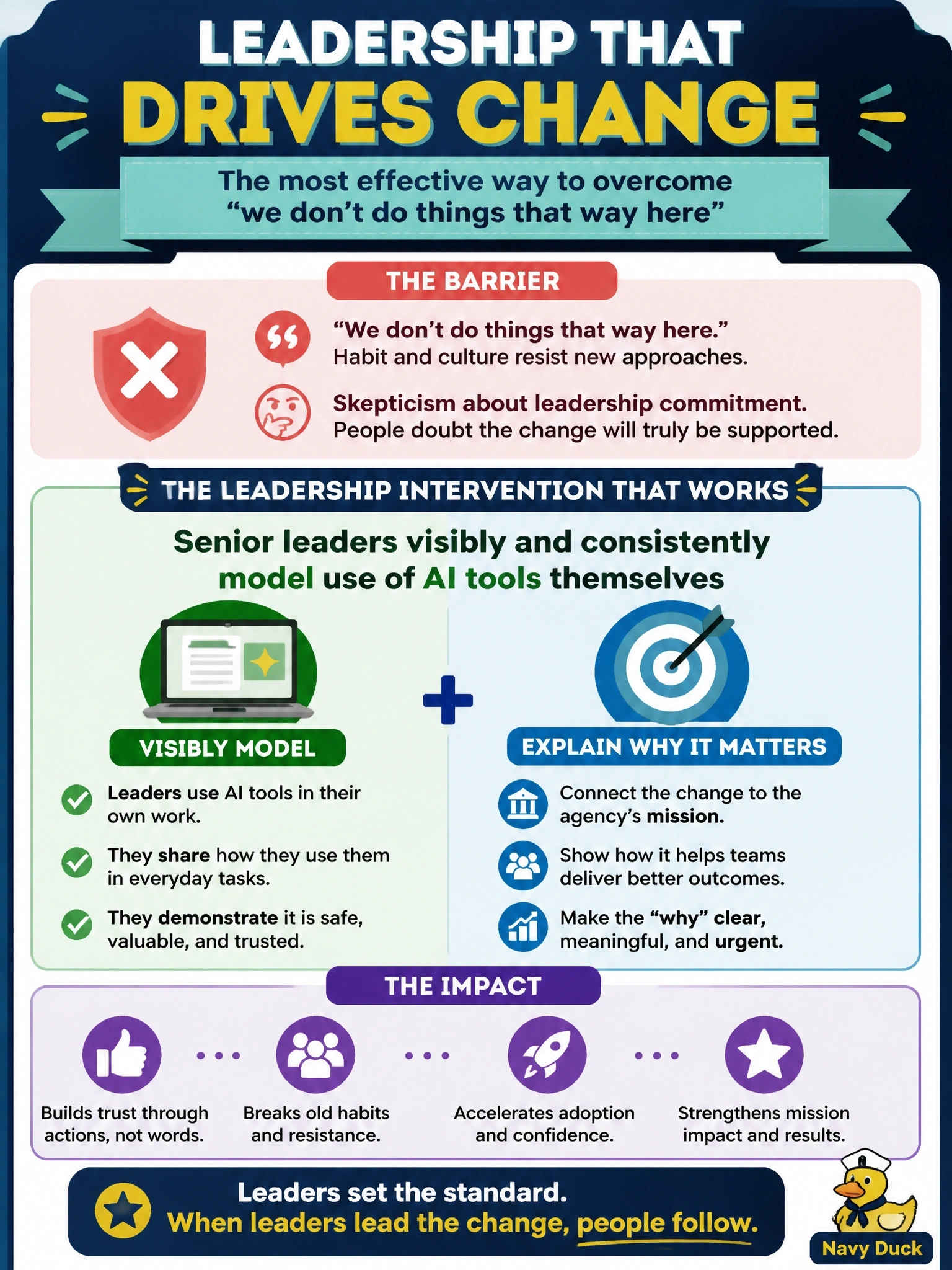
You can write a glowing memo about a new tool, but if your own leaders never touch it themselves, that gap is exactly what breeds 'we don't do things that way here.' Once senior leaders visibly use the tool and tie it back to the mission, that skepticism has nothing left to point at — your actions read as commitment in a way words on paper never do.
Full Explanation
The stated barrier is skepticism that leadership genuinely backs the change — a culture read of 'that's not how we do things here' — and the intervention that answers that directly is leaders visibly using the tools themselves and explaining why the shift matters to the agency's mission. A detailed written policy spelling out technical steps doesn't touch that skepticism at all; it assumes the barrier is confusion about process, when the actual barrier is doubt about leadership's commitment. A one-time cash bonus for the first manager to comply is a similar mismatch — it treats the resistance as a pricing problem rather than a trust problem, and a gimmick like that can even reinforce the suspicion that leadership doesn't really believe in the change themselves. Waiting for a future generation of program managers to arrive with more favorable attitudes abandons the current workforce and stalls the transformation indefinitely rather than leading through it. What makes visible modeling effective is that it's the one intervention that directly answers 'does leadership actually believe this,' since actions from senior leaders carry more credibility than any memo or incentive. Operational check: before rolling out a change, ask whether senior leaders are doing the new behavior themselves, publicly and consistently, not just announcing it.