
A nonprofit social services agency wants caseworkers to become comfortable using AI to draft client intake summaries. Leadership is choosing the first workforce-development step. Which approach best builds literacy while managing the sensitivity of client data discussed in the scenario?
Select an answer to reveal the explanation.
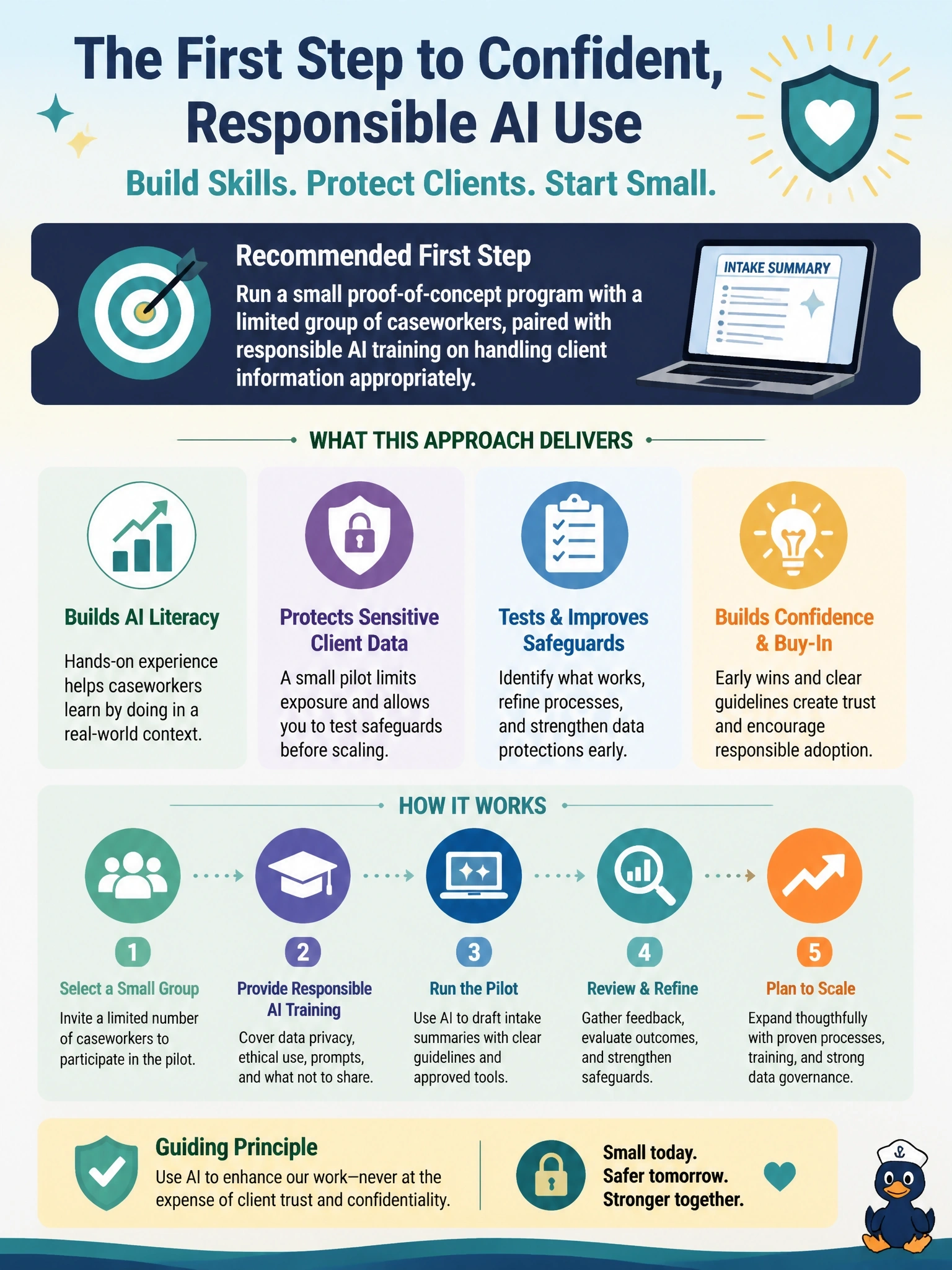
Short Explanation
Think of rolling out a new tool around sensitive client data the way you'd handle a live wire — you test it small, with the right protection in place, before you run it through the whole building. A small proof-of-concept group paired with training on handling client information responsibly does exactly that. It builds real comfort with the tool without putting everyone's data-handling practices at risk at once.
Full Explanation
A small proof-of-concept group paired with training specifically on handling client information responsibly lets the agency build practical literacy while containing the exposure of sensitive case data to a controlled, limited setting. Rolling the tool out to every caseworker immediately skips that controlled learning phase entirely, which multiplies the number of people handling sensitive client details before anyone has been trained on the specific risks — exactly the wrong sequencing for data this sensitive. Handing out a written user manual with no hands-on session builds weaker practical understanding than a structured, applied program, and it says nothing about how to handle client data appropriately in practice. Requiring a generic, agency-wide AI ethics course unrelated to caseworkers' specific client-data responsibilities misses the situational need entirely — it's broad where the scenario calls for something targeted. What makes the proof-of-concept approach work is that it scales both the exposure and the training to the actual risk level of the use case, rather than treating every rollout the same regardless of the sensitivity of the data involved. Operational check: before expanding an AI pilot that touches sensitive data, ask whether the training given actually addresses that specific data-handling risk, not just AI use in general.