
An environmental nonprofit's field scientists are hesitant to use a new AI tool for analyzing sensor data, worried that an AI-driven conclusion could be wrong and damage the organization's scientific credibility with funders. Leadership wants to address this risk aversion without discouraging eventual adoption. What is the best leadership intervention?
Select an answer to reveal the explanation.
Short Explanation
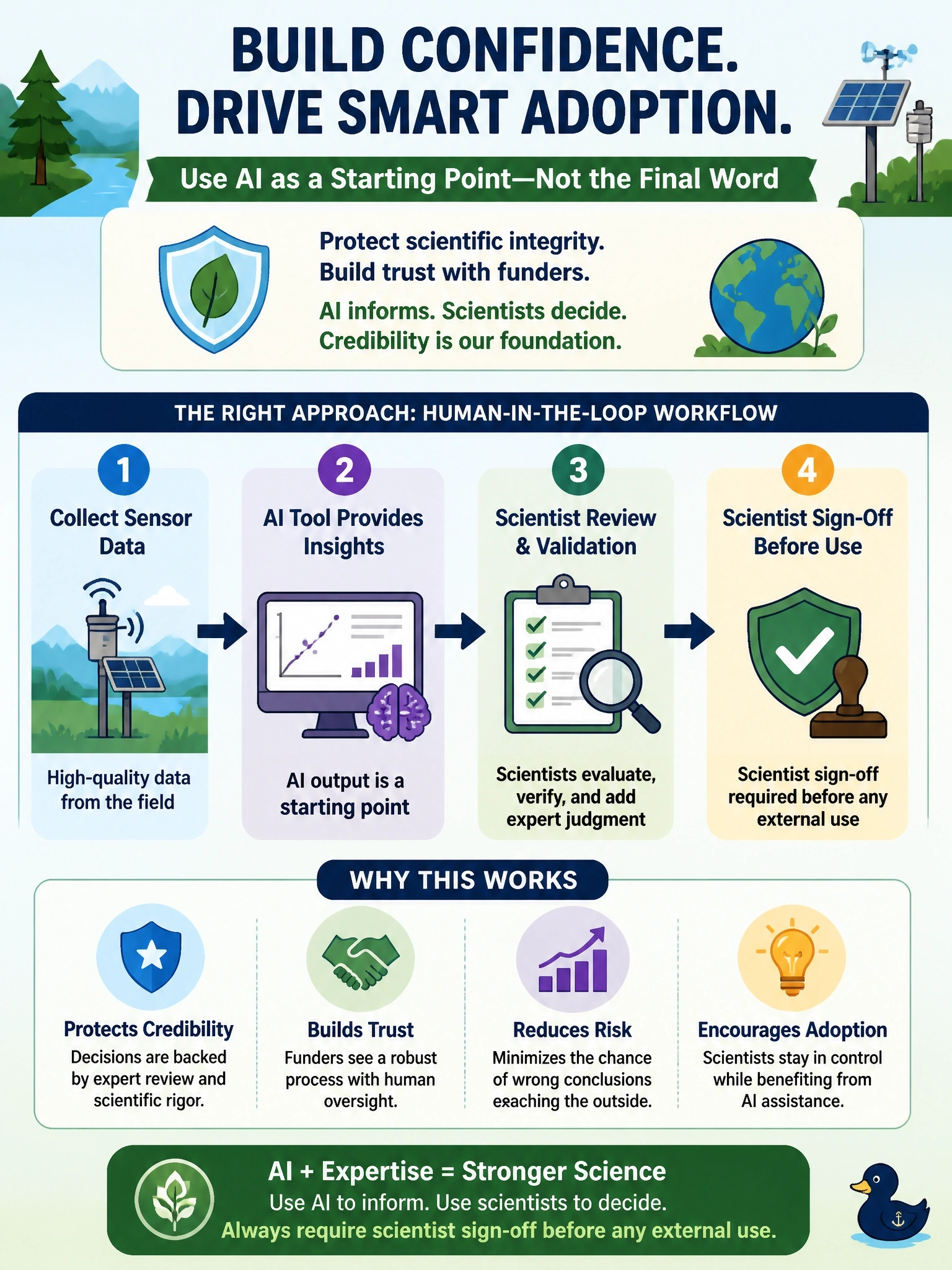
Think of the AI's draft the way you'd think of a research assistant's first pass — useful, fast, but not something that goes out the door without a scientist's eyes on it. Requiring sign-off before anything reaches a funder keeps the tool's speed without putting the organization's credibility on the line. That's what actually answers the scientists' worry, not banning the tool or pretending it carries zero risk.
Full Explanation
Positioning the AI's output as a draft that scientists must review and sign off on before external use keeps their expertise in the loop exactly where the credibility risk lives — at the point content reaches funders. Telling scientists that funder credibility is outside their responsibility dismisses a real, legitimate professional concern instead of addressing it, and that kind of dismissal tends to deepen resistance rather than resolve it. Requiring unanimous agreement that the tool carries zero risk sets an impossible bar, since no analytical tool is risk-free — that approach effectively stalls adoption indefinitely under the appearance of due diligence. Requiring scientists to publish the AI's conclusions in every external report without any modification removes their judgment from the process entirely, which increases the very risk they're worried about, because there's no longer a human checkpoint to catch an AI-driven conclusion before it reaches a funder. The mechanism that makes the correct answer work is preserving human sign-off on high-stakes, externally-facing output while still capturing the tool's speed. A useful operational check: for any AI-assisted output leaving the organization, ask who is accountable for reviewing it before it goes out, and what happens if they say no.