
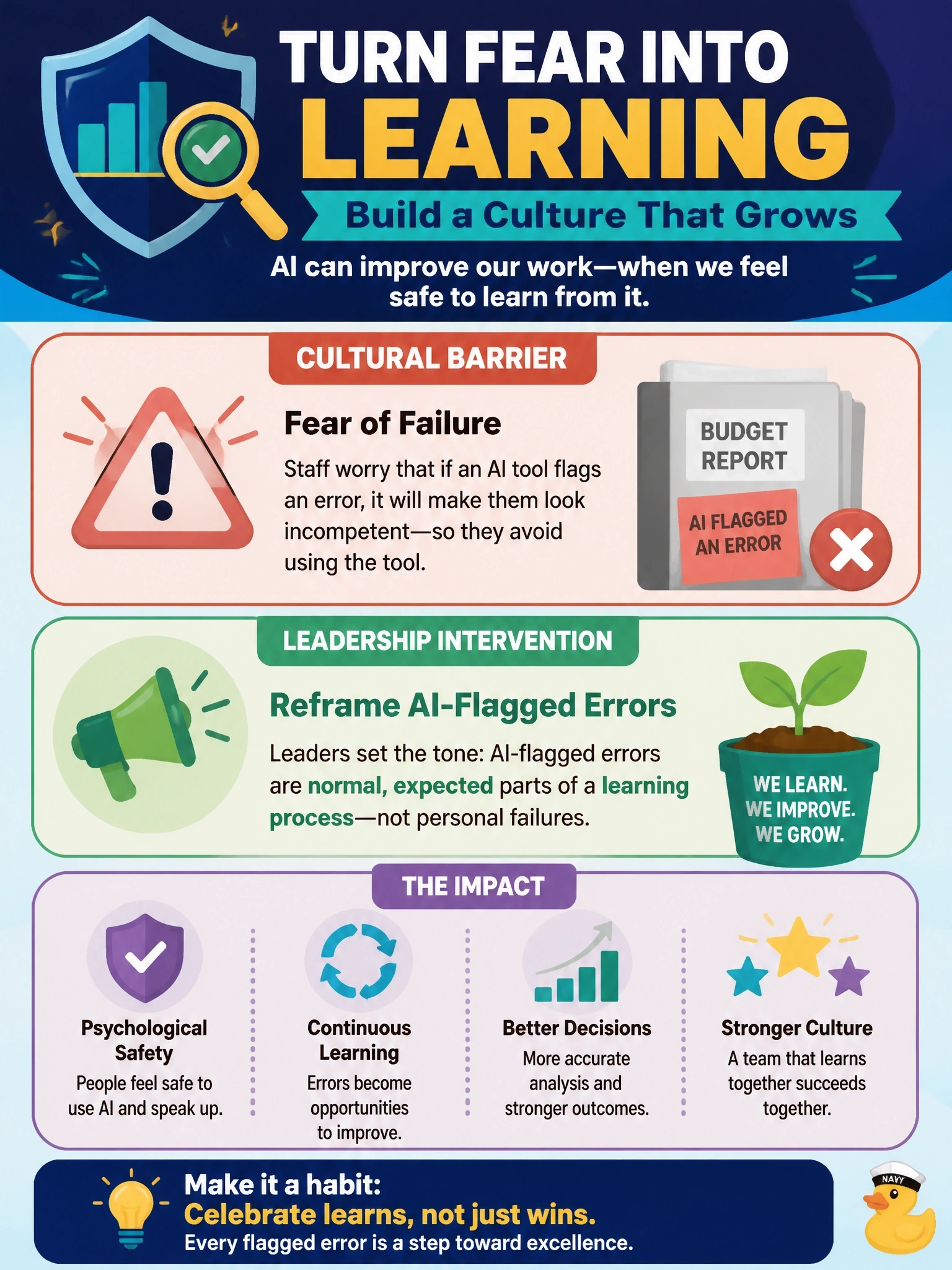
A municipal government's finance department resists piloting an AI tool for budget-variance analysis. Staff privately say they are afraid that flagging an error the AI catches will make them look incompetent, so they would rather avoid the tool altogether. What cultural barrier is most directly at play, and what leadership intervention best addresses it?
Select an answer to reveal the explanation.
Short Explanation
Think about the last time you were scared of looking dumb in front of your boss — that fear alone can make you avoid a tool entirely, even a helpful one. These staff aren't confused about how AI works; they're afraid a flagged error reads as personal failure. The fix is reframing: catching an error is what the tool is supposed to do, not a verdict on someone's competence.
Full Explanation
Staff are describing a specific psychological barrier — fear that an AI-caught error will make them look incompetent — and that's classic fear of failure, not a skills gap or generic resistance. The fix has to match the diagnosis: leadership should explicitly reframe AI-flagged discrepancies as a normal, expected part of learning a new process, not as evidence someone did their job poorly. Sending staff to a multi-week technical certification course misreads the barrier as a lack of AI knowledge, but a training course doesn't touch the underlying worry about looking incompetent in front of colleagues — it just adds workload without addressing the fear. Mandating use with disciplinary consequences attached does the opposite of what's needed: threatening penalties for avoidance raises the stakes of getting flagged, which deepens the very fear driving the resistance rather than easing it. Pulling the tool out of the budget process entirely avoids the discomfort but also forfeits any of its value, and it never actually resolves the psychological barrier — it just postpones the same conversation. The operating principle: match the intervention to the specific barrier. Fear-based resistance calls for psychological safety and reframing, not mandates, unrelated training, or retreat. A good check: does the intervention name the actual fear staff described, or does it just work around it?