
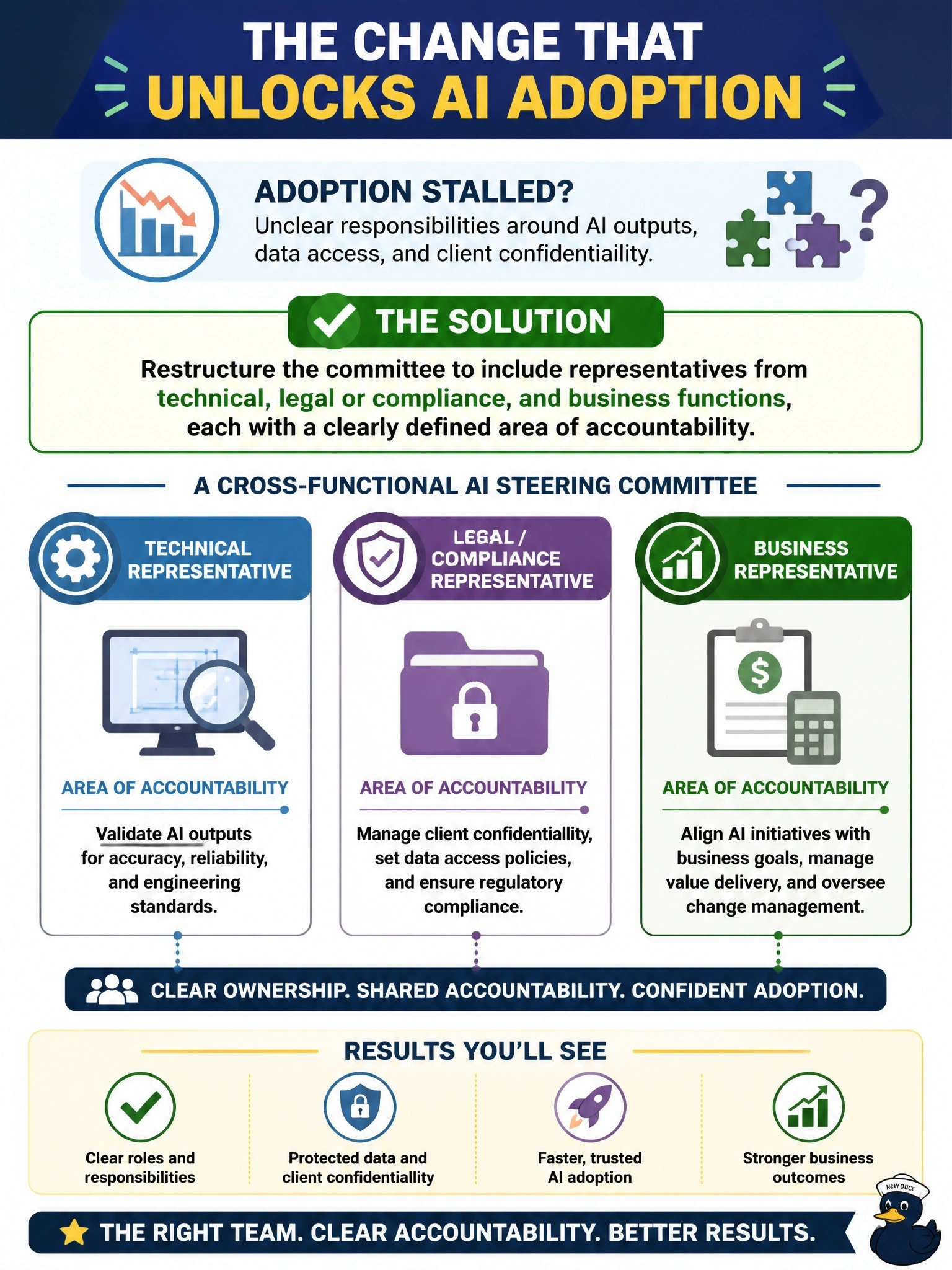
A civil engineering firm's AI steering committee consists entirely of senior engineers who are enthusiastic about using AI for design-review support. Six months into the initiative, adoption has stalled because staff are unsure who is responsible for validating AI outputs, managing data access, and handling client-confidentiality questions. What change would best address this?
Select an answer to reveal the explanation.
Short Explanation
A band that's all drummers is technically skilled but missing the parts that make the whole song work. If your committee stalls like this one did, it's not a lack of enthusiasm, it's a lack of range: you need legal, compliance, and business voices alongside the engineers, each owning a clear piece of the puzzle.
Full Explanation
Staff confusion over validation, data access, and confidentiality reflects a committee that lacks the legal, compliance, and business perspectives needed to own those areas — it isn't a shortage of engineering talent. Adding more senior engineers reinforces expertise the committee already has in abundance, which doesn't address the composition gap actually causing the stall. Dissolving the committee and letting each project team decide its own approach creates inconsistent standards firm-wide instead of the clear, shared accountability the initiative needs. Concentrating authority in a single accountable executive removes the diverse expertise the committee is specifically missing and creates a single point of failure for decisions that touch legal, technical, and client-relationship risk at once. The operational check: map each open question — who validates outputs, who controls data access, who owns confidentiality — to a named committee member from the right function, and don't consider the committee complete until every row has an owner.