
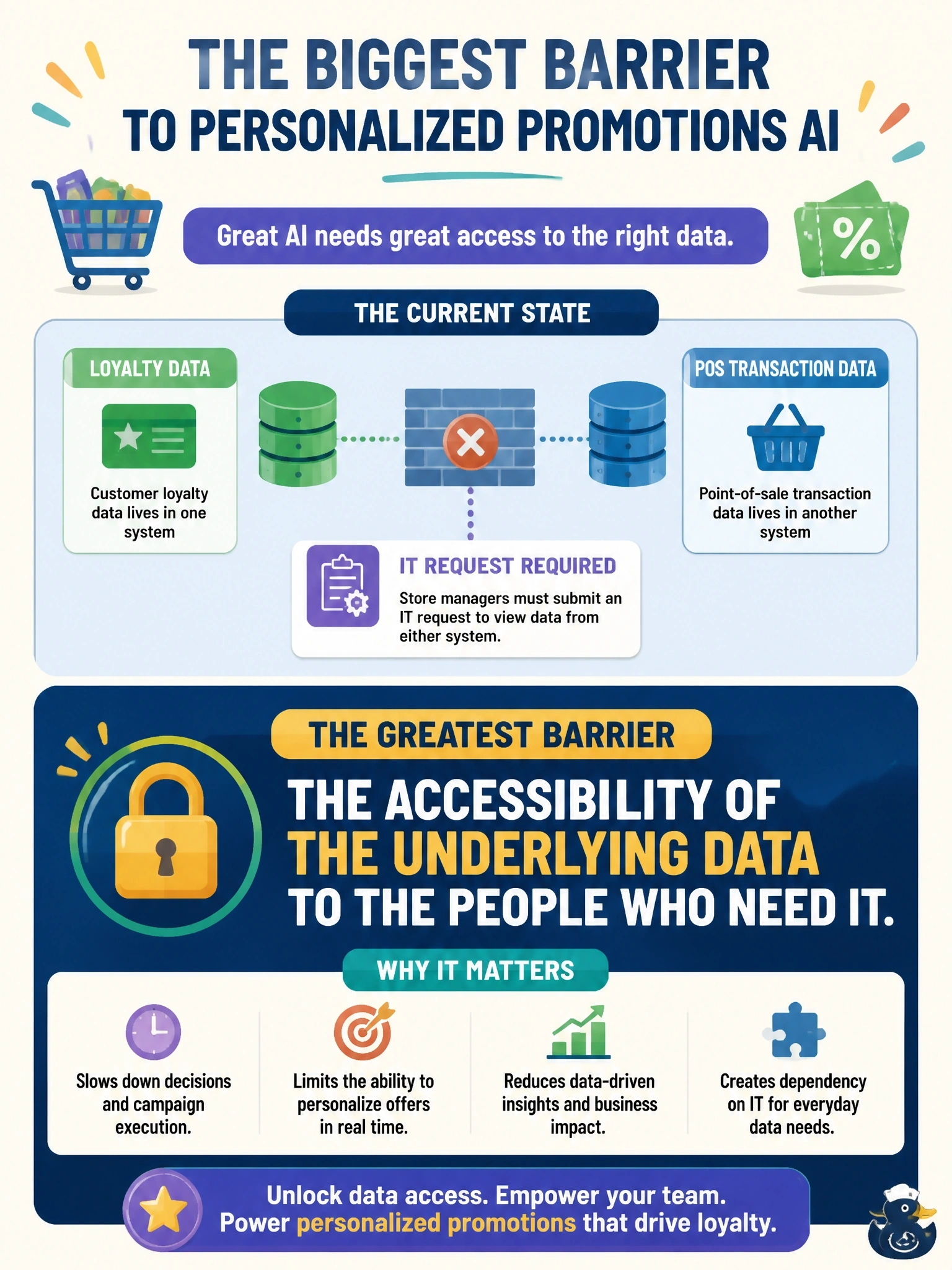
A grocery chain wants to launch a personalized-promotions AI capability. Customer loyalty data lives in one system and point-of-sale transaction data lives in another, and store managers currently must submit an IT request to view data from either system. Which factor is the greatest barrier to the initiative at this stage?
Select an answer to reveal the explanation.
Short Explanation
Think of it like a library where every book is cataloged perfectly, but you need a permission slip just to open the door. Great data locked behind an IT ticket doesn't help anyone — accessibility is its own readiness problem, separate from cost or strategy.
Full Explanation
The stem describes store managers needing to file an IT ticket just to view data from either system, a direct accessibility problem, since even complete, high-quality data is useless to an AI initiative if the people who need it can't readily reach it. The fact that loyalty and transaction data are managed by different teams is the closest distractor, because differing ownership often causes access friction in practice, but ownership itself isn't the barrier the stem names; the IT-ticket requirement is the actual obstacle, and that would exist regardless of who owns the data. The cost of maintaining two separate systems is a real consideration for many initiatives, but nothing in the scenario suggests maintenance cost is the issue; the problem described is about reaching the data, not paying for it. The absence of a defined customer segmentation strategy is a strategy gap, not a data-readiness issue, and the stem gives no indication the chain lacks a segmentation approach. The principle: accessibility is a distinct data-readiness dimension from cost, strategy, and ownership, and business leaders should pin down exactly which dimension is blocking an initiative before acting on it.