
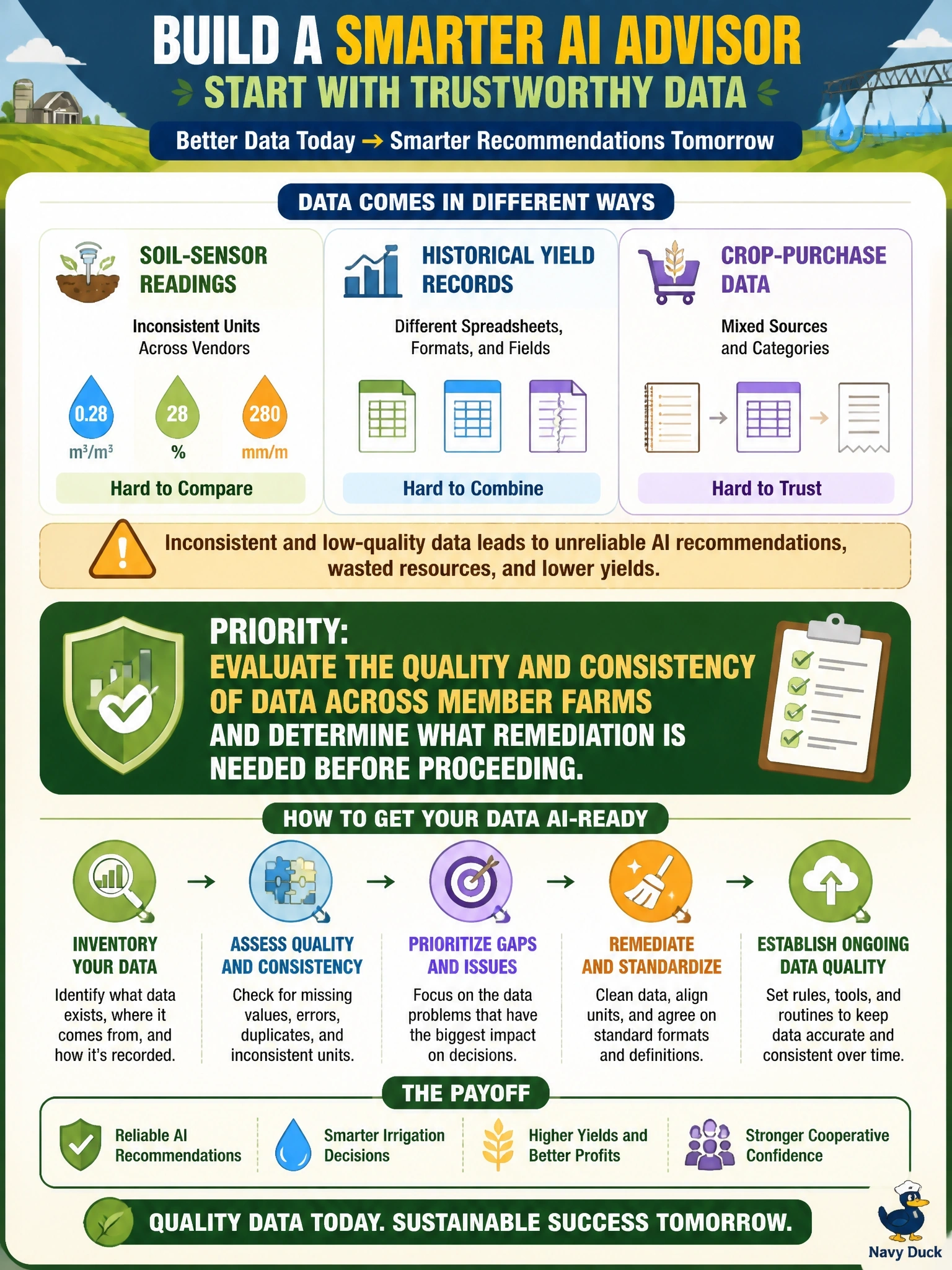
A regional farming cooperative wants to launch an AI advisory tool that recommends irrigation schedules using soil-sensor readings, historical yield records, and crop-purchase data from its member farms. Each farm records this information differently — some in spreadsheets, some on paper logs transcribed later, and sensor readings use inconsistent units across equipment vendors. Before selecting a vendor or approving a budget, what should the cooperative's leadership prioritize?
Select an answer to reveal the explanation.
Short Explanation
Baking with ingredients measured in three different systems — cups here, grams there, guesswork on the paper logs — never produces a reliable recipe. Check and fix your data across every farm before you ever pick a vendor or sign a budget.
Full Explanation
Leadership should evaluate data quality and consistency across every member farm and plan remediation before committing to a vendor or budget, since the inconsistencies described, mixed formats, transcribed paper logs, and mismatched sensor units, would undermine any advisory model regardless of how it's built. Selecting the vendor with the most advanced forecasting model and letting them handle the inconsistencies shifts responsibility to the wrong party: data quality problems originate with the cooperative's own collection practices, and a vendor cannot fix flawed inputs it didn't create, since the business still owns the outcome. Requiring every farm to switch to identical sensor equipment addresses only one dimension, hardware standardization, and is a costly, premature technical fix that skips the broader readiness work covering formats and recordkeeping. Moving forward using only the farms whose records are already in spreadsheets avoids the problem rather than solving it, and it would bias any recommendations against the farms left out. The general principle: a readiness assessment examining data quality and consistency across every contributing source must come before vendor selection or budget approval, not be delegated to a vendor or sidestepped by narrowing scope.