
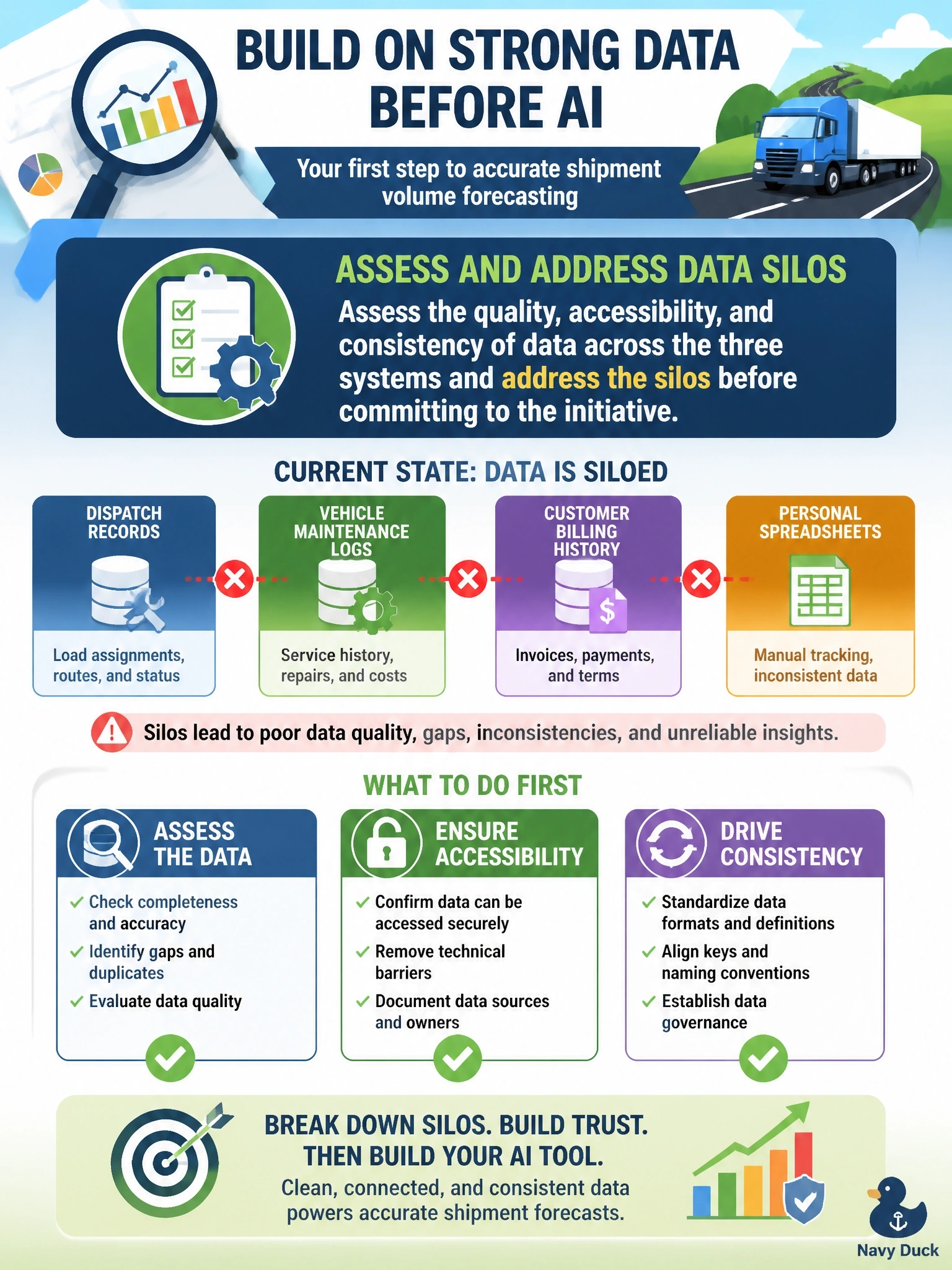
A regional trucking company plans to build an AI tool that forecasts shipment volume by lane. Dispatch records, vehicle maintenance logs, and customer billing history are stored in three separate systems that do not exchange data, and several dispatchers still track load assignments in personal spreadsheets. What should the company do first?
Select an answer to reveal the explanation.
Short Explanation
Think of it like trying to forecast with three maps that don't agree on the roads: dispatch, maintenance, and billing each tell a different story, and some dispatchers are still using sticky notes. You fix the map first — assess and connect the data before building anything that depends on it.
Full Explanation
The company should assess data quality, accessibility, and consistency across all three systems and resolve the silos before committing budget to the forecasting tool, because a model trained on fragmented, disconnected data will produce unreliable forecasts no matter how sophisticated it is. Building the model using only the dispatch system is tempting since dispatch holds the richest shipment-related detail, but ignoring maintenance and billing data leaves out factors that influence lane volume and simply relocates the silo problem inside the model instead of solving it. Running a limited regional pilot before addressing data quality is premature; any lessons learned would likely need rework once the silos across the three systems are actually resolved, so the pilot risks building on a flawed foundation. Asking dispatchers to consolidate their personal spreadsheets treats a symptom rather than the cause, since it does nothing to connect the maintenance and billing systems or resolve the inconsistencies between them. The underlying principle is that evaluating data quality, accessibility, and the effects of silos is a necessary readiness step that precedes any AI initiative, not an afterthought handled once a pilot is already underway.