
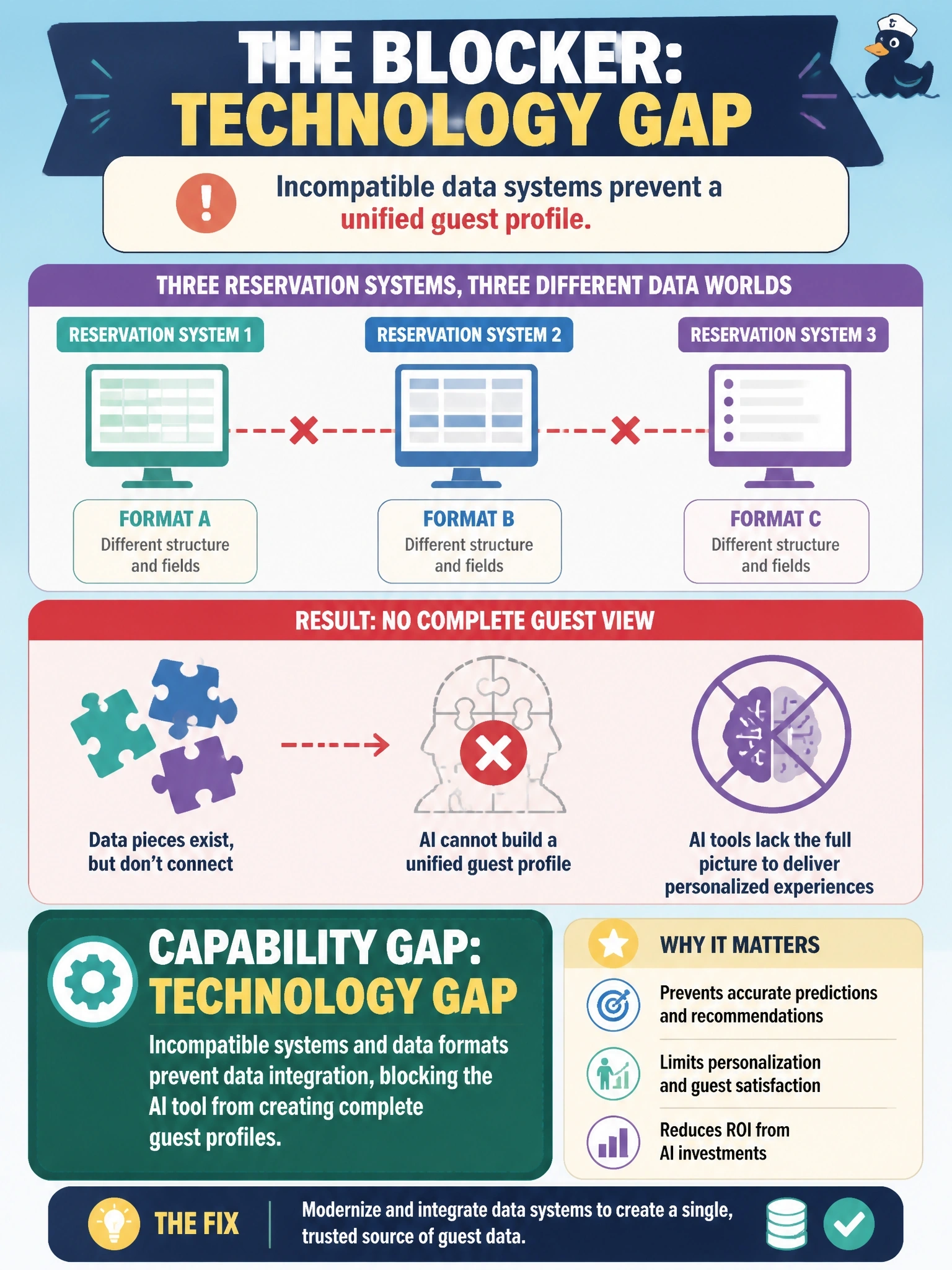
A hotel chain has thoroughly trained its front-desk staff on a new AI chat tool and established a clear AI governance committee. Bookings and guest-preference data, however, are stored in incompatible formats across three different reservation systems acquired through past mergers, making it difficult for any AI tool to draw a complete guest profile. Which capability gap most directly blocks the intended use case?
Select an answer to reveal the explanation.
Short Explanation
Staff are trained and there's a governance committee in place, so neither of those is your problem. Three merged reservation systems still can't agree on what a guest record looks like, and no amount of training or oversight fixes that — it's a straight-up technology and data-integration gap.
Full Explanation
The blocking issue here is that three merged reservation systems store guest data in incompatible formats, which is a technology and data-integration gap that directly prevents the AI tool from building a complete guest profile. Calling this a people gap is wrong because the stem states staff have already been thoroughly trained. Calling it a governance gap is wrong because the stem explicitly says a governance committee already exists. Calling it a process gap introduces a complaint-escalation issue that is never mentioned in the scenario, which is entirely about incompatible data systems. The general principle: when a scenario names a specific technical obstacle, such as incompatible systems from a merger, the correct classification should match that named obstacle rather than defaulting to a generic gap that sounds plausible for AI transformations in general.