
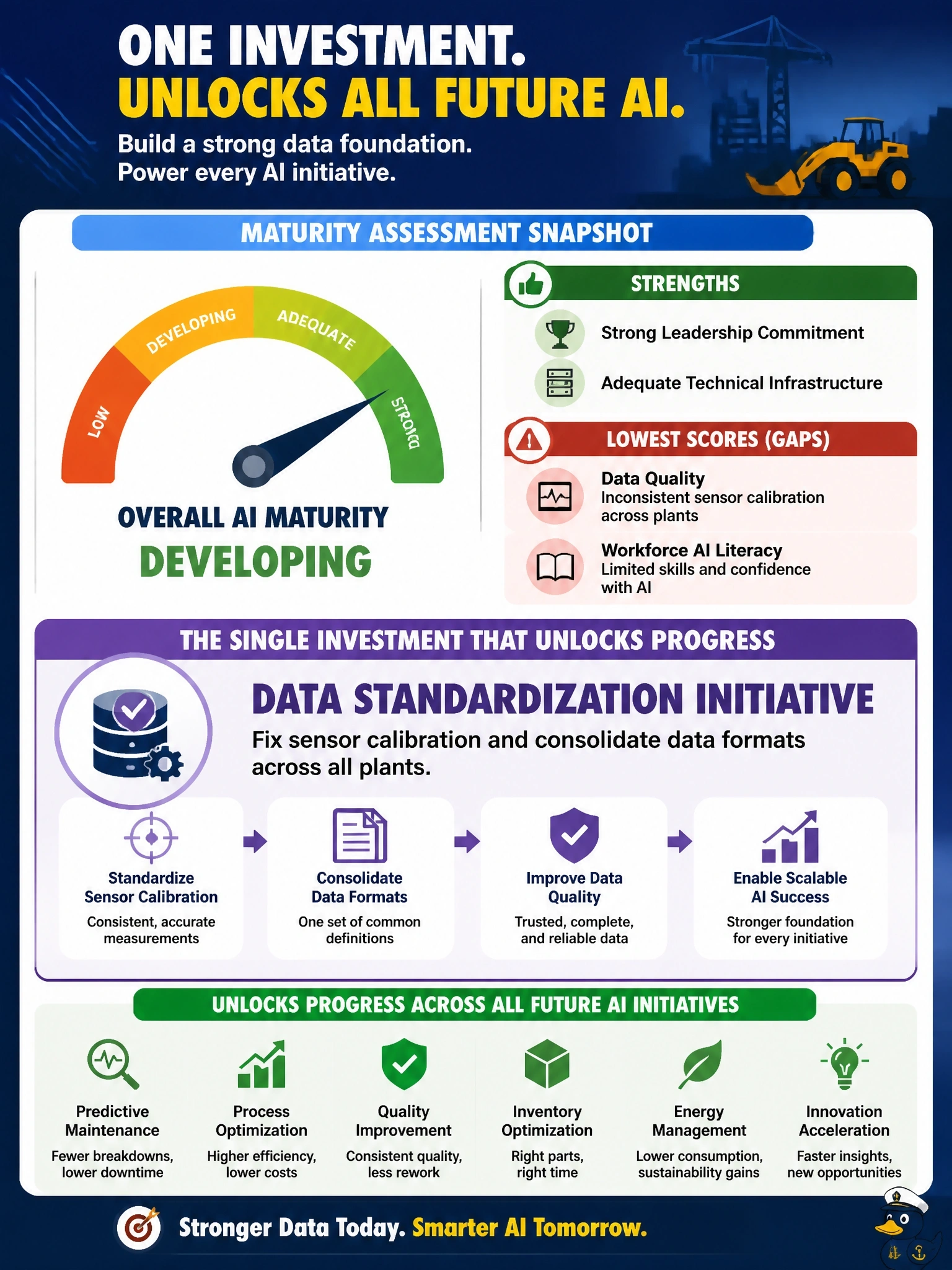
A heavy machinery manufacturer completed a maturity assessment showing strong leadership commitment and adequate technical infrastructure, but the lowest scores were on data quality (inconsistent sensor calibration across plants) and workforce AI literacy. Budget is limited to one initiative this year. Which investment is most likely to unlock progress on future AI initiatives across the company?
Select an answer to reveal the explanation.
Short Explanation
Every AI initiative this company builds later is only as good as the data feeding it. If sensor calibration is inconsistent from plant to plant, no amount of governance or training fixes what the model actually sees, so you fix the data foundation first and everything downstream gets easier.
Full Explanation
Data standardization directly targets the company's two lowest-scoring gaps at once: fixing sensor calibration and consolidating formats produces the comparable, reliable data every future AI initiative will depend on, which is why it's the highest-leverage investment when budget covers only one initiative. The governance committee builds oversight structure, which matters over time but does nothing to resolve the immediate technical blocker keeping the company's data unusable for AI work. Company-wide AI literacy training addresses the workforce gap, but training employees to interpret data that's still inconsistent across plants won't produce usable AI outcomes on its own — the underlying data problem persists either way. Expanding computing infrastructure spends money on a dimension the assessment already rated adequate, so it does not close any of the company's actual gaps. The operating principle: when budget covers only one initiative, fund the investment that removes the constraint blocking the largest number of future initiatives — here, unreliable and inconsistent data — rather than one that reinforces an already-strong area or addresses a secondary weakness in isolation.