
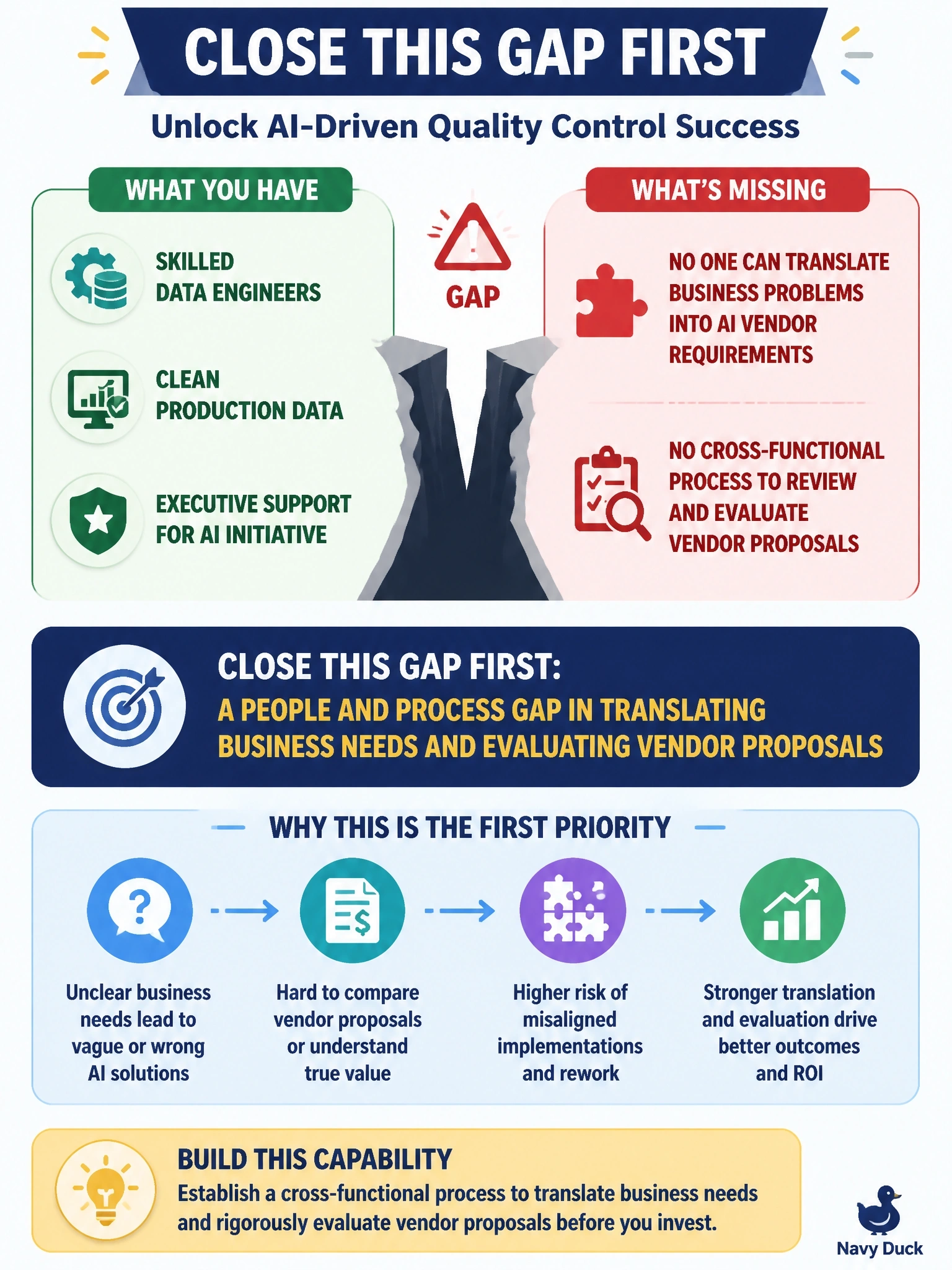
A packaging manufacturer has skilled data engineers, clean production data, and executive support for an AI-driven quality control initiative. No one on staff, however, understands how to translate a business problem into requirements an AI vendor can act on, and there is no cross-functional process for reviewing vendor proposals. Which capability gap should the company close first?
Select an answer to reveal the explanation.
Short Explanation
Your engineers can build it and the data's clean, but nobody on staff knows how to turn 'we want better quality control' into a spec a vendor can actually bid on. That's a people and process gap — the skill of translating business needs, plus a cross-functional way to vet what vendors propose, simply doesn't exist here yet.
Full Explanation
The stem describes two specific missing capabilities: staff who can turn a business problem into requirements a vendor can act on, and a cross-functional process to evaluate vendor proposals. Both are a people and process gap. Calling this a technology gap is wrong because the production data and infrastructure are described as clean and the engineers as skilled. Calling it a governance gap introduces a risk-classification issue that the stem never raises; the described problem is about translating needs and reviewing proposals, not classifying risk levels. Calling it a cultural gap assumes an employee trust problem that has no support in the scenario, which instead describes strong executive backing. The general principle: the capability gap that should be prioritized is the one the evidence directly names, not one that sounds like a plausible AI transformation issue in general.