
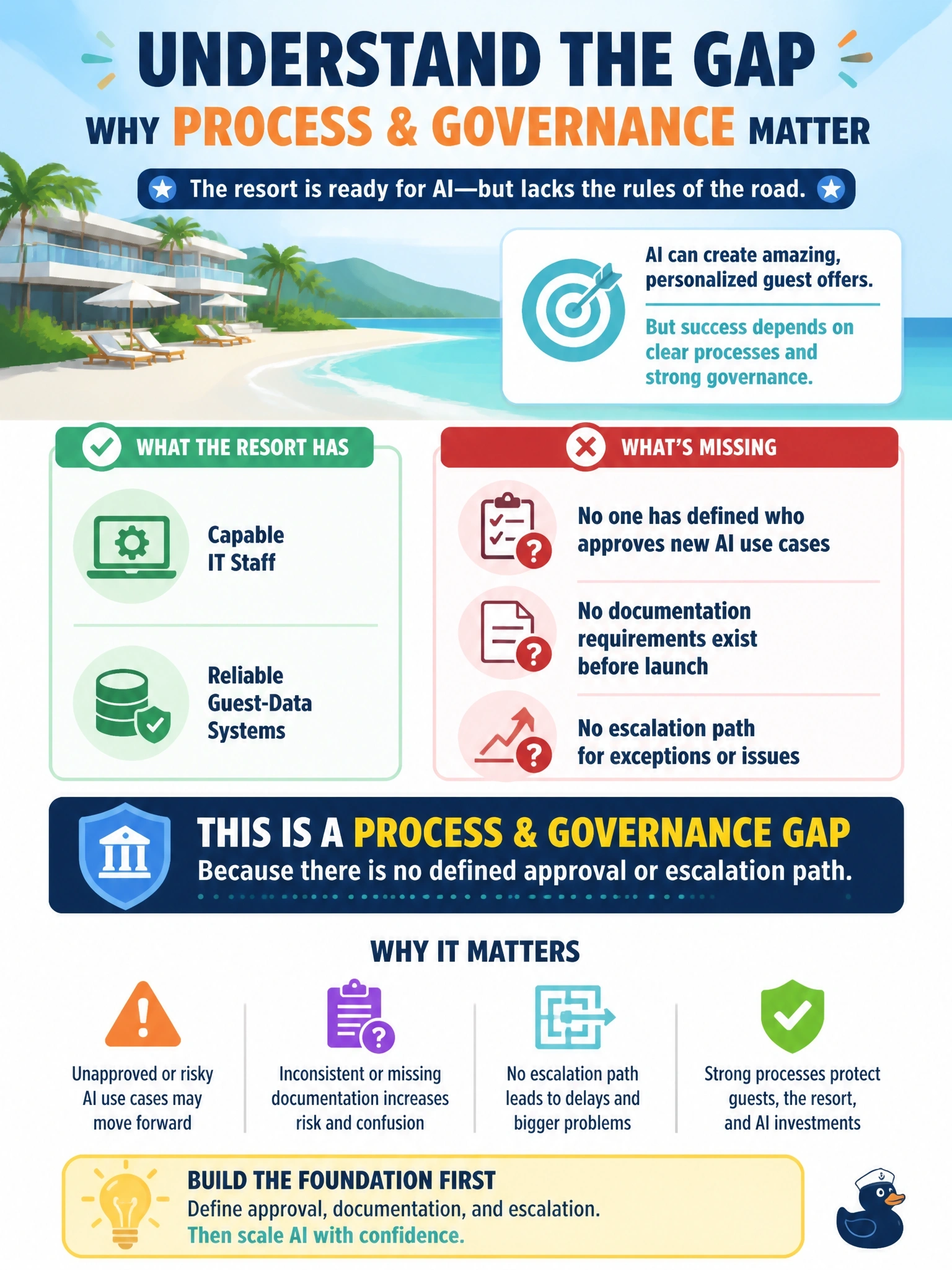
A beachfront resort wants to use AI to personalize guest offers. The resort has capable IT staff and reliable guest-data systems. However, no one in the organization has defined who approves new AI use cases, what documentation is required before launch, or how exceptions are escalated. Which type of capability gap does this describe?
Select an answer to reveal the explanation.
Short Explanation
Nobody's decided who signs off on a new AI use case, what paperwork you need, or where exceptions go — that's not a skills problem or a tech problem, it's a missing rulebook. A process and governance gap is exactly this: capable people and solid systems with nobody defining the path your project has to follow to launch.
Full Explanation
The missing pieces here are entirely about decision rights and procedure: who approves a use case, what documentation is required, and how exceptions are escalated. That is a process and governance gap. Calling this a people gap is wrong because the stem describes capable IT staff, not a skills shortfall. Calling it a technology gap is wrong because the guest-data systems are described as reliable, not outdated. Calling it a cultural gap introduces staff resistance that the scenario never mentions; nothing in the stem describes attitudes toward AI, only the absence of approval and escalation procedures. The principle: a capability gap should be classified by what evidence the scenario actually provides. Here, the missing structures are entirely procedural and governance-related, so the correct classification tracks the described facts rather than a generic assumption about resistance or skill.