
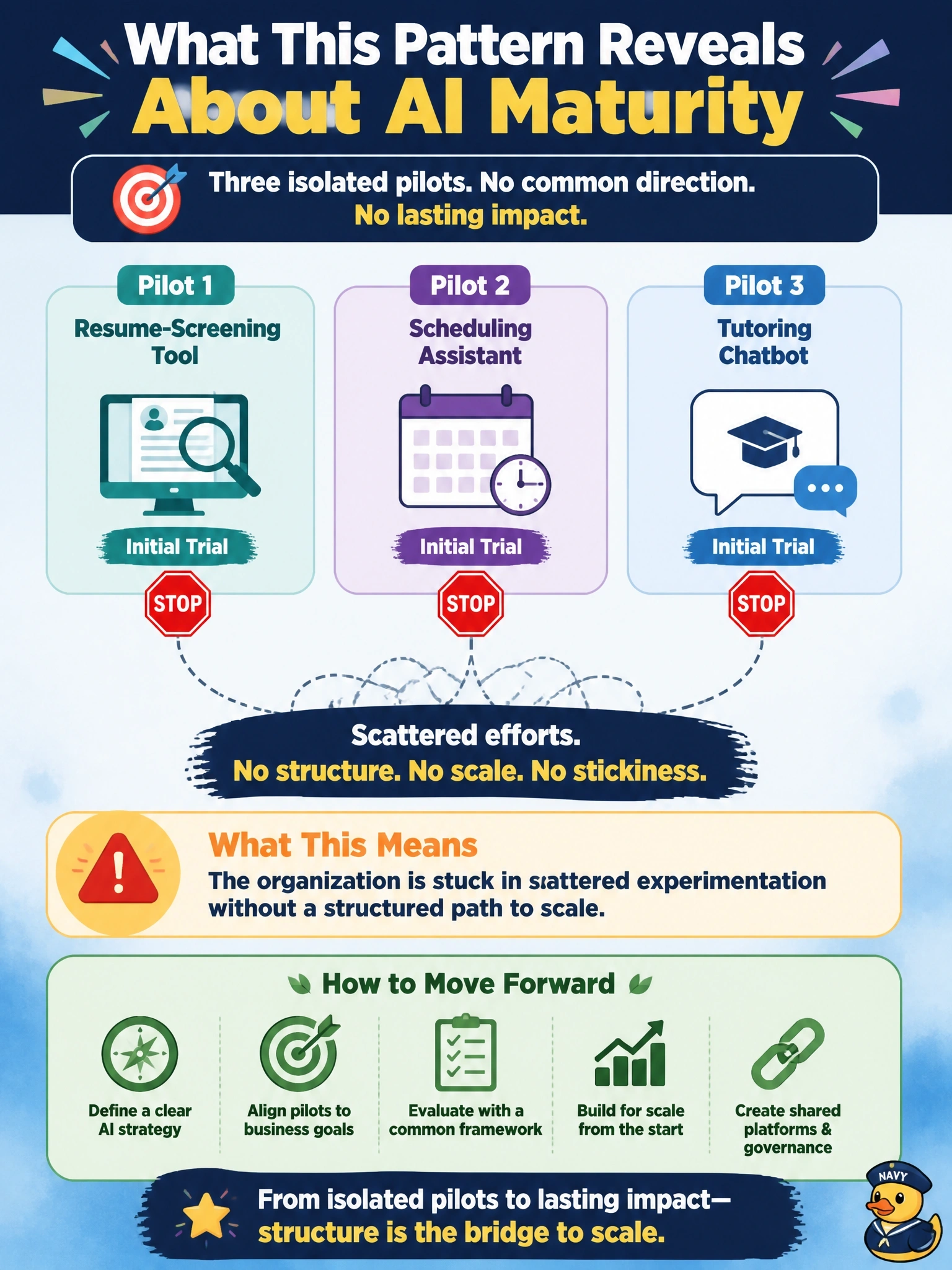
A vocational training provider has run three unrelated AI pilots in the past two years: a resume-screening tool, a scheduling assistant, and a tutoring chatbot. Each pilot was built by a different department, none were evaluated against a common business case, and none continued after the initial trial. What does this pattern most strongly indicate about the provider's AI maturity?
Select an answer to reveal the explanation.
Short Explanation
Three pilots, three different departments, zero coordination, and every single one died after the trial — that's not a maturity ladder, that's three separate ladders leaning against different walls. Scattered experimentation is exactly this pattern: activity with no shared business case and no path to scale, and building a lot of tools doesn't mean you've matured if none of them connect.
Full Explanation
Three disconnected, uncoordinated pilots that each died after their trial is the defining pattern of scattered experimentation: activity without a structured business case or path to scale. Calling this enterprise-scale deployment mistakes volume of pilots for enterprise maturity, but building several one-off tools with no continuity or coordination is the opposite of enterprise-scale deployment. Calling it strong governance misreads the absence of coordination as intentional containment; the stem shows no evidence of deliberate governance, only the lack of any cross-department oversight. Calling it data maturity assumes that using real operational data automatically signals data maturity, but data maturity is about consistency, ownership, and reuse across the organization, none of which this fragmented pattern demonstrates. The principle: maturity is measured by structure and continuity across initiatives, not by counting how many pilots were attempted.