
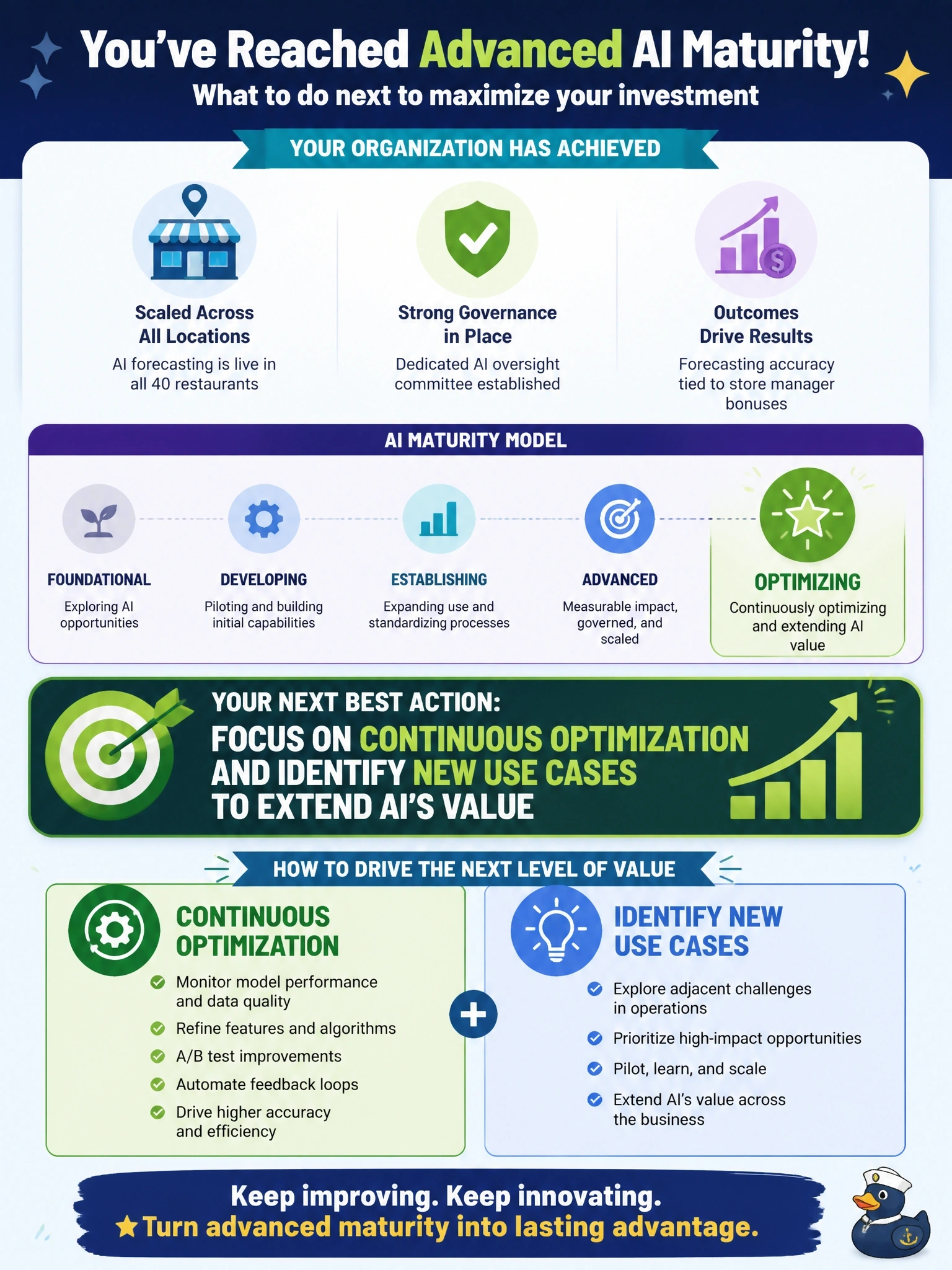
A restaurant group has scaled its AI-based inventory forecasting tool to all 40 locations, established a dedicated AI oversight committee, and ties forecasting accuracy to store manager bonuses. Leadership is now debating whether to invest further in AI or shift focus elsewhere. According to AI maturity models, which action best fits an organization that has already reached advanced maturity for this use case?
Select an answer to reveal the explanation.
Short Explanation
Forty stores running the same forecasting tool, a standing oversight committee, and bonuses tied to accuracy — that's not a company that needs to prove the concept again, it's one that's already proven it. At advanced maturity, the move is to optimize what's already working for you and go hunting for the next use case, not restart, pause, or shrink what already succeeded.
Full Explanation
An organization that has scaled a tool to every location, formalized oversight, and tied it to performance incentives has already reached advanced maturity for that use case; the appropriate next step is to optimize what exists and expand into adjacent use cases. Restarting with a small five-store pilot wastes proven scale by re-validating a use case that is already confirmed across all 40 locations, which is a regressive step, not a maturity-appropriate one. Pausing all investment is incorrect because the stem states the governance committee already exists — there's no missing structure to wait on. Limiting the tool to store managers only introduces an access restriction the scenario gives no reason for, and narrowing usage does not align with an already-mature, enterprise-wide deployment. The underlying principle: maturity models call for different actions at different stages, and advanced maturity means optimizing and expanding, not repeating earlier stages.