
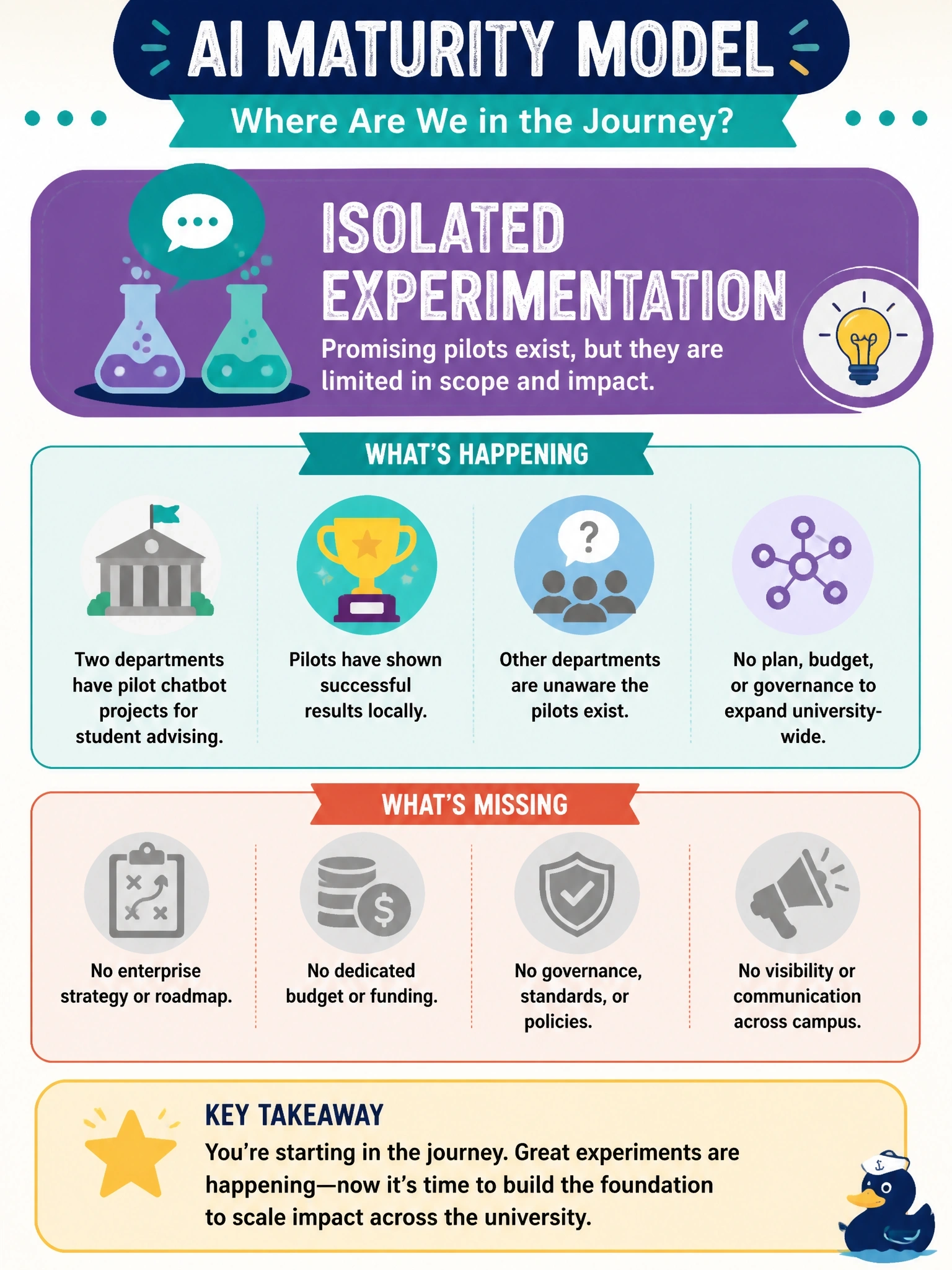
A university's data science team has completed successful pilot projects with a chatbot for student advising in two departments, but there is no plan, budget, or governance structure to expand it university-wide, and other departments don't know the pilots exist. Based on common AI maturity models, which stage best characterizes the university's current position?
Select an answer to reveal the explanation.
Short Explanation
Two successful pilots with no budget, no plan, and no one else in the building even knowing they exist? That's not scale—you've basically got a science-fair project that happened to work. Isolated experimentation is the stage where wins exist but haven't been connected to funding, governance, or visibility beyond the team that built them.
Full Explanation
AI maturity models distinguish between isolated wins and organizational scale; a working pilot with no funding, plan, or cross-department awareness is a textbook example of the experimentation stage. Calling this enterprise-scale deployment confuses a functioning prototype with enterprise deployment, but true enterprise-scale maturity requires the budget, governance, and organizational visibility this university lacks. Calling it governance-first maturity invents a compliance review that the stem never mentions, and even if it existed, one review would not establish organization-wide governance maturity. Calling it continuous optimization mistakes running the same pilot twice for a formal optimization cycle, which requires established metrics and a scaled deployment to optimize in the first place. The general principle: maturity is judged by organizational reach, planning, and funding, not by whether a working demo exists.