
An electric vehicle maker's AI tool predicts the likelihood of battery warranty claims. It was accurate for the first year, but its predictions have grown less reliable as newer battery chemistries were introduced into the vehicle lineup. How is this best described?
Select an answer to reveal the explanation.
Short Explanation
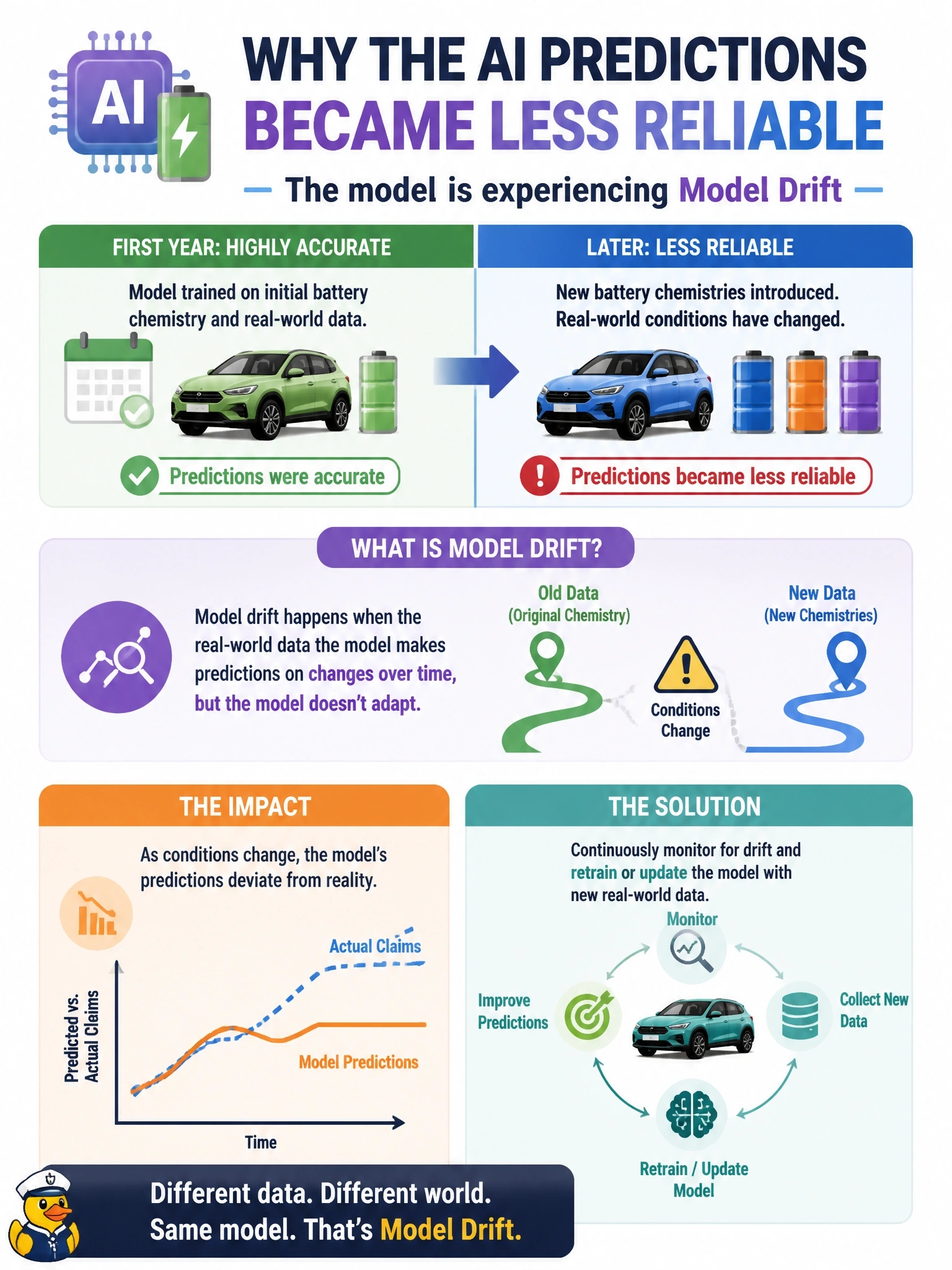
Think of it like a tailor who made you a perfect suit years ago but hasn't seen you since — the measurements never got updated, so the fit slowly gets worse as your body changes. Here the real world changed: newer battery chemistries entered the lineup, and the model never adapted to that shift. That's model drift, and the fix is updating the model to match today's conditions, not a contract or content fix.
Full Explanation
Model drift is correct because the described pattern, declining reliability as a new real-world factor, newer battery chemistries, is introduced, is the defining signature of drift: the conditions the model predicts have changed while the model itself has not adapted. Calling this a hallucination misapplies that term, which describes fabricated content generated in response to a single prompt, not a gradual decline in prediction accuracy tied to a real underlying change. Framing this as a harmful content issue focuses on a possible downstream consequence, customer reaction, rather than naming the reliability issue that caused it. Calling this an indemnification gap introduces a contractual concept that addresses who bears legal or financial responsibility for a problem, not what the technical reliability issue actually is. The general principle: model drift occurs when the real-world conditions a model was built to predict evolve over time, and recognizing it as drift, rather than mislabeling it, points toward the right mitigation, updating the model or its inputs to reflect current conditions.