
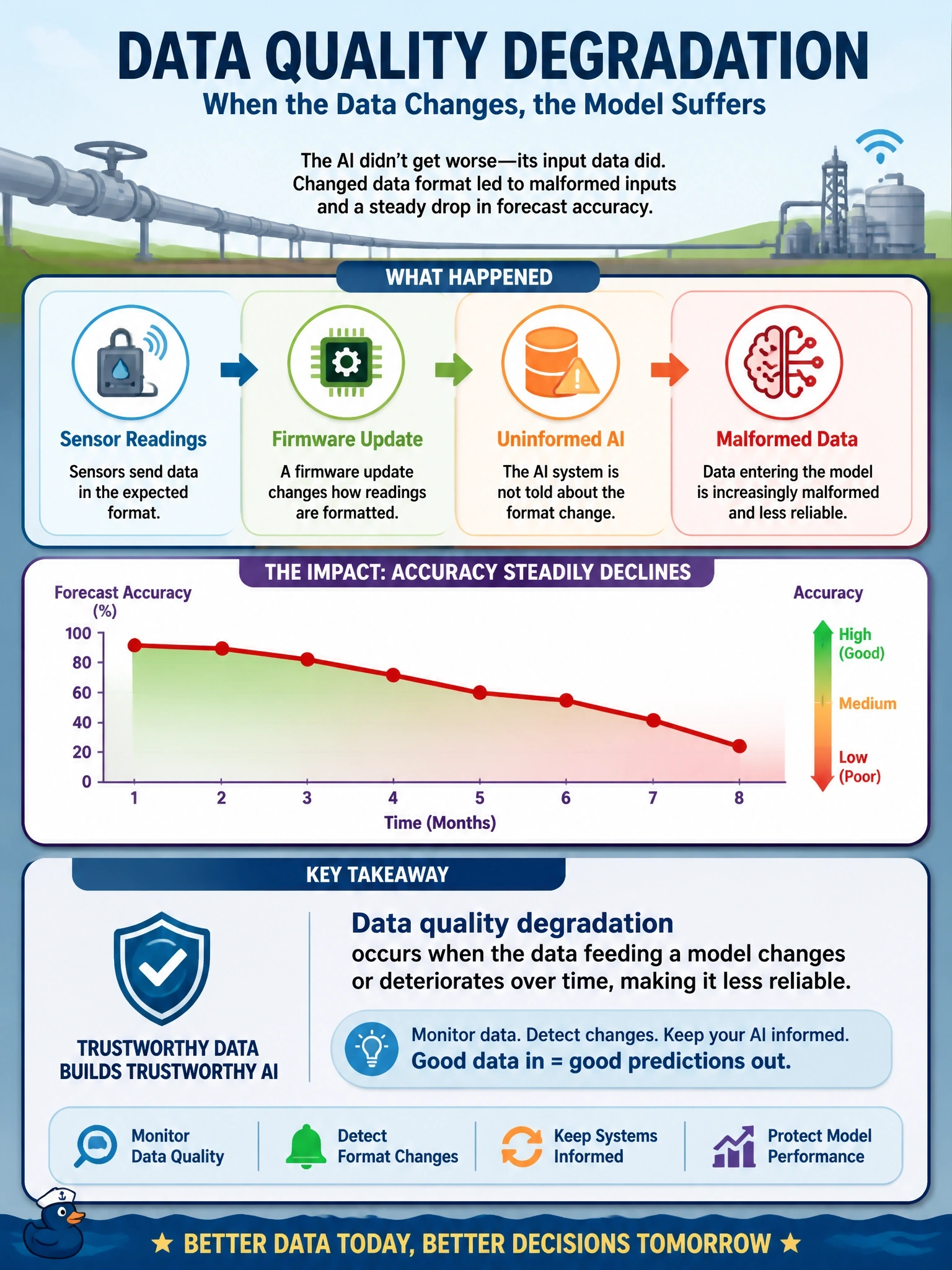
A pipeline company's AI forecasting tool has grown steadily less accurate over eight months. An investigation finds that a sensor firmware update changed how readings are formatted, and the AI was never told the format changed, so the data now feeding the model is increasingly malformed. How is this best described?
Select an answer to reveal the explanation.
Short Explanation
Feed a recipe app ingredient measurements in the wrong units without telling it the units changed, and it doesn't know anything shifted — it just starts cooking with bad numbers. Your pipeline's real-world conditions didn't change here; the sensor firmware did, so the readings feeding the model became malformed, which is data quality degradation, not drift.
Full Explanation
Data quality degradation is correct because the root cause described is a change in the format and integrity of the input data itself, which is the definition of that risk, not a shift in the real-world conditions the model was trained to predict. Model drift is a close but incorrect distractor: drift refers to the world or population the model predicts changing over time, whereas here the underlying pipeline conditions haven't necessarily changed; the sensor data feeding the model has simply become malformed. Calling this a hallucination misapplies that concept, which describes a model inventing plausible but false content from a prompt, not a model producing degraded output because of corrupted input data. Framing this as a harmful content risk describes a downstream consequence, misleading field crews, rather than naming the reliability issue itself. The general principle: distinguishing data quality degradation from model drift matters because they point to different root causes, one in the integrity of incoming data and the other in a real shift in what the model is trying to predict.