
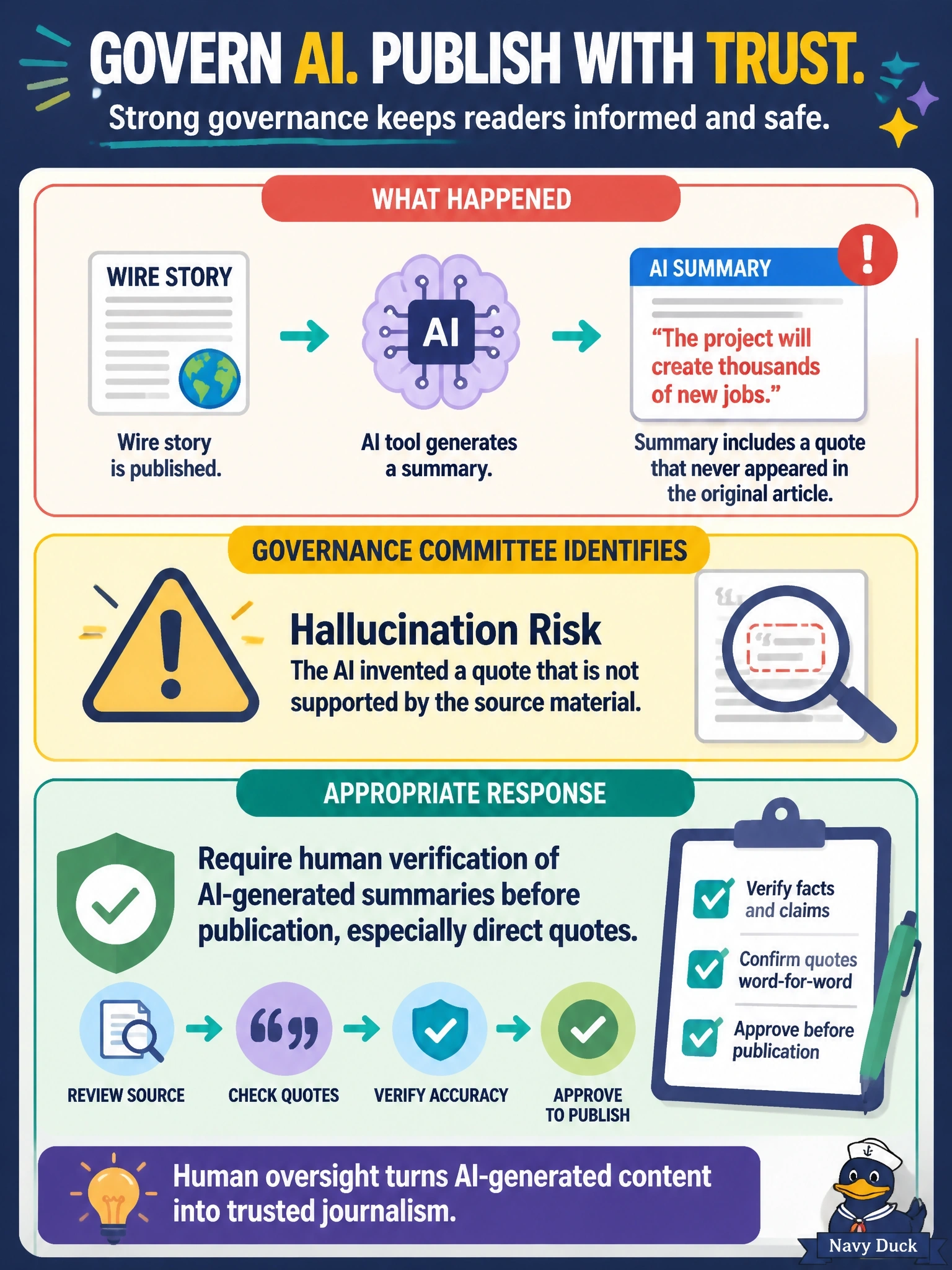
A news aggregator's generative AI tool summarizes wire stories. An editor discovers that a summary invented a quote that never appeared in the original article. What should the governance committee identify this as, and what is the appropriate response?
Select an answer to reveal the explanation.
Short Explanation
A confident dinner guest telling a great story that never actually happened still sounds plausible to you — it's just fabricated. That's a hallucination, and the fix isn't retraining the model or restricting topics, it's putting a human eyeball on AI-generated quotes before they go to print.
Full Explanation
Naming this a hallucination risk is correct: the model generated a plausible but fabricated quote, which is the defining pattern of a hallucination, and the appropriate response is human verification before publication rather than a technical retraining project. Calling this a data quality degradation issue misdiagnoses the problem as one with the input data being outdated, but the scenario describes the model inventing content, not working from stale source material. Calling this a model drift issue misattributes it to a gradual change in system behavior over time, but a single fabricated quote in one summary does not by itself establish that the model's overall behavior has shifted since launch. Framing this as a harmful content issue and restricting political topics narrows the fix too far, but fabricated quotes are a general reliability risk that could occur on any topic, not one confined to a single subject area. The general principle: hallucinations are false but plausible-sounding outputs, and the most direct mitigation is requiring human verification for claims that carry real consequences, such as direct quotes.