
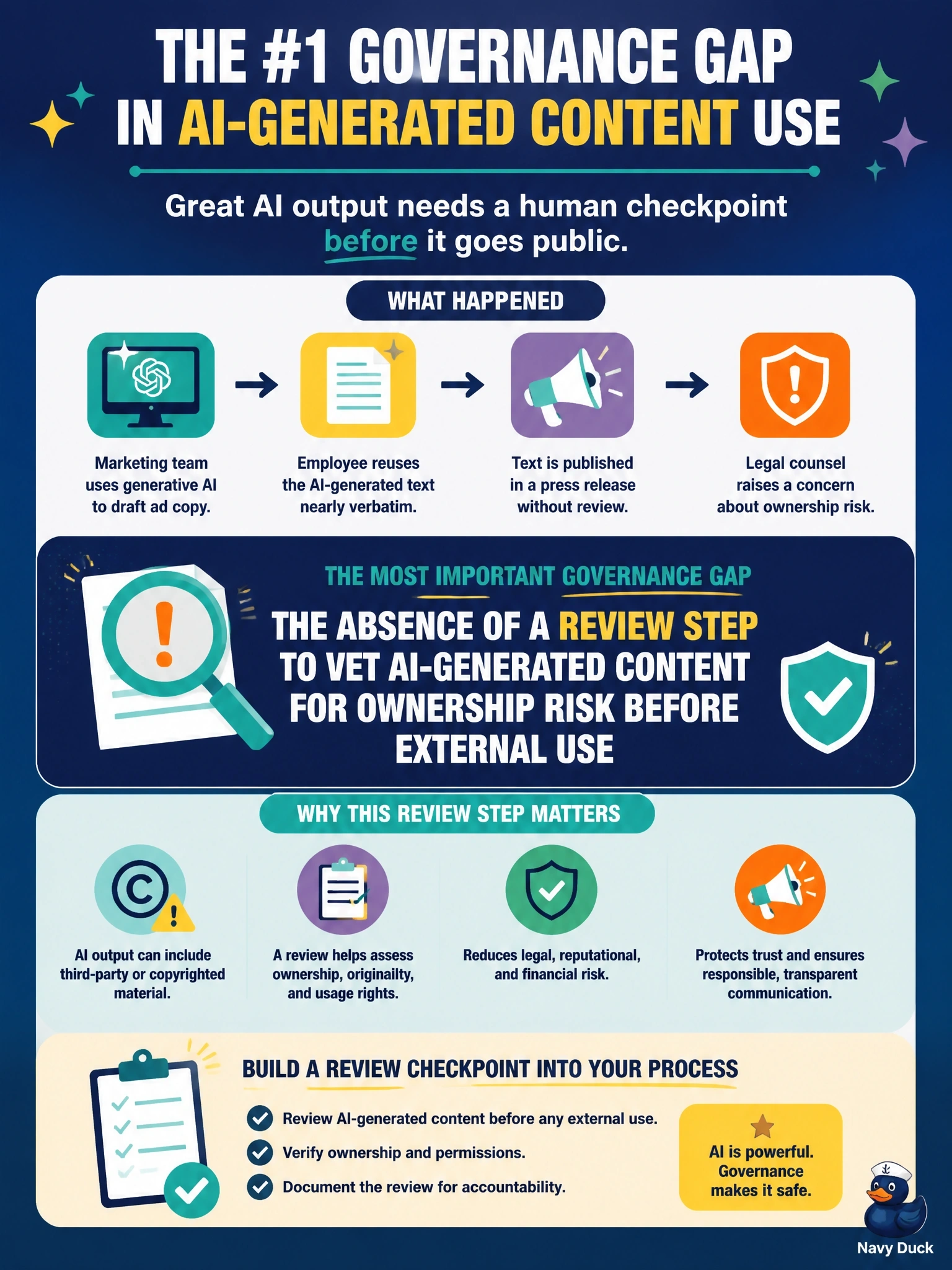
An automotive engineering firm's marketing team uses a generative AI tool to draft ad copy. An employee later reuses the AI-generated text nearly verbatim in a press release without review, and legal counsel raises a concern. What is the most important governance gap this reveals?
Select an answer to reveal the explanation.
Short Explanation
A rough draft escaped the writers' room before an editor ever touched it — the tool did what it was supposed to do, but nothing caught the copy before it went external as a press release. The real gap isn't the decision to use AI at all; it's the missing review step you need to vet the text for ownership risk before it ever goes external.
Full Explanation
The absence of a review step correctly names the gap: the incident happened because AI-generated text went external without anyone checking it for ownership, originality, or IP risk, which is a missing process step rather than a problem with the tool or the decision to use it. Pointing to generation speed is irrelevant to the actual concern; how quickly the tool produces content has nothing to do with whether unreviewed content created legal exposure. Blaming the original decision to adopt AI overreaches by treating that decision as the problem, when the actual issue is the missing review step around how the AI-generated content was used, not whether AI was used at all. Proposing a blanket ban is disproportionate to the specific gap identified and would eliminate a useful tool rather than fixing the process around it. The general principle: IP risk from AI-generated content is best managed through a review step before external use, not by banning the tool or blaming the choice to adopt it.