
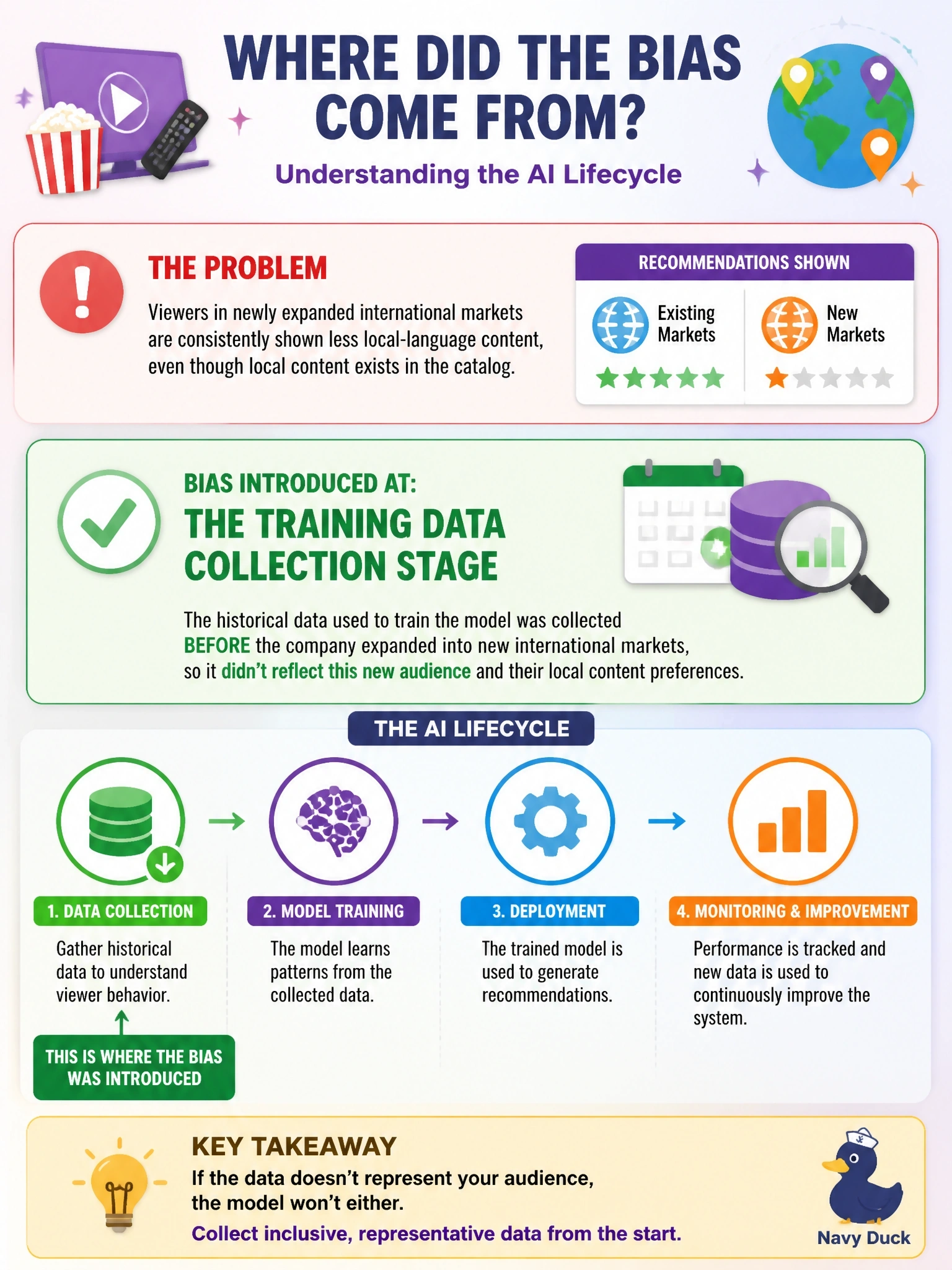
A streaming service's AI recommendation system was trained on historical viewing data collected before the company expanded into several new international markets. Viewers in those new markets are now consistently shown less local-language content than viewers elsewhere, even though local content exists in the catalog. Which stage of the AI lifecycle introduced this bias?
Select an answer to reveal the explanation.
Short Explanation
Garbage in, garbage out starts way upstream — if the map you're using was drawn before a neighborhood existed, of course it leaves that neighborhood off the route. The recommendation system's training data was collected before the new markets existed, so it never learned those viewers' preferences in the first place.
Full Explanation
The training data collection stage correctly locates the bias at its source: the data used to build the system's understanding of viewer preferences was collected before the new markets existed, so it structurally underrepresents them, and the system's behavior reflects that gap. Blaming the pace of deployment is tempting because rollout speed sounds relevant, but the timing of deployment is not what caused the skew; the same bias would exist even with a slower rollout, because the underlying data never represented the new audience. Pointing to insufficient user feedback misidentifies the cause, since the scenario describes a pattern baked in before any new-market feedback was even collected. Blaming a lack of recent retraining is a plausible-sounding but incorrect explanation, since the issue originates from what data went into the system in the first place, not simply how recently it was touched. The general principle: bias frequently originates upstream, in what data was collected and who it represents, and identifying that source stage is what allows the right stage to be fixed.