
A news publisher's AI tool drafts article summaries for editors before publication. Legal counsel has asked the governance committee to define an escalation path for the tool. What is the most appropriate first step?
Select an answer to reveal the explanation.
Short Explanation
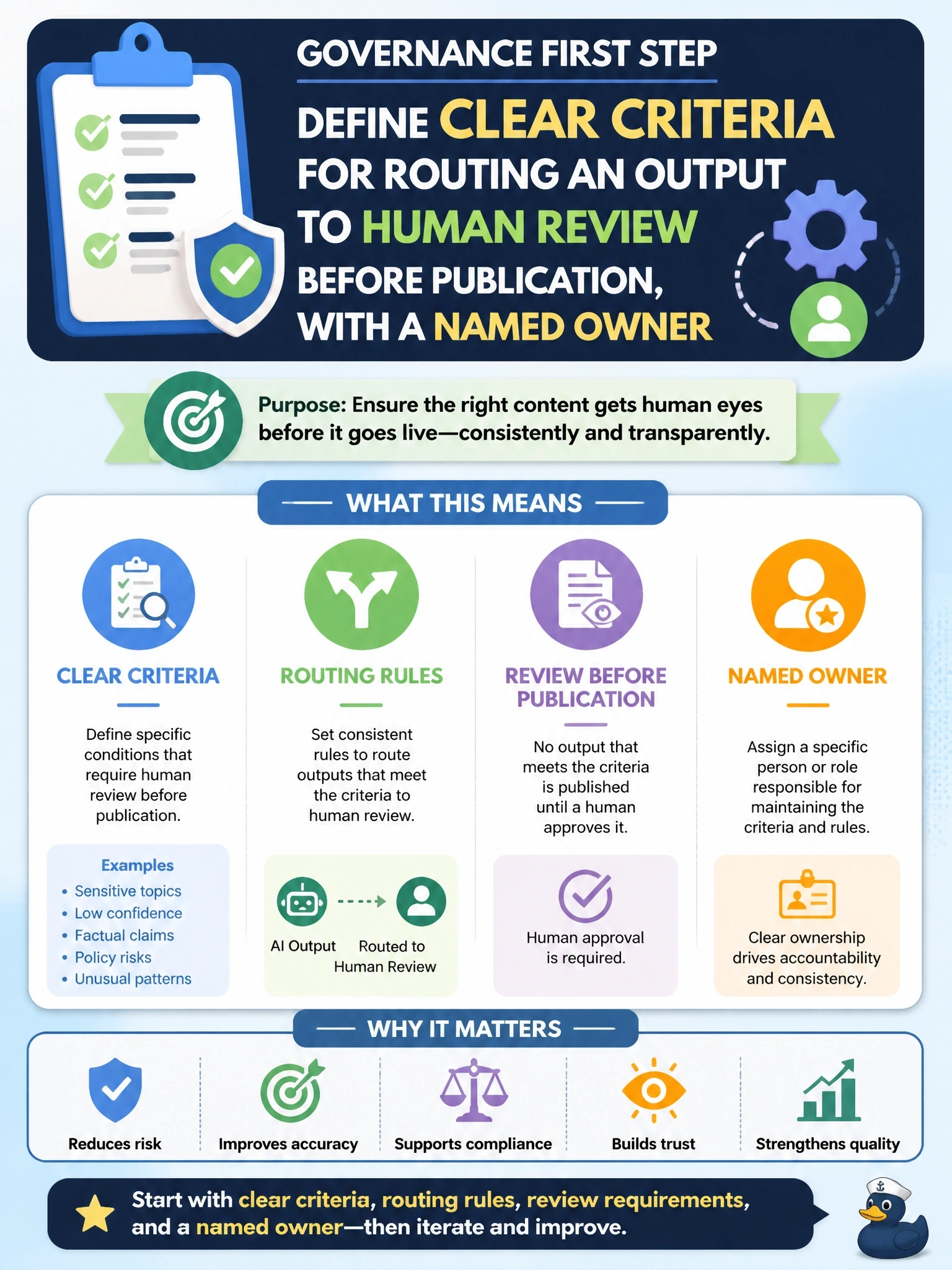
An escalation path with no rules and no owner is just a hallway with no doors — nobody knows when to walk through it or who's on the other side. Set clear triggers for routing an output to human review, and put a named owner behind that call, and you've turned 'escalate when needed' into something that actually works.
Full Explanation
Defining clear criteria for routing an output to human review, with a named owner, is correct because an escalation path requires two concrete things: clear triggers for when a human must review an output, and accountability for that decision. Without both, escalation exists in name only. Asking the vendor to certify that escalation is unnecessary conflicts with the request and hands a governance decision to a party with a commercial interest in the product being used as-is. Restricting editors to AI-free content halts AI use entirely rather than building the requested escalation path, which is a disproportionate response that stalls the business without solving the underlying gap. Making editors personally liable shifts risk onto individuals instead of the organization, does not define when or how escalation happens, and could discourage editors from using the tool at all rather than using it responsibly. The general principle: an escalation path is a governance structure, defined triggers plus clear ownership, not a disclaimer, a certification, or a blanket restriction.