
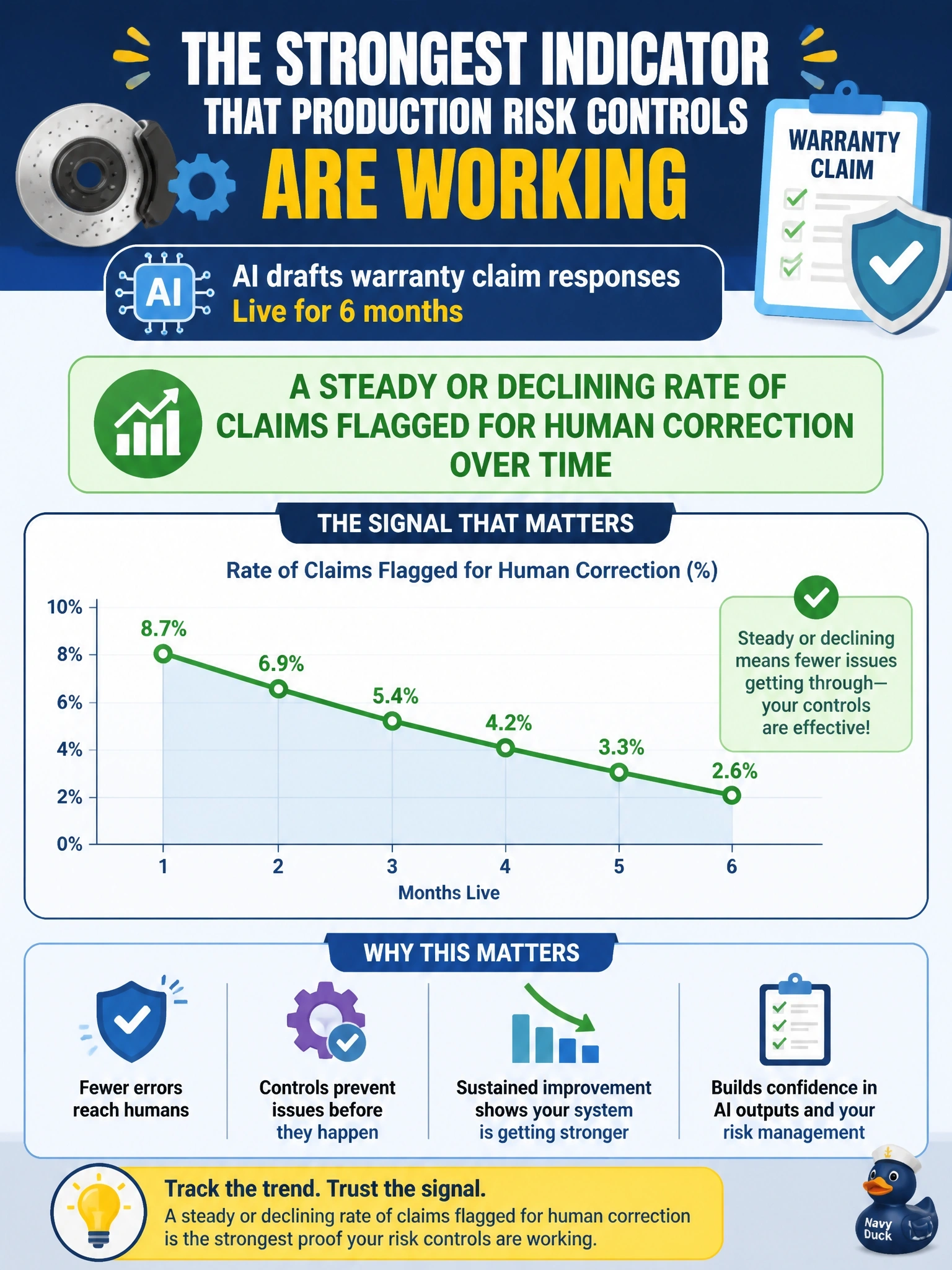
An automotive parts supplier's AI tool drafts responses to warranty claims and has been live for six months. Which of the following is the strongest indicator that the current production risk controls are actually working?
Select an answer to reveal the explanation.
Short Explanation
Think of a spell-checker's error count over time — if it keeps catching fewer mistakes, you know it's actually working, not just running. A steady or falling rate of claims flagged for human correction is real, ongoing proof that the controls are holding up, unlike a stale pre-launch score or a vendor's self-praise.
Full Explanation
A steady or declining correction rate is correct because it directly shows that the controls in place, such as review and escalation, are catching problems and that output quality is holding up in real use. Daily claim volume measures throughput, not quality; a supplier could process many claims quickly while producing an increasing number of errors, and volume alone would not reveal that. Vendor feedback is not an independent signal: a vendor has an incentive to describe its own product favorably, and their feedback is not evidence about how the system is actually performing inside this company's process. The original pre-launch accuracy score is stale by definition; it reflects conditions before real-world claims, customers, and edge cases were introduced, so it cannot speak to whether today's controls are effective. The general principle: the best evidence that production controls work comes from ongoing, independent measurement of real outcomes, not from a one-time score or a vendor's assurance.