
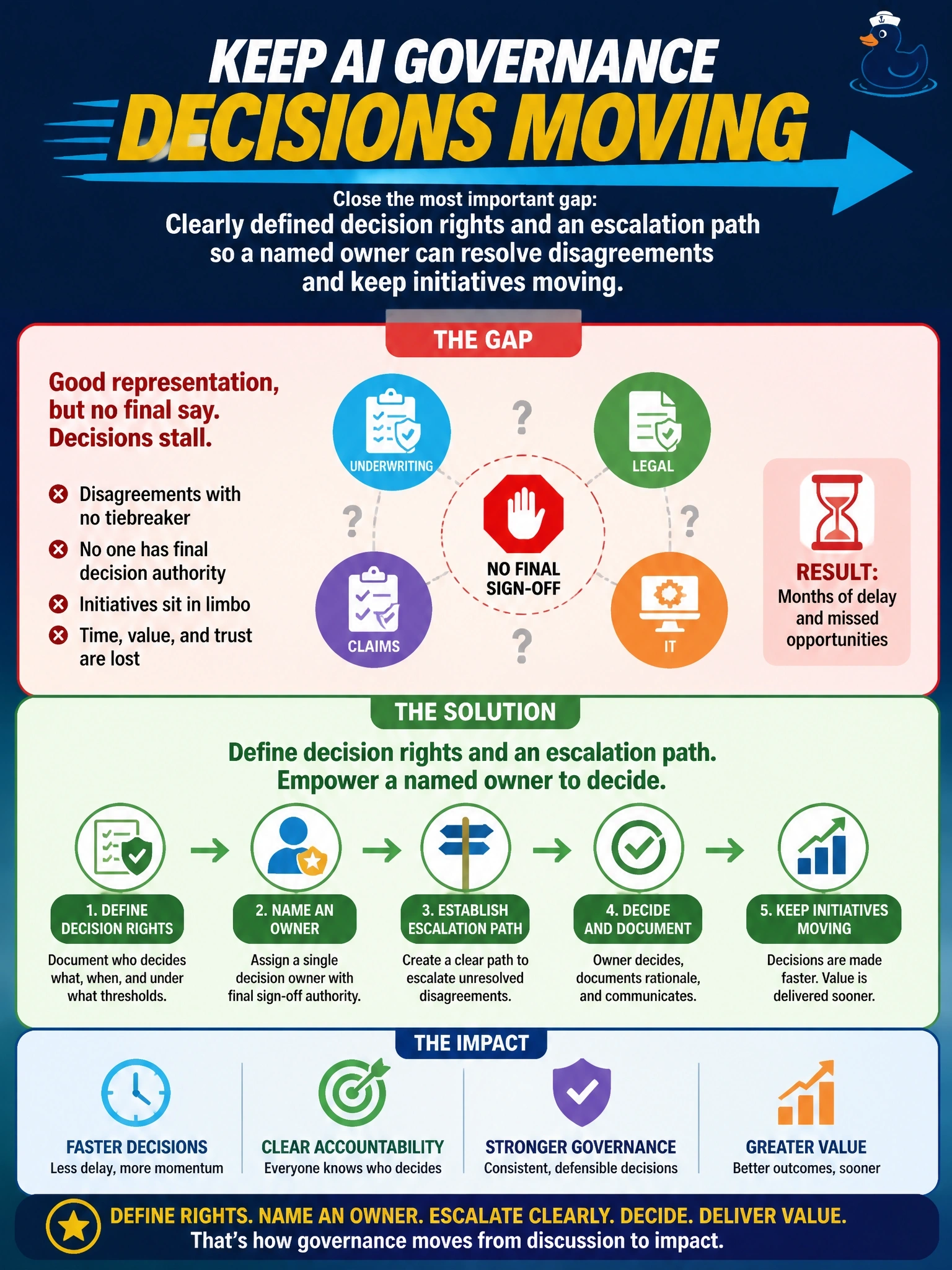
An insurance company's AI governance committee has representation from underwriting, claims, legal, and IT, but decisions have stalled for months because no one has final sign-off authority when members disagree. What is the most important gap the company needs to close?
Select an answer to reveal the explanation.
Short Explanation
A committee that argues for hours because nobody has final say won't be fixed by adding more voices to the room — only a tiebreaker fixes that. Your committee already has the right people at the table; what it's missing is a named owner with clear decision rights who can break the tie and keep things moving.
Full Explanation
The committee already has appropriate cross-functional representation; what it lacks is a defined way to resolve disagreement, which is exactly what clear decision rights and an escalation path provide. Replacing the committee with a single executive sponsor discards the cross-functional input that's valuable for catching risks across underwriting, claims, and legal — it treats the symptom (slow decisions) by eliminating the structure rather than fixing how it decides. Adding more business-unit representatives makes consensus harder to reach, not easier, and doesn't address the actual gap, which is authority, not input. Requiring unanimous consent would make the stalling worse, since any single dissenting member could block progress indefinitely — it's the opposite of what's needed. The general principle: cross-functional representation and clear decision rights are two separate requirements of good governance, and having one doesn't substitute for the other.