
A pharmaceutical company's clinical operations, IT, legal/compliance, and commercial teams are each using GenAI tools to draft protocols, summarize trial data, and generate marketing content. Leadership wants clear accountability without slowing innovation. Which structure best achieves this?
Select an answer to reveal the explanation.
Short Explanation
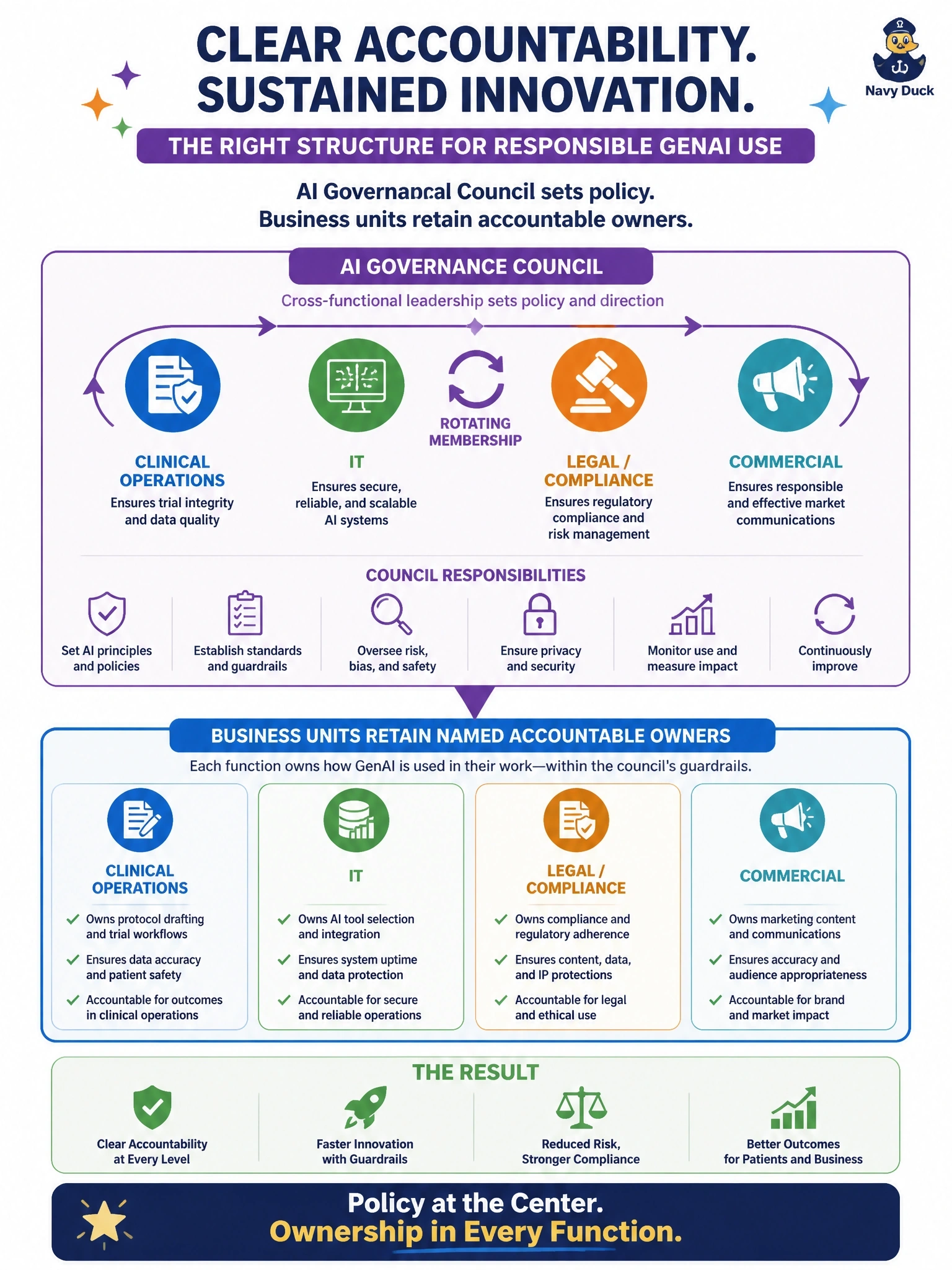
A company's board sets overall policy while each department head still owns their own numbers — that same split works for AI governance. A rotating cross-functional governance council sets the shared rules, and each business unit keeps a named owner accountable for its own use case, so you get oversight without grinding innovation to a halt, and you don't have to choose one over the other.
Full Explanation
A governance council with rotating cross-functional membership sets shared policy, while a named accountable owner per business unit keeps decisions close to the people who understand each use case — this balances oversight with speed. Routing every AI use case through a centralized IT committee turns technology into a single approval bottleneck and misses that legal, clinical, and commercial risks require their own expertise, not just a technical review; it would also slow innovation, the opposite of what leadership wants. A voluntary quarterly sharing meeting has no enforcement mechanism or ownership attached, so nothing changes when things go wrong — it's informal, not governance. Twice-yearly external audits are periodic and reactive; they catch problems after the fact rather than providing the ongoing accountability leadership is asking for. The general principle: effective governance pairs cross-functional standard-setting with clear, ongoing ownership at the point of use — not a single gatekeeping function or occasional check-ins.