
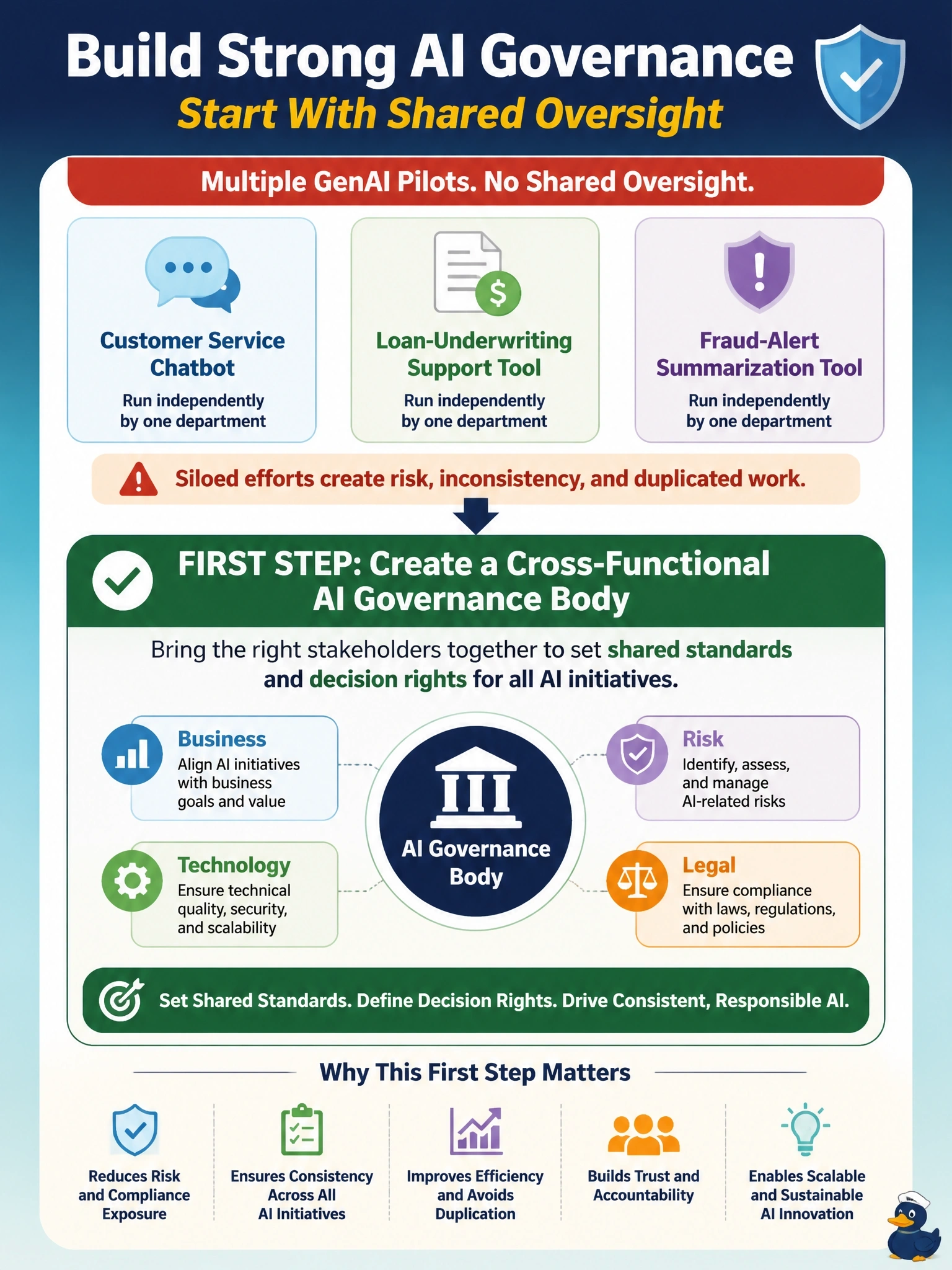
A regional bank is running several GenAI pilots at once — a customer service chatbot, a loan-underwriting support tool, and a fraud-alert summarization tool — each run independently by its own department with no shared oversight. What should the bank do first to establish sound AI governance?
Select an answer to reveal the explanation.
Short Explanation
Think about a hospital's ethics board: you don't want just the surgeons deciding what's acceptable, you want risk, legal, and clinical voices in the room together. A bank running AI pilots in silos needs that same cross-functional table — shared standards and decision rights beat having any single department own the call alone.
Full Explanation
A cross-functional governance body gives the bank shared standards, defined decision rights, and a single place where risk, legal, technology, and business concerns are weighed together — exactly what's missing when departments run AI pilots in isolation. Appointing the CTO as sole decision-maker concentrates authority in one function and loses the risk and legal perspective that AI decisions with customer and regulatory impact require; technology alone shouldn't own governance. Pausing all pilots until a full strategy document is finalized is an overcorrection — it halts value delivery on a premise (a finished strategy) that isn't a prerequisite for basic oversight. Reporting monthly usage statistics to the board creates visibility but not governance: it doesn't establish standards, decision rights, or accountability for how AI initiatives are run day to day. The underlying principle is that governance structures need cross-functional representation before they can produce accountability — visibility and centralization are not substitutes for it.