
A homeowners insurer uses a GenAI tool to help draft settlement offer language for catastrophe claims after a major storm. Which factor should weigh MOST heavily in deciding whether a human must review and approve the AI-drafted settlement offer before it is sent to the policyholder?
Select an answer to reveal the explanation.
Short Explanation
In an ER, the sickest patient gets seen first, not the one who happened to arrive fastest. You should scope human review of a settlement offer the same way — by how much the decision actually matters to the policyholder receiving it, not by how quickly the draft came together.
Full Explanation
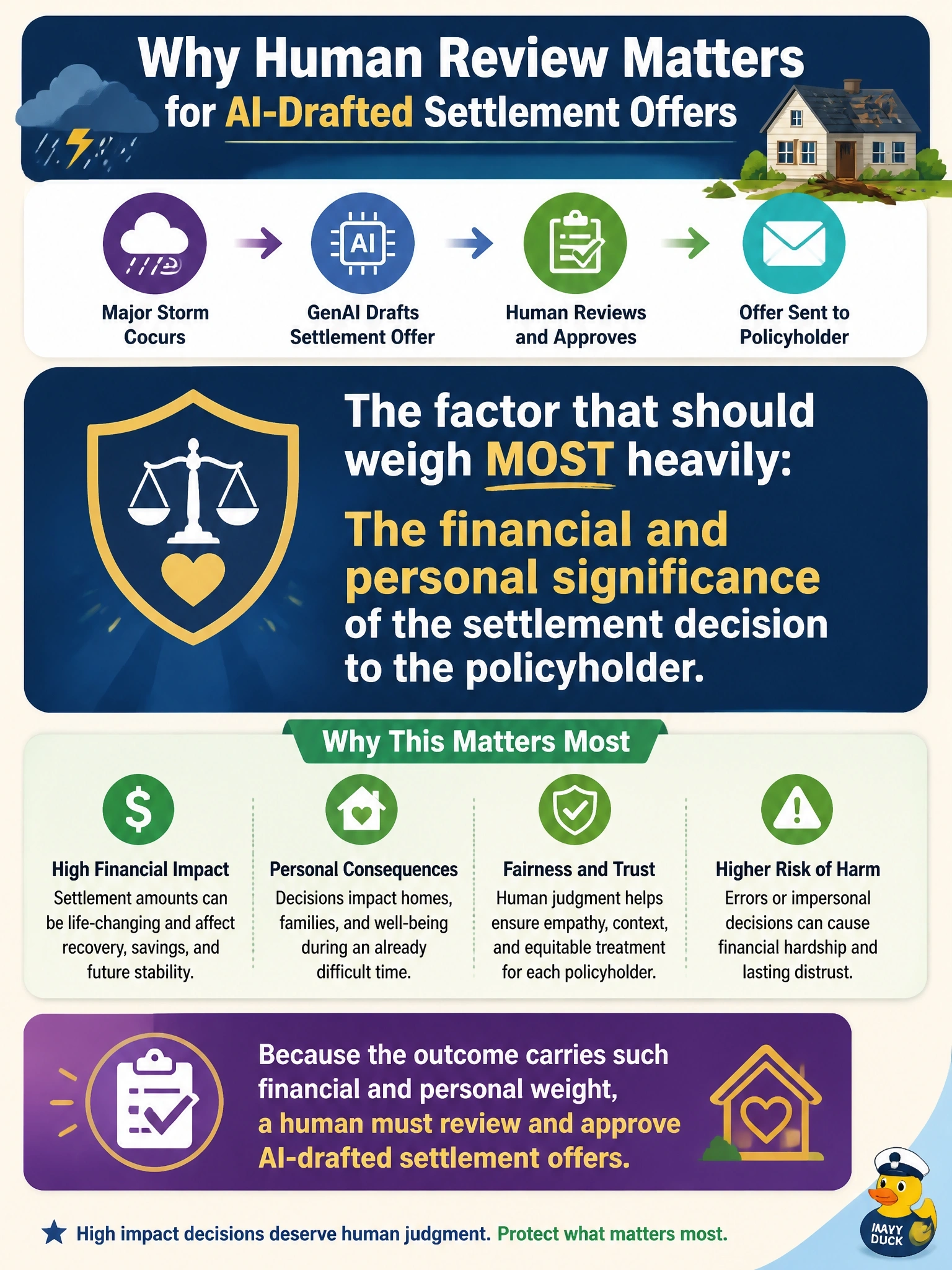
Human oversight requirements should scale with the stakes of the decision for the person affected, and a settlement offer after a major storm can determine whether a policyholder can rebuild, making its financial and personal significance the factor that should most heavily drive the review requirement. Weighing how quickly the AI tool can generate the draft compared to a human adjuster focuses on generation speed, which is a convenience factor, not a reason to skip or require oversight; a faster draft isn't inherently safer or riskier to send. Weighing whether the storm affected a large or small number of policyholders overall looks at claims volume, which is a workload consideration, not a measure of what's at stake for the individual policyholder receiving a given offer. Weighing which vendor built the underlying GenAI model has no direct bearing on whether a specific settlement decision needs human review; vendor choice is a procurement consideration, not a stakes-based oversight criterion. Operational check: before deciding whether a settlement offer needs human sign-off, ask what this specific decision means for this specific policyholder's ability to recover — that answer, not speed, volume, or vendor, should set the review requirement.