
A veterans benefits administration office uses a GenAI tool to draft initial determinations on disability compensation claims, which a human adjudicator reviews before any decision is finalized. Leadership is now considering removing the human review step for claims where the AI's confidence score is very high, to reduce a growing case backlog. A policy advisor recommends against this change. What is the strongest reason to keep human review even for high-confidence AI determinations?
Select an answer to reveal the explanation.
Short Explanation
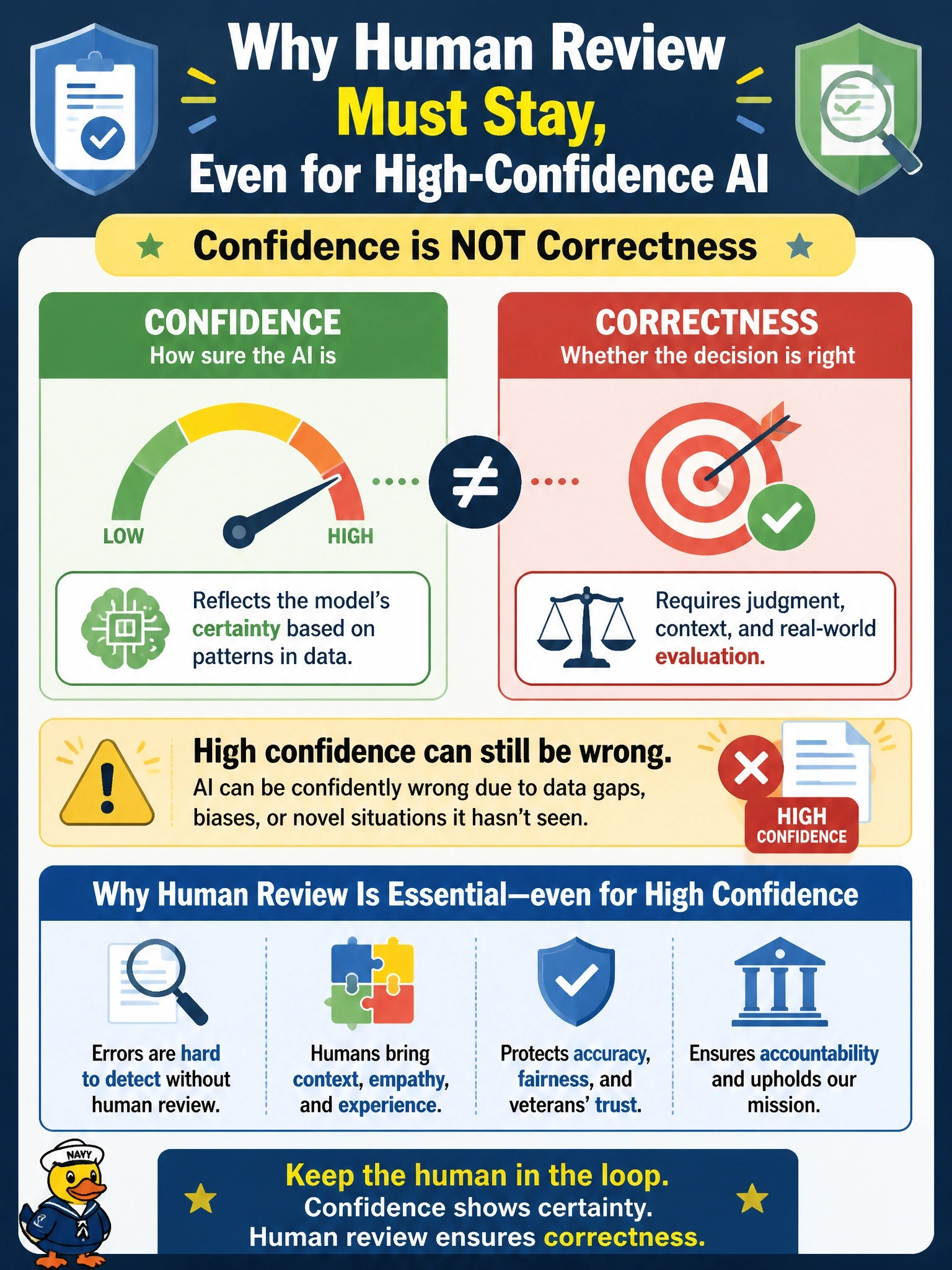
A friend who's absolutely sure they parked on the third floor can still be completely wrong. Confidence is just how sure the model feels about its own answer, not proof the answer is right, and that gap is exactly why you still need a human check on high-confidence claims.
Full Explanation
A model's confidence score measures how certain the model is in its own output, which is not the same as the output actually being correct; a model can be confidently wrong, and for a disability compensation determination that affects a veteran's income and care, an undetected error is hard to catch without an independent human check. Claiming high-confidence determinations are, by definition, always correct treats confidence as a guarantee of correctness, a false equivalence that ignores how confidence scores are actually generated and what they measure. Arguing the backlog is more urgent than the small risk introduced by removing review for high-confidence cases prioritizes reducing the backlog over the risk to individual veterans, understating the real harm of an undetected wrong determination in a high-stakes benefits context. Reserving review only for claims the AI itself flags as uncertain is circular: it relies on the model's own self-assessment of uncertainty to decide when review is needed, which defeats the purpose of independent human oversight as a check specifically against the model's own errors, including ones it's confidently unaware of. Operational check: treat a confidence score as an internal signal about the model, never as a substitute for an independent human check on a determination that materially affects someone's benefits.