
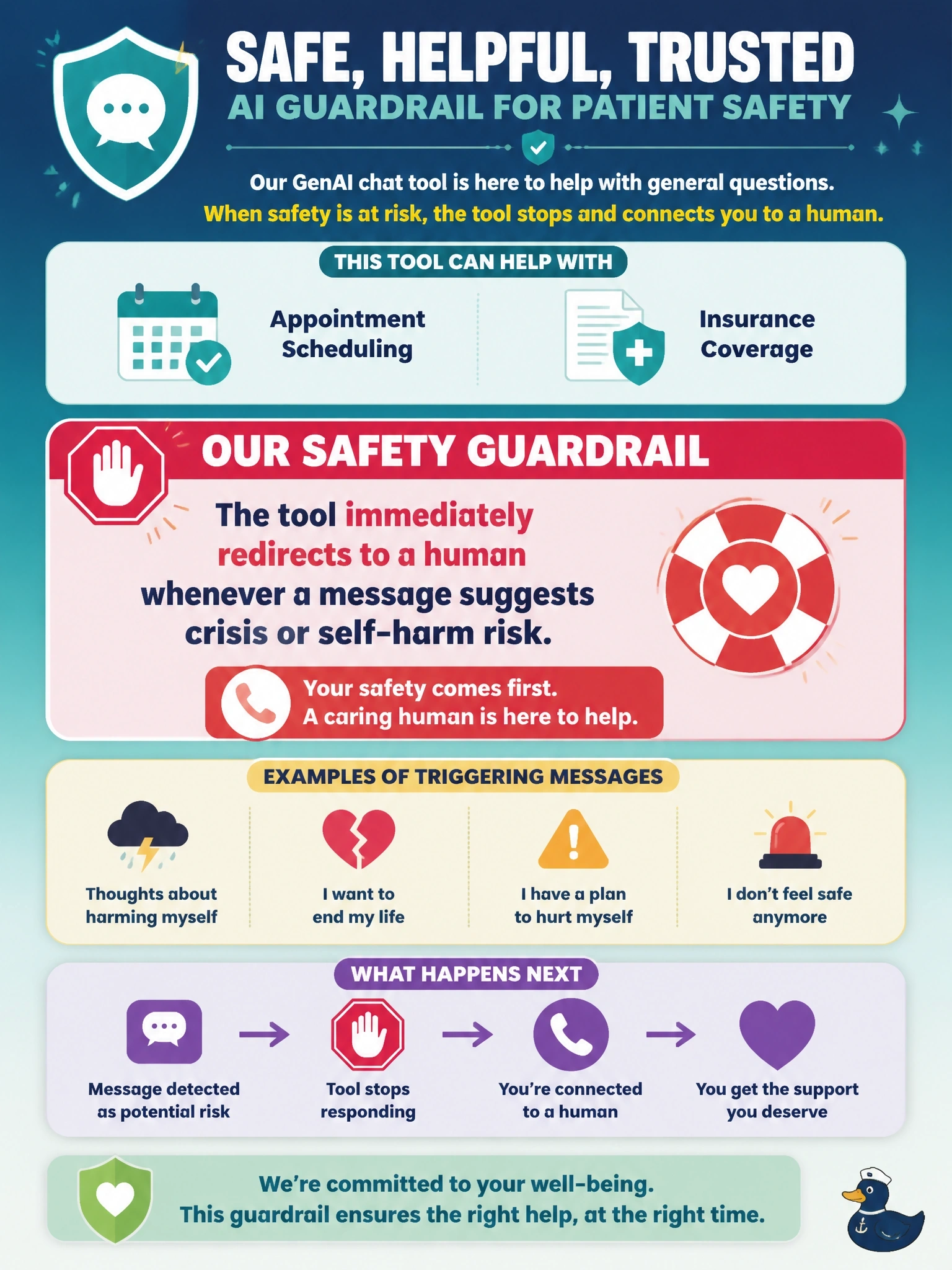
A mental health treatment network is piloting a GenAI chat tool to answer patients' general questions about appointment scheduling and insurance coverage between therapy sessions. Leadership wants to define a guardrail for when the tool must stop responding and redirect the patient to a human. What is the most appropriate guardrail?
Select an answer to reveal the explanation.
Short Explanation
A lifeguard who only checks the water during a scheduled break is useless the moment it actually matters. Your scheduling chatbot needs the same always-on instinct: the second crisis or self-harm language shows up, it hands off to a human immediately, no matter what the conversation started out as.
Full Explanation
A guardrail that redirects to a human the moment crisis or self-harm language appears, regardless of the conversation's original topic, matches the severity and urgency of the risk: a scheduling tool that stumbles into a safety signal must not keep treating the exchange as routine. Continuing to answer scheduling questions even when crisis language appears, on the theory that it falls outside the tool's intended scope, dangerously ignores a safety signal — that narrow, scope-only thinking is exactly what misses real risk when it shows up unexpectedly in an otherwise routine conversation. Waiting for three consecutive crisis-related messages before redirecting introduces a delay that's unacceptable when the first message may already signal danger requiring an immediate response. Redirecting only during business hours, and simply storing crisis-related messages for later review otherwise, defers a potentially urgent safety issue to a schedule that doesn't match the time-sensitive nature of a possible crisis. Operational check: guardrails tied to safety risk should trigger immediately and regardless of the tool's original intended use, because the severity of the signal — not the topic the conversation started on — is what determines whether escalation is needed.