
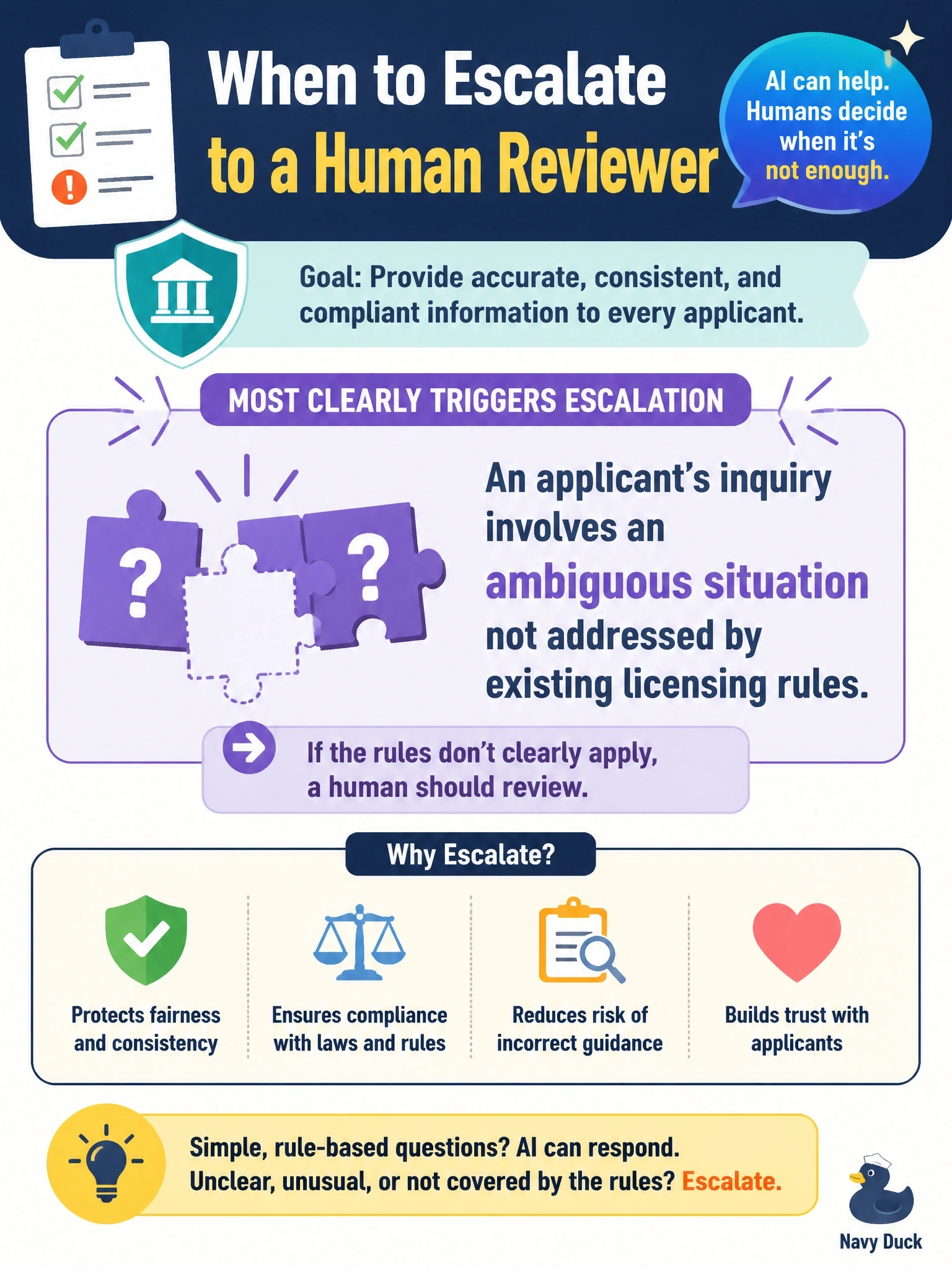
A state licensing board uses a GenAI tool to draft responses to applicant inquiries about license requirements. The board wants to define escalation criteria for when a case must go to a human reviewer instead of receiving an AI-drafted response automatically. Which situation should MOST clearly trigger escalation to a human?
Select an answer to reveal the explanation.
Short Explanation
A good help desk routes the weird one-off ticket to a senior tech instead of the standard password reset, and your escalation rules should follow that same logic — by complexity, not by the clock. When a question lands in territory the existing rules don't clearly cover, that's exactly when you need a human in the loop, because that's where a confident-sounding AI answer is most likely to steer you wrong.
Full Explanation
Escalation criteria should target situations where the AI's confident-sounding output is most likely to be wrong or insufficient, and an ambiguous eligibility question not clearly covered by existing licensing rules is exactly that — it requires judgment the tool isn't equipped to apply reliably. Escalating a frequently asked question that matches a standard, previously reviewed answer describes the opposite case: a well-covered, already-vetted answer is precisely what an AI-drafted response is well suited to handle without escalation. Tying escalation to whether the inquiry arrives outside normal business hours ties the decision to timing rather than the complexity or risk of the inquiry itself; submission time has no bearing on whether the question requires human judgment. Tying escalation to how many times the applicant has contacted the board that week ties the decision to contact frequency, which may simply reflect an applicant following up on the same routine question and says nothing about whether the underlying inquiry is ambiguous or high-risk. Operational check: when defining escalation rules, sort cases by how well the existing rules actually cover the situation — well-covered cases stay automated, and cases the rules don't clearly answer go to a human, regardless of when they arrive or how often the applicant has asked.