
A hospital's radiology department is considering a GenAI tool that drafts a preliminary summary of imaging findings for radiologists to review before finalizing a report. In which circumstance is human oversight of the AI output most clearly required?
Select an answer to reveal the explanation.
Short Explanation
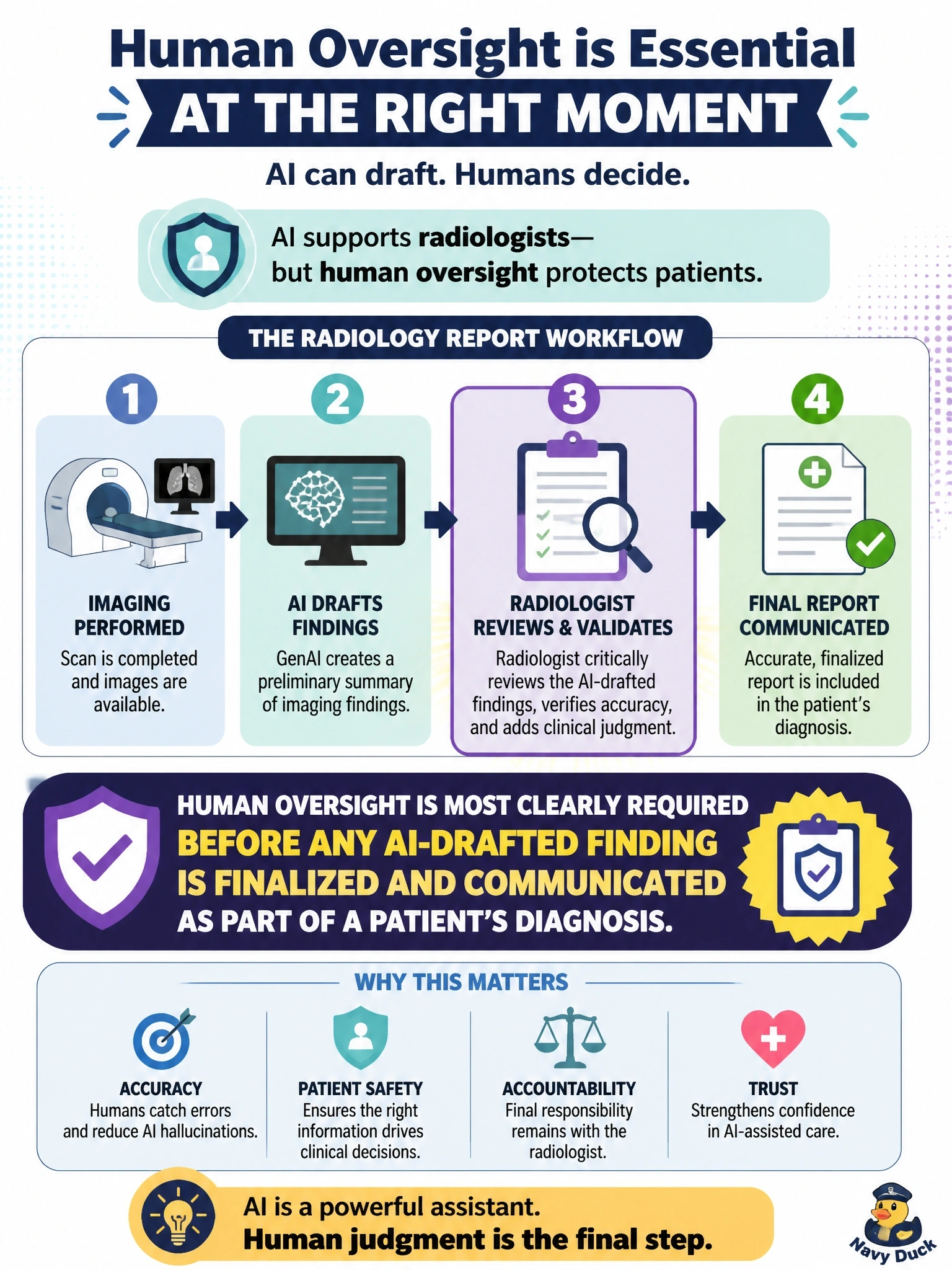
An incorrect or incomplete imaging summary can directly shape a patient's diagnosis and treatment, so you need human review before any AI-drafted finding gets finalized — every single time, not just when something looks off. That standing checkpoint doesn't depend on the tool's track record, a technical flag, or whether the patient happens to ask for it.
Full Explanation
Because an incorrect or incomplete imaging summary can directly affect a patient's diagnosis and treatment, human review before any AI-drafted finding is finalized is the clearest and most consistent point at which oversight is required, regardless of how the tool has performed previously. Limiting oversight to cases where the hospital's IT department flags a technical malfunction misses that the risk described — an inaccurate clinical finding — can occur without any technical malfunction at all. Making review contingent on the tool having a track record of incident-free use ignores that a diagnostic tool's past reliability doesn't guarantee any single output is correct, so oversight can't be conditioned on tenure alone. Making review opt-in, triggered only when a patient specifically requests it, puts the burden on patients who aren't positioned to know whether a given AI-drafted finding needs scrutiny, and the stakes of a missed error are too high to leave to an individual request. Operational check: every AI-drafted finding that will become part of a diagnosis gets a human review before finalization, as a standing requirement — not one conditioned on incident history, a technical flag, or a patient asking for it.