
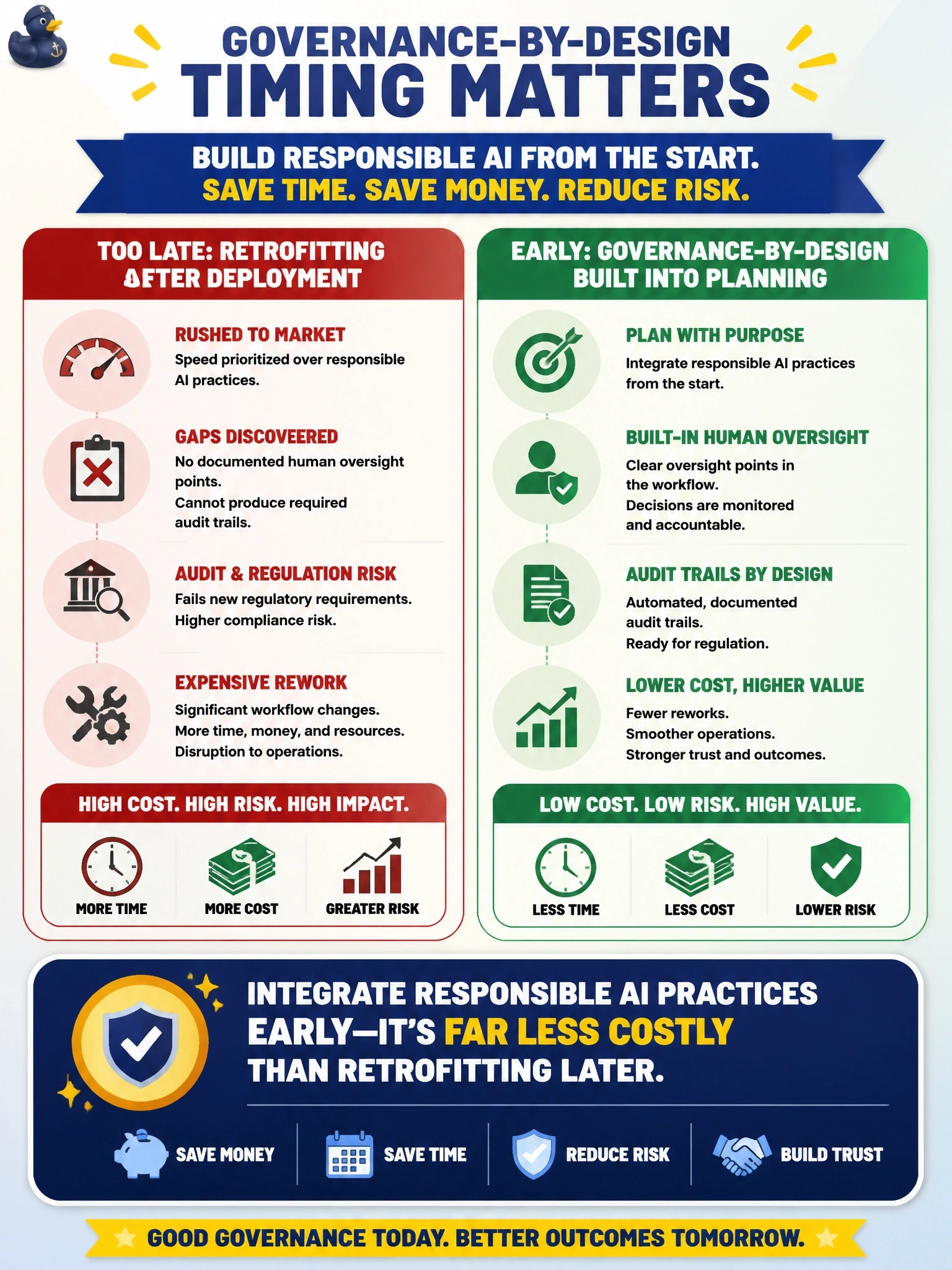
A federal benefits agency built and deployed an AI-assisted claims-processing tool without formal responsible AI review, prioritizing speed to market. Eighteen months later, an audit finds the tool lacks documented human-oversight points and cannot produce the audit trails required by a new regulation. Fixing this now requires significant rework of the tool's workflow. What does this scenario best illustrate about governance-by-design timing?
Select an answer to reveal the explanation.
Short Explanation
Remodeling a kitchen after the walls are already drywalled costs a lot more than remodeling one that's still framed — and the eighteen-month rework this agency now faces is the drywalled version. Build oversight and audit trails in early, and you spend a fraction of what fixing it after deployment costs you now.
Full Explanation
The scenario's own evidence — that fixing the gap now requires significant workflow rework eighteen months in — demonstrates the core rationale for governance by design: early integration is cheaper and less disruptive than retrofitting controls into a system that's already built and running. Concluding the agency acted appropriately because responsible-AI review is only necessary once regulators require it rationalizes deferring governance until a regulation forces the issue, which is the reactive posture governance by design exists to avoid, and it doesn't reflect appropriate practice even if no rule required review at launch. Recommending the agency abandon the tool entirely is an overcorrection; the audit findings call for rework, oversight documentation, and audit-trail capability, not abandonment of a functioning tool that's presumably still delivering value. Claiming retrofitting is generally just as efficient as designing controls in from the start directly contradicts the scenario, which explicitly describes the retrofit as requiring significant rework rather than being comparably efficient. Operational check: when a real audit or regulatory finding forces substantial rework, treat that outcome as evidence for planning governance in from the beginning on the next system, not as a one-off cost to absorb and repeat.