
A community health clinic network's leadership wants to skip the standard governance-by-design intake for a new GenAI patient-intake summarization tool because the vendor describes it as "low-risk." The compliance lead argues intake review should still occur before build begins. What is the best justification for the compliance lead's position?
Select an answer to reveal the explanation.
Short Explanation
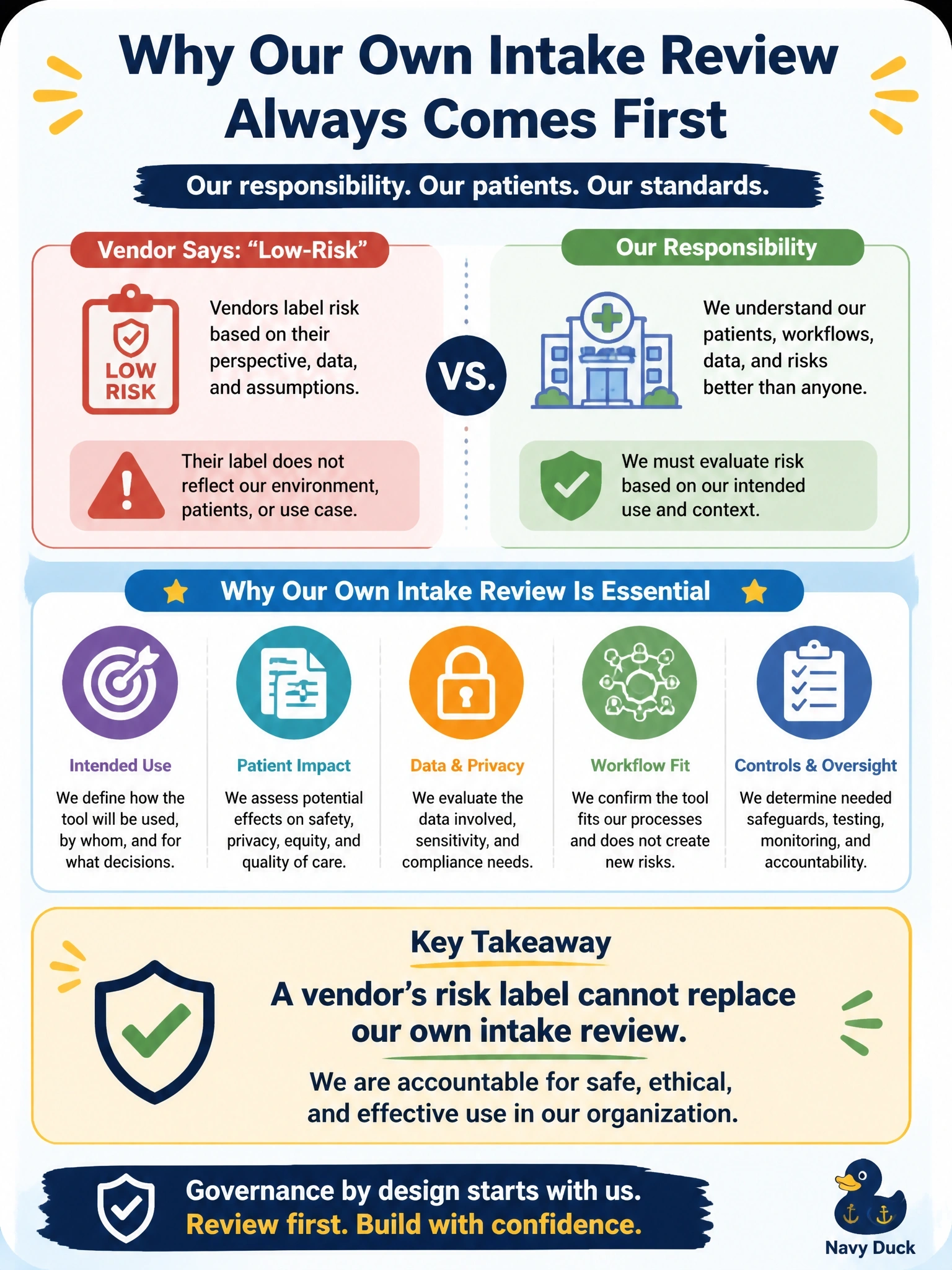
Think about buying a used car that the seller calls 'reliable': that's their word, not your mechanic's inspection. A vendor calling its tool 'low-risk' is the same kind of self-interested label — it doesn't replace the clinic network's own review of how the tool will actually be used with its own patients.
Full Explanation
A vendor's self-described risk label reflects the vendor's own framing, not the clinic network's specific intended use, patient population, or how the tool will handle protected health information — all of which the organization's own intake review is designed to assess. Trusting the vendor's classification because vendors have supposedly completed their own governance review incorrectly assumes a vendor's internal review satisfies the buyer's own governance obligations, when in fact the organization deploying the tool remains accountable for its own risk assessment regardless of what the vendor has done. Claiming all GenAI tools carry identical risk regardless of intended use is a false absolute; risk genuinely varies with intended use and data handling, which is exactly why review timing matters here. Limiting governance-by-design intake to tools that directly automate clinical decisions incorrectly narrows its scope — a documentation tool that processes patient information still carries privacy and accuracy risks worth reviewing before build begins. Operational check: before skipping an intake review on the strength of a vendor's risk label, ask whether the organization has independently assessed the tool against its own intended use and its own patients' data — if not, the vendor's label is standing in for work that hasn't actually been done.