
A health insurer's product team wants to expand a GenAI tool from drafting internal prior-authorization summaries to auto-approving low-dollar routine procedures without physician review, projecting a 30% reduction in reviewer costs. Clinical leadership warns that removing human review of medical necessity, even for low-dollar claims, risks improper denials or approvals that affect patient care and are hard to catch after the fact. What should the product team do?
Select an answer to reveal the explanation.
Short Explanation
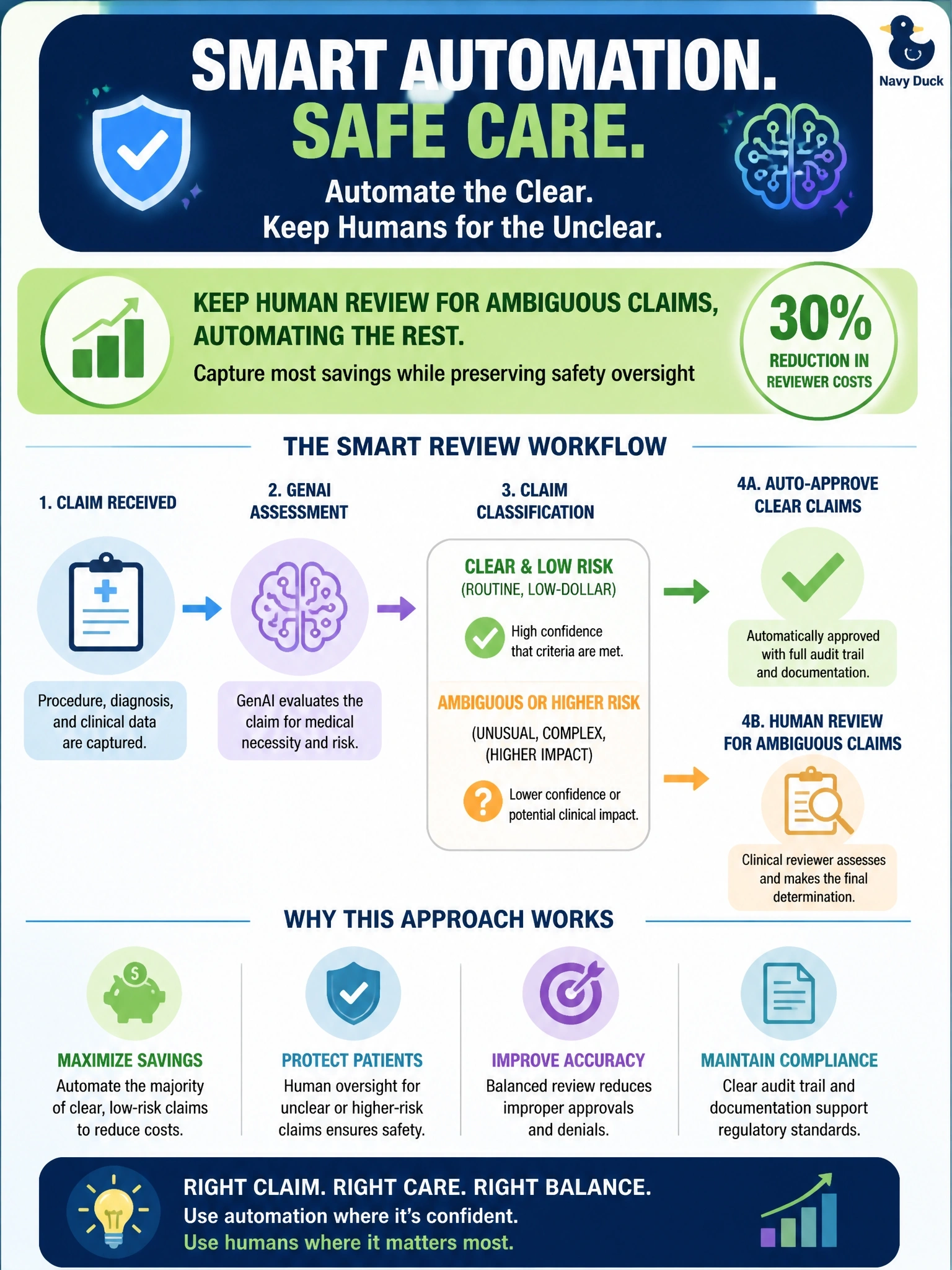
A pharmacist double-checks any prescription that looks off but doesn't re-verify routine refills — the review effort goes where the risk actually is. Keeping human review for ambiguous claims and automating the rest does the same thing: it protects patients where judgment calls matter most while still letting you capture most of the savings.
Full Explanation
This approach preserves clinical oversight precisely where it matters most — ambiguous cases with real patient-safety implications — while still automating the routine, low-ambiguity majority of claims to capture most of the projected savings. Launching full auto-approval to capture the entire cost savings conflates a claim's dollar amount to the insurer with its clinical risk to the patient; a low-cost procedure can still carry a genuine medical-necessity question, so financial exposure is the wrong proxy for patient-safety risk. Cancelling the automation project entirely forfeits all value from it despite a workable middle path being available, which is an overcorrection given the actual risk profile described. Delaying the decision indefinitely until state regulators issue explicit guidance treats indefinite delay as a safe default, but leadership is responsible for applying sound responsible-AI judgment now, rather than waiting on guidance that may be slow to arrive or may never address this exact scenario. Operational check: when a business objective conflicts with a responsible-AI principle, look for a design that concentrates human oversight specifically where the stakes or ambiguity are highest, rather than treating the choice as all-or-nothing between full automation and full manual review.