
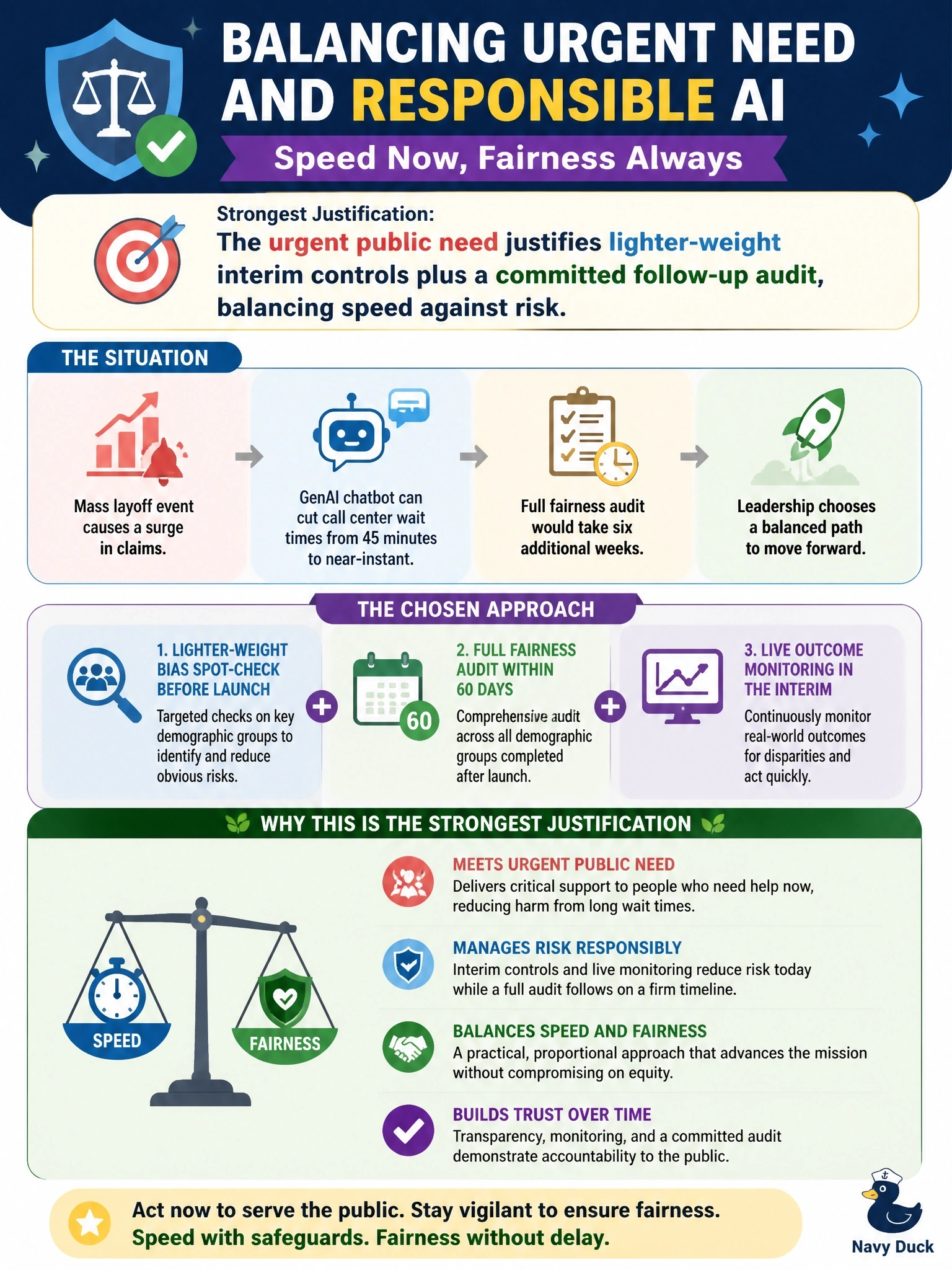
A state unemployment agency wants to launch a GenAI chatbot in two weeks to handle a surge in claims following a mass layoff event, cutting call center wait times from 45 minutes to near-instant. The responsible AI team says a full fairness audit across demographic groups would take six additional weeks. Leadership decides to launch with a lighter-weight bias spot-check now, complete the full audit within 60 days after launch, and monitor live outcomes for disparities in the interim. What is the strongest justification for this decision?
Select an answer to reveal the explanation.
Short Explanation
An ER nurse during a mass-casualty event doesn't skip checking vitals, she just checks faster and flags anyone who needs a closer look later. That's what you're doing when you launch with a quick bias spot-check, live monitoring, and a committed full audit on a deadline — you're compressing the safeguard, not cutting it.
Full Explanation
This scenario carries real cost on both sides: delaying help during a mass layoff harms claimants who need support now, while skipping fairness review entirely risks discriminatory outcomes reaching thousands of people. Launching with an interim bias spot-check, active monitoring for disparities, and a committed full audit on a fixed 60-day timeline captures most of the urgent value while keeping a real, resourced control in place to catch and correct problems quickly. Assuming that a chatbot handling only general questions carries no fairness risk is wrong — uneven response quality across demographic groups is itself a fairness concern, regardless of how routine the questions seem. Insisting the full six-week audit always be completed before any launch treats the delay as costless, ignoring that claimants harmed by a 45-minute wait during a crisis also bear real, immediate harm; an unconditional "always audit first" rule fails to weigh that tradeoff. Abandoning the chatbot altogether discards all of its value despite a workable interim safeguard being available and a firm remediation deadline already committed to. Operational check: when speed and fairness both carry real stakes, look for a way to layer a lighter-weight interim control with active monitoring and a hard deadline for the full review, rather than treating the choice as pick-one between launching blind and waiting indefinitely.