
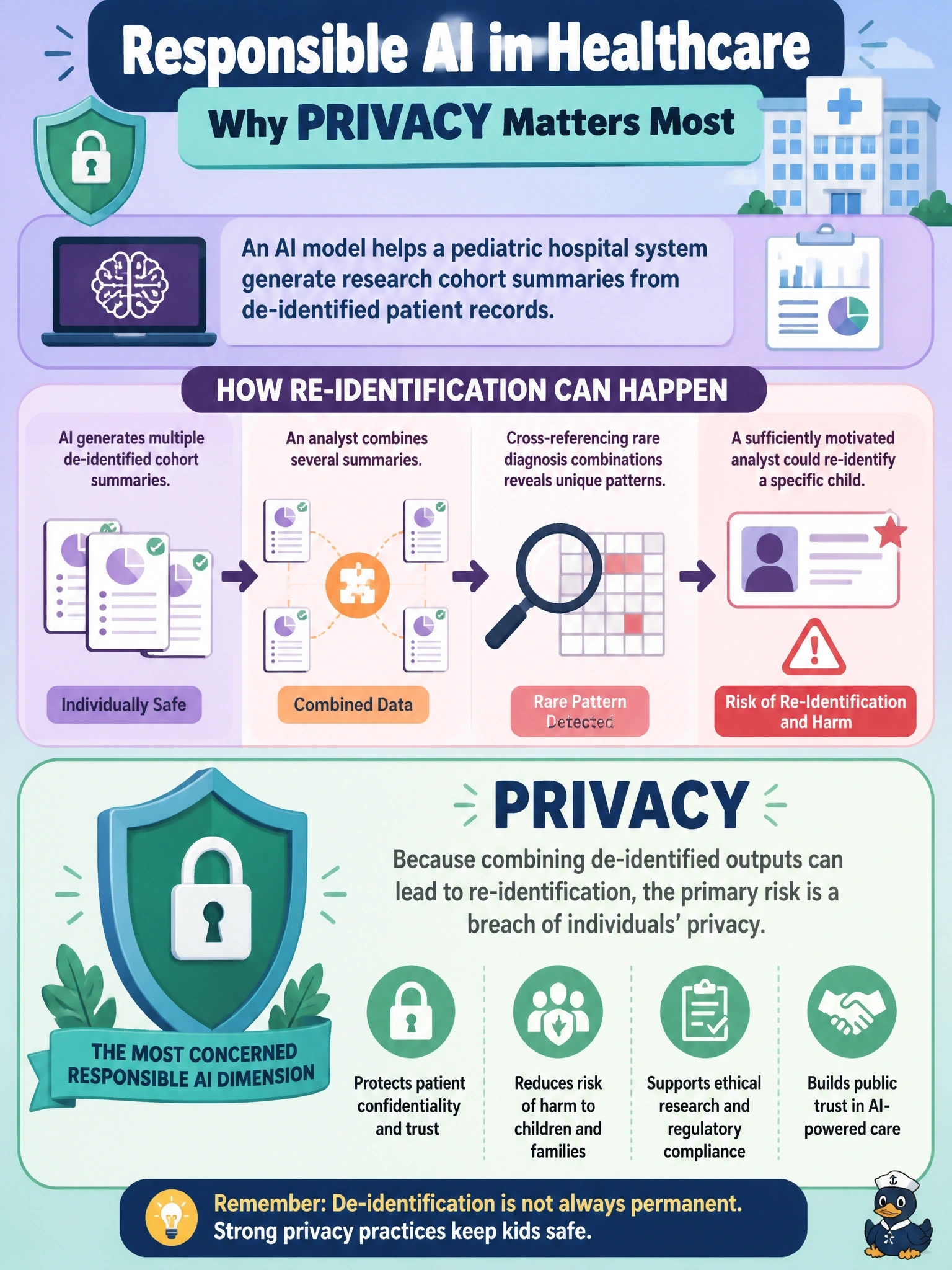
A pediatric hospital system uses an Amazon SageMaker AI model to generate research cohort summaries from de-identified patient records. A data scientist discovers that combining the model's outputs across several individually de-identified summaries could let a sufficiently motivated analyst re-identify specific children by cross-referencing rare diagnosis combinations. Leadership is most concerned about which responsible AI dimension?
Select an answer to reveal the explanation.
Short Explanation
Each summary here passed de-identification fine on its own — the risk only shows up once you start combining them. Enough rare diagnosis combinations stacked together let a motivated analyst reconstruct who a child actually is, and that's a privacy risk hiding in the aggregate, not in any single output.
Full Explanation
Privacy concerns protecting individuals from unauthorized identification or exposure of their personal information, and re-identification risk from combining outputs is exactly that, even though each individual summary passed de-identification on its own. This is a subtler and higher-stakes case than an obvious single data leak, because the risk only emerges in aggregate, once several summaries are cross-referenced by rare diagnosis combinations. Fairness would apply if the model treated groups of children differently in a biased way, which isn't the concern described here — the issue is identifiability, not disparate treatment. Safety concerns harm from acting on incorrect or dangerous outputs, not exposure of a person's identity. Robustness concerns performance stability across conditions, not whether the underlying subjects of an output can be identified. Operational check: privacy risk isn't eliminated just because each individual output meets a de-identification standard on its own; an organization also has to evaluate re-identification risk across combined or aggregated outputs, which is a higher and separate bar from assessing any single output in isolation.