
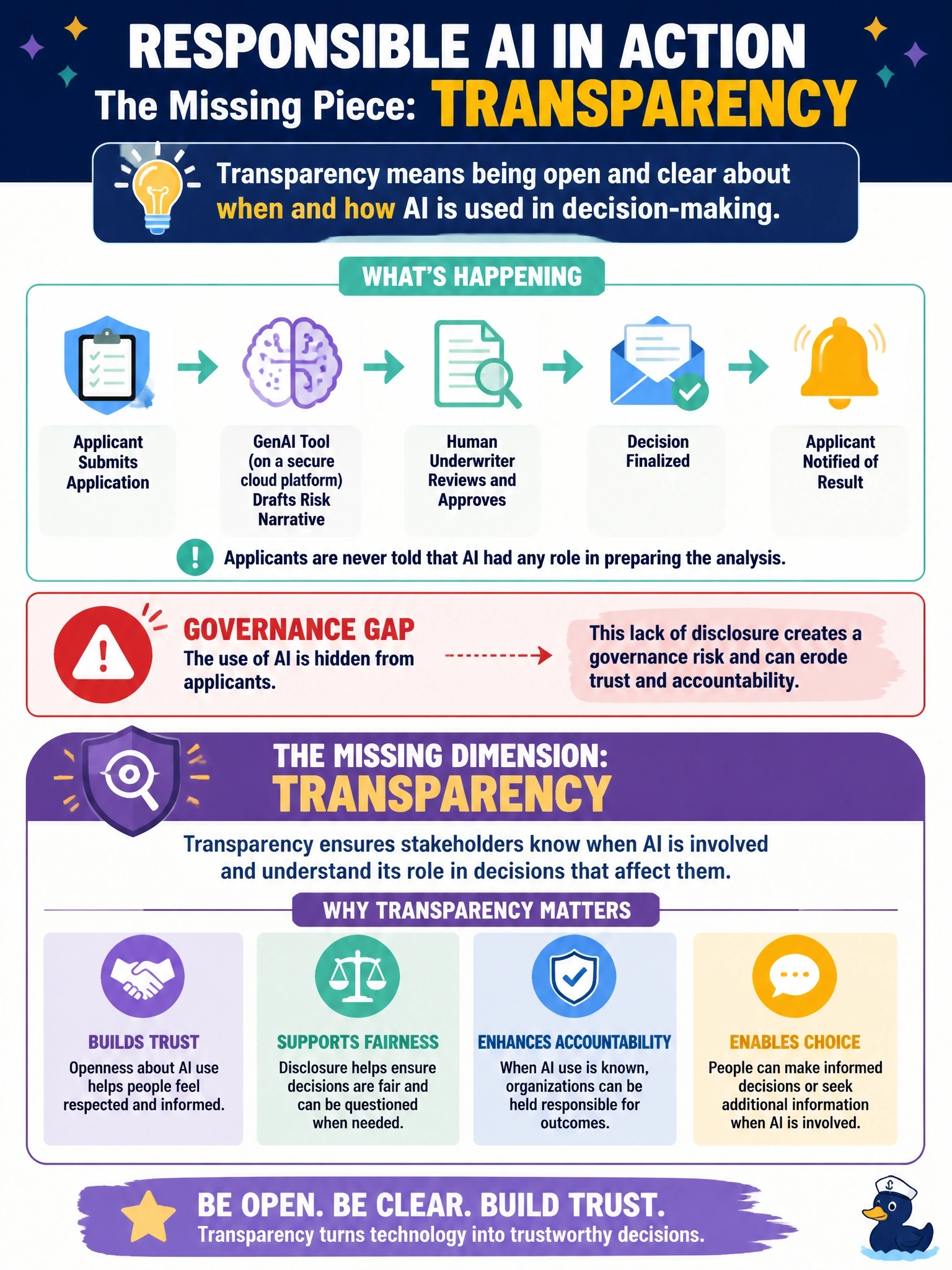
A life insurance company's underwriting team begins using a GenAI tool built on Amazon Bedrock to draft risk narratives that human underwriters review and approve before applicants are notified of results. Applicants are never told that AI had any role in preparing the analysis behind their decision. A compliance officer flags this as a governance gap. Which responsible AI dimension does the missing disclosure primarily concern?
Select an answer to reveal the explanation.
Short Explanation
Think about a doctor who never mentions a computer helped draft your diagnosis: you deserve to know a machine had a hand in it, even before you get into the details of how. That's transparency — telling people AI was involved at all — and it's exactly what's missing for these applicants.
Full Explanation
Transparency concerns whether people affected by an AI system are told that AI is involved and, at a general level, how it's used, and that's exactly what's missing here: applicants have no idea AI drafted the analysis behind their underwriting outcome. Explainability is a closely related but distinct concept — it concerns the ability to explain how a specific decision was reached, whereas transparency concerns disclosing that AI was involved at all. An insurer could disclose AI's involvement without offering a detailed explanation of any single decision, or vice versa, which is why the two are tracked separately in responsible AI practice. Safety concerns the risk of harmful outputs, which isn't the issue described — the underwriting process here includes human review before any decision is finalized. Robustness concerns performance consistency across conditions, which is unrelated to whether applicants are informed that AI played a role. Operational check: before any AI-assisted decision reaches someone it affects, ask whether that person was told AI was involved at all — if not, that's a transparency gap, and the fix is a disclosure policy, kept separate from any work on explaining individual decisions.