
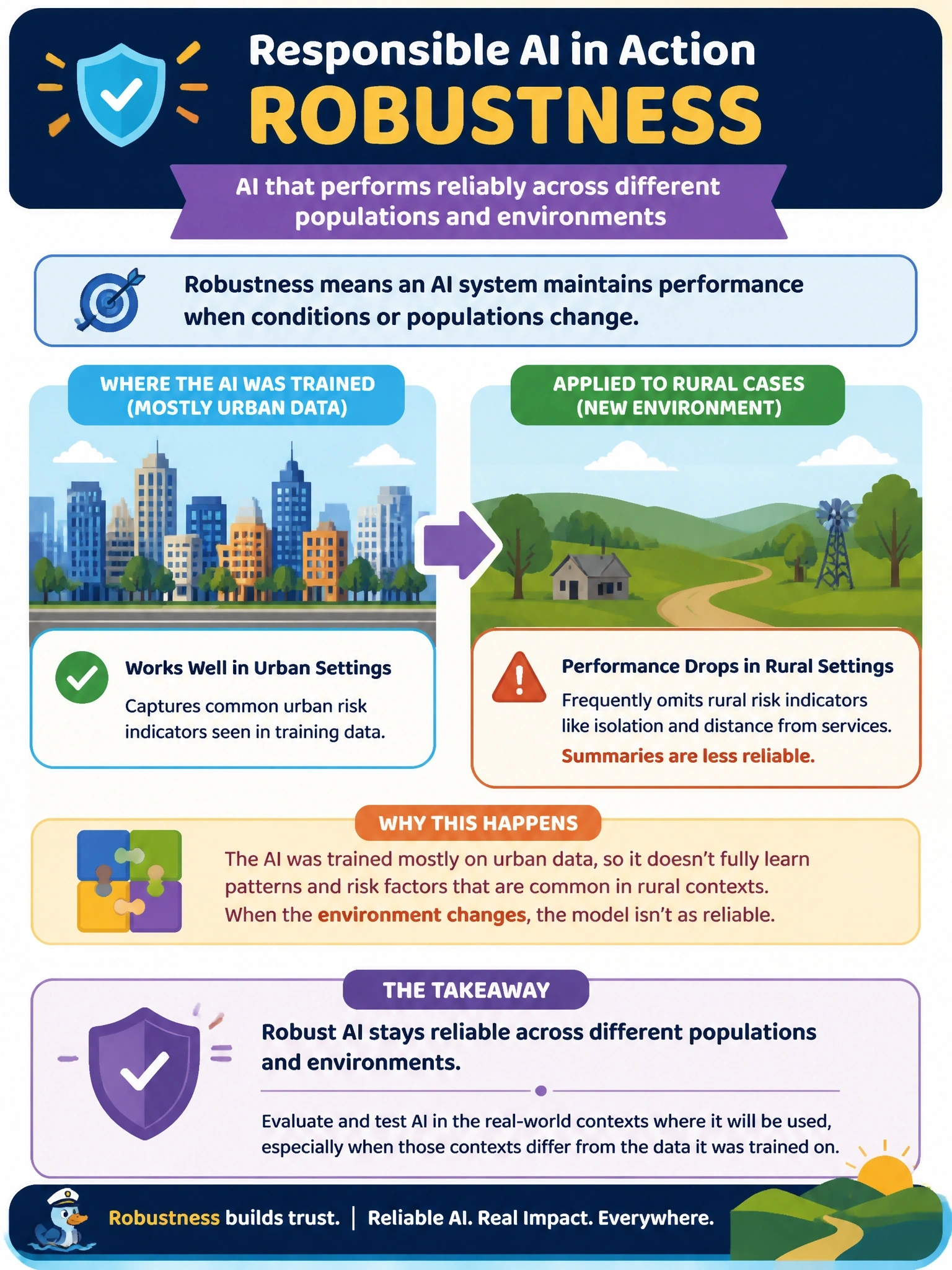
A county child protective services agency pilots a GenAI case-summary tool trained mostly on urban case data from other regions. When applied to the agency's largely rural caseload, the tool frequently omits risk indicators common in rural settings, such as isolation or distance from services, and its summaries are noticeably less reliable than in the vendor's original testing environment. Which responsible AI dimension does this decline in reliability across a different population best represent?
Select an answer to reveal the explanation.
Short Explanation
A car that drives beautifully on smooth highways can stall the moment it hits gravel, because it was never built for that road. You're seeing the same thing here — the tool learned from urban cases and stumbles on the rural caseload it was never tuned for, and that gap in performance across conditions is what robustness measures.
Full Explanation
Robustness is the dimension concerned with whether a model's performance holds up consistently across varied conditions, populations, and inputs, rather than degrading outside the data it was trained on. Here, the tool's accuracy drops specifically because the agency's rural population differs from the urban training data, a classic robustness failure showing up as omitted risk indicators. Fairness is tempting to name instead, since different populations are affected differently, but fairness concerns disparate treatment tied to protected or demographic characteristics; rural versus urban caseload composition isn't evidence of that kind of bias, and the root cause here is a generalization failure, not discrimination. Explainability would be the right call if the concern were understanding why a given summary was generated, not whether summaries are reliably accurate across different settings. Transparency concerns disclosure of AI's role and its limitations to the people affected, which is unrelated to the tool's actual accuracy under different real-world conditions. Operational check: when a model's performance is inconsistent specifically because real-world conditions differ from its training data, that's a robustness issue, and it should be addressed through retraining on representative data, validation against the actual deployment population, or added human safeguards — not through fairness-specific remediation.