
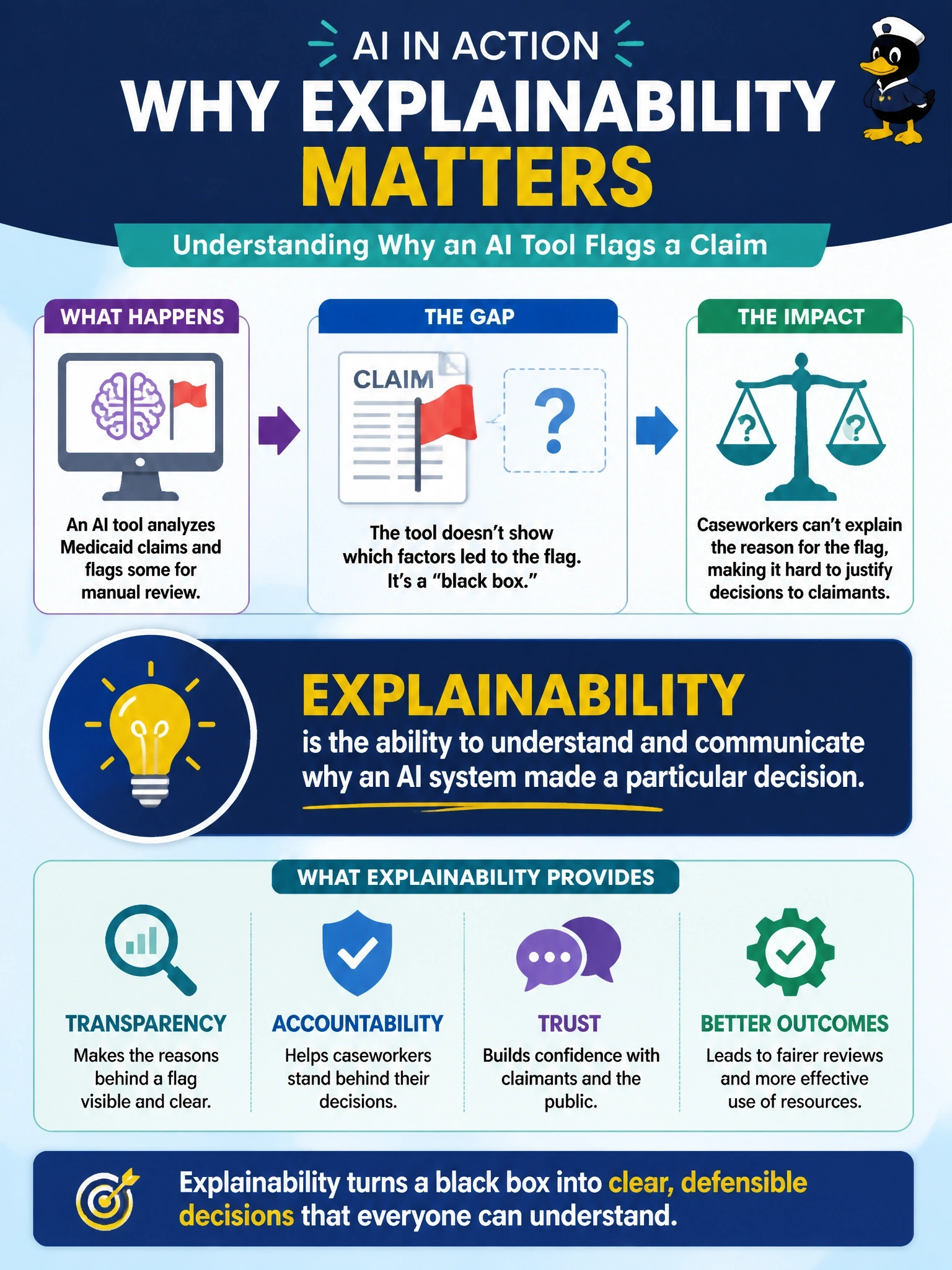
A state Medicaid agency uses an AI tool to flag claims for manual fraud review. Caseworkers can see which claims were flagged, but the tool gives no indication of which factors drove each flag, making it hard for caseworkers to justify escalation decisions to claimants who ask why they were selected. Which dimension does this gap primarily concern?
Select an answer to reveal the explanation.
Short Explanation
A teacher marking an essay with just a grade and no comments leaves the student with no idea why they got a C. That's the caseworkers' problem here too: you get a flag with zero reasoning behind it, so there's nothing to tell the person it affects when they ask why — that gap has a name, explainability.
Full Explanation
Explainability is the ability to describe, in terms a person can understand, why a specific AI output occurred, and caseworkers being unable to tell claimants why their claim was flagged is precisely a failure to interpret an individual decision. Fairness would be the right call if flags disproportionately targeted a protected group, but the scenario describes a lack of reasoning transparency, not a demonstrated disparity in outcomes across groups. Privacy would apply if claimant data were mishandled or exposed, which isn't what's described here — the data itself isn't the issue, the missing rationale is. Safety concerns the risk of a tool causing harm through unsafe outputs, which is a different concern from a caseworker's inability to justify a decision after the fact. Operational check: if a person affected by an AI decision asks 'why me?' and no one, including the tool's own output, can answer in understandable terms, that's an explainability gap, and it should be closed by improving the tool's interpretability or requiring a documented rationale for each flag — not by treating it as a bias or data-handling issue.