
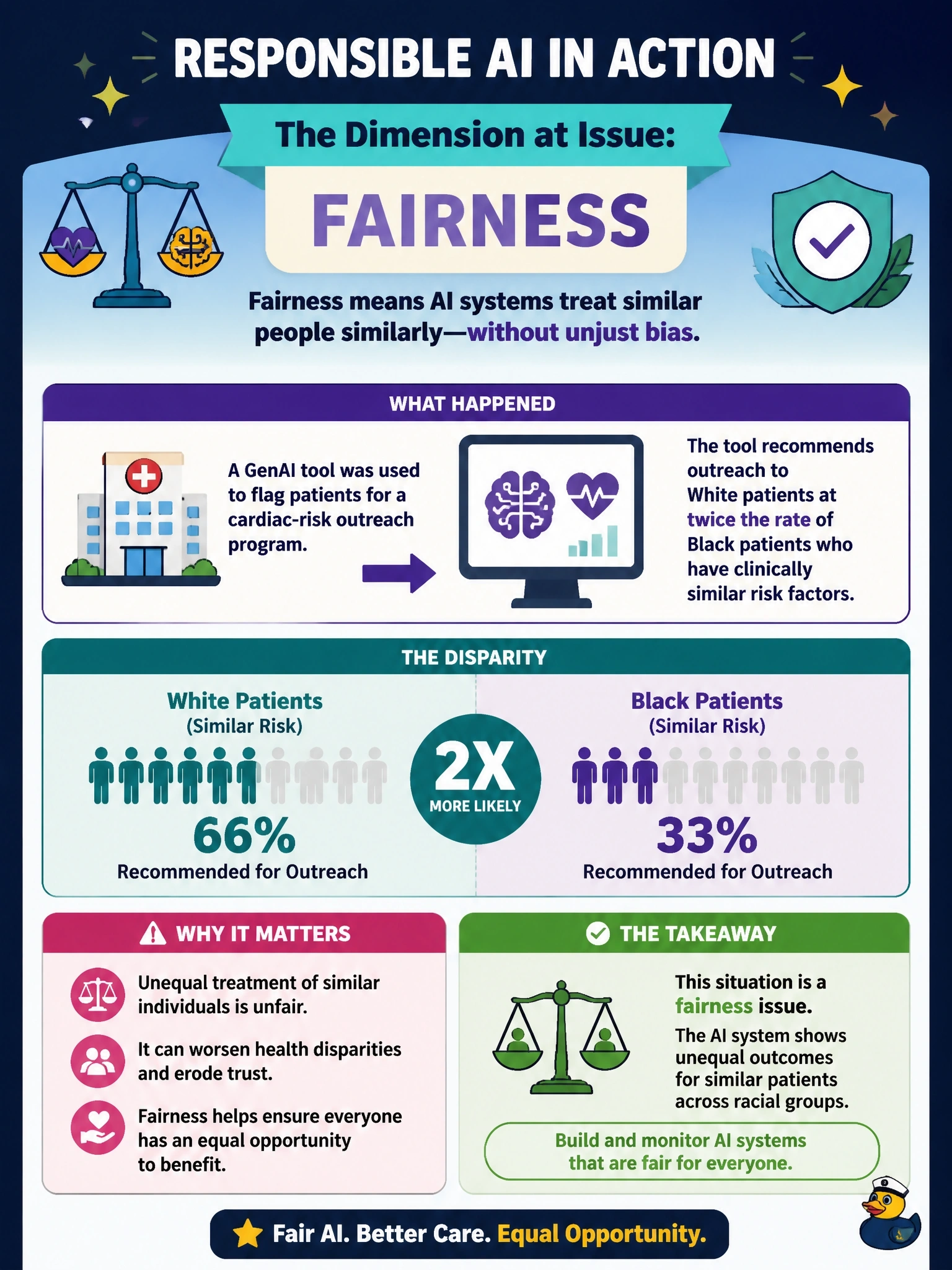
A regional hospital network deploys a GenAI tool built on Amazon Bedrock to flag patients for a cardiac-risk outreach program. An internal review finds the tool recommends outreach to White patients at twice the rate of Black patients who have clinically similar risk factors. Which responsible AI dimension is most directly at issue?
Select an answer to reveal the explanation.
Short Explanation
Think of it like a clinic that quietly skips half the line based on skin color even though everyone's paperwork looks the same: that's not a data glitch, that's a fairness problem. When two patients look identical on the factors that should matter but the tool treats them differently, you're looking at disparate outcomes.
Full Explanation
Fairness concerns whether an AI system produces equitable outcomes across groups, and a two-to-one disparity in outreach recommendations between patients with similar clinical risk profiles is a textbook fairness failure: the tool is treating clinically comparable patients differently based on a factor unrelated to their actual risk. Explainability is tempting to name instead, since diagnosing the problem required understanding the tool's reasoning, but explainability concerns whether a decision can be interpreted at all, not whether the decision itself is equitable once it has been interpreted — a fully explainable tool can still be biased. Privacy is unrelated here, since the issue is disparate treatment in who gets flagged for outreach, not exposure or misuse of patient data. Robustness refers to a model's performance stability across varied conditions or inputs, not systematic disparities in outcomes across demographic groups; a model can be perfectly stable and still be unfair. Operational check: when reviewing an AI system's outputs, compare outcomes across protected or demographic groups for people who are otherwise similar on the factors that should drive the decision — a persistent gap there is a fairness finding, and it should be remediated with fairness-specific techniques such as bias testing and outcome monitoring, not folded into a different governance category.