
A real estate brokerage is in an industry segment where AI adoption is only just beginning, but leadership is aware that adoption in adjacent industries, such as retail, has moved much faster. What should leadership conclude about the brokerage's appropriate investment level?
Select an answer to reveal the explanation.
Short Explanation
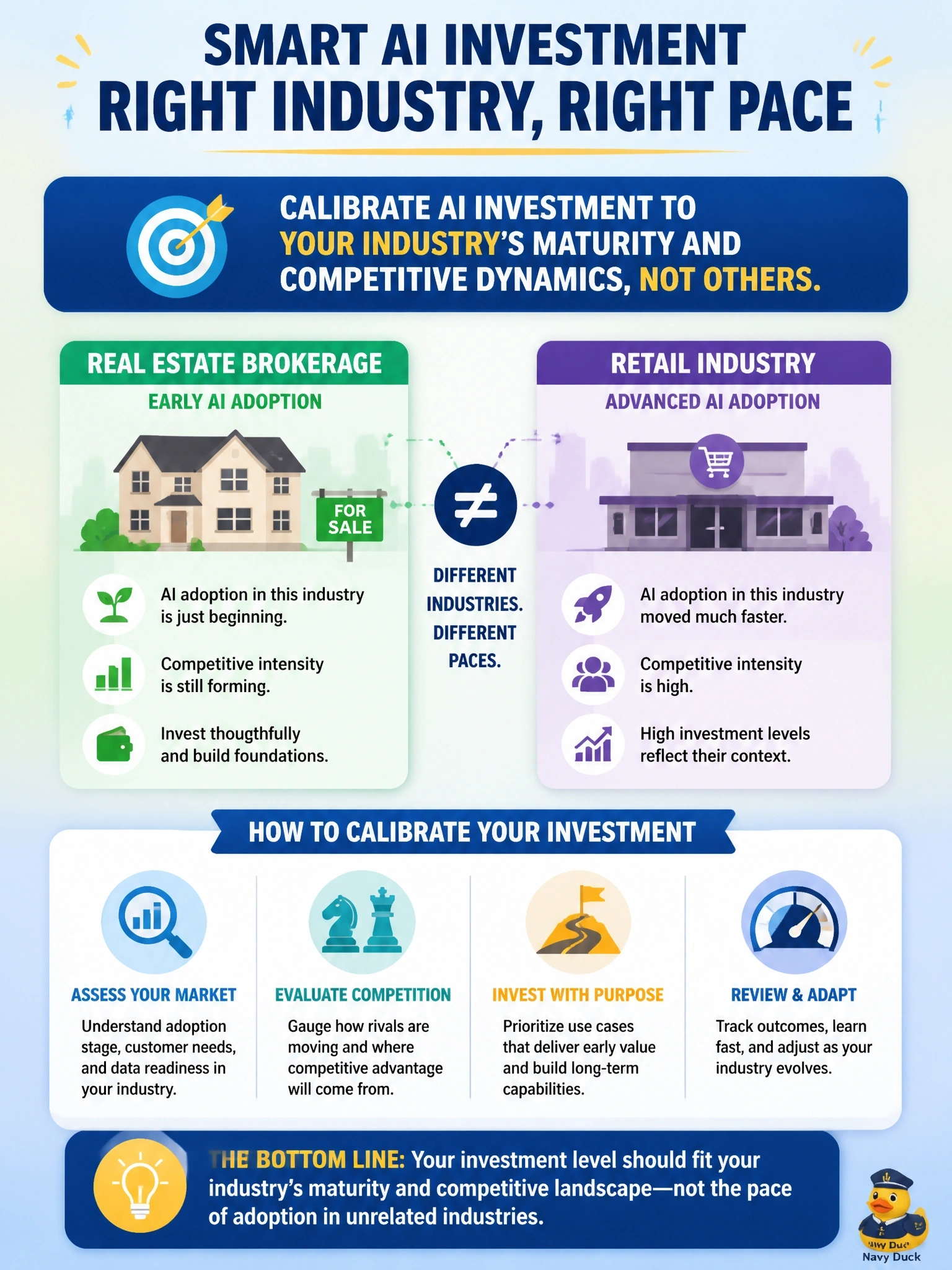
Think about training for your own sport, not somebody else's: a swimmer doesn't pace their workouts off a sprinter's schedule. The real estate brokerage should size its AI investment to what's actually happening in its own industry and among its own competitors, not to how fast retail happens to be moving.
Full Explanation
Investment calibration is grounded in the maturity and competitive dynamics of the company's own industry, because that is what determines whether AI adoption is a baseline expectation or a genuine differentiator for this specific business. A faster pace in an adjacent industry like retail says nothing about how mature AI actually is in real estate brokerage or how it's affecting the brokerage's own competitors. Delaying all investment until the brokerage's own industry 'catches up' to retail treats a different sector's pace as the benchmark to wait for, when the brokerage's own industry dynamics are what should be driving the decision regardless of what retail is doing. Investing at the same level as fast-moving retail companies assumes all industries converge to a similar maturity level and timeline, which is not a safe assumption and would likely mean over-investing relative to what the brokerage's actual competitive landscape requires. Concluding that AI is overhyped because retail moved faster draws an unsupported inference — a different industry's faster pace reflects that industry's own conditions, not a verdict on AI's value generally. Operational check: before setting an investment level, ask what's happening with AI adoption and competitor use specifically within your own industry — if the answer comes from a different sector, it's the wrong input.