
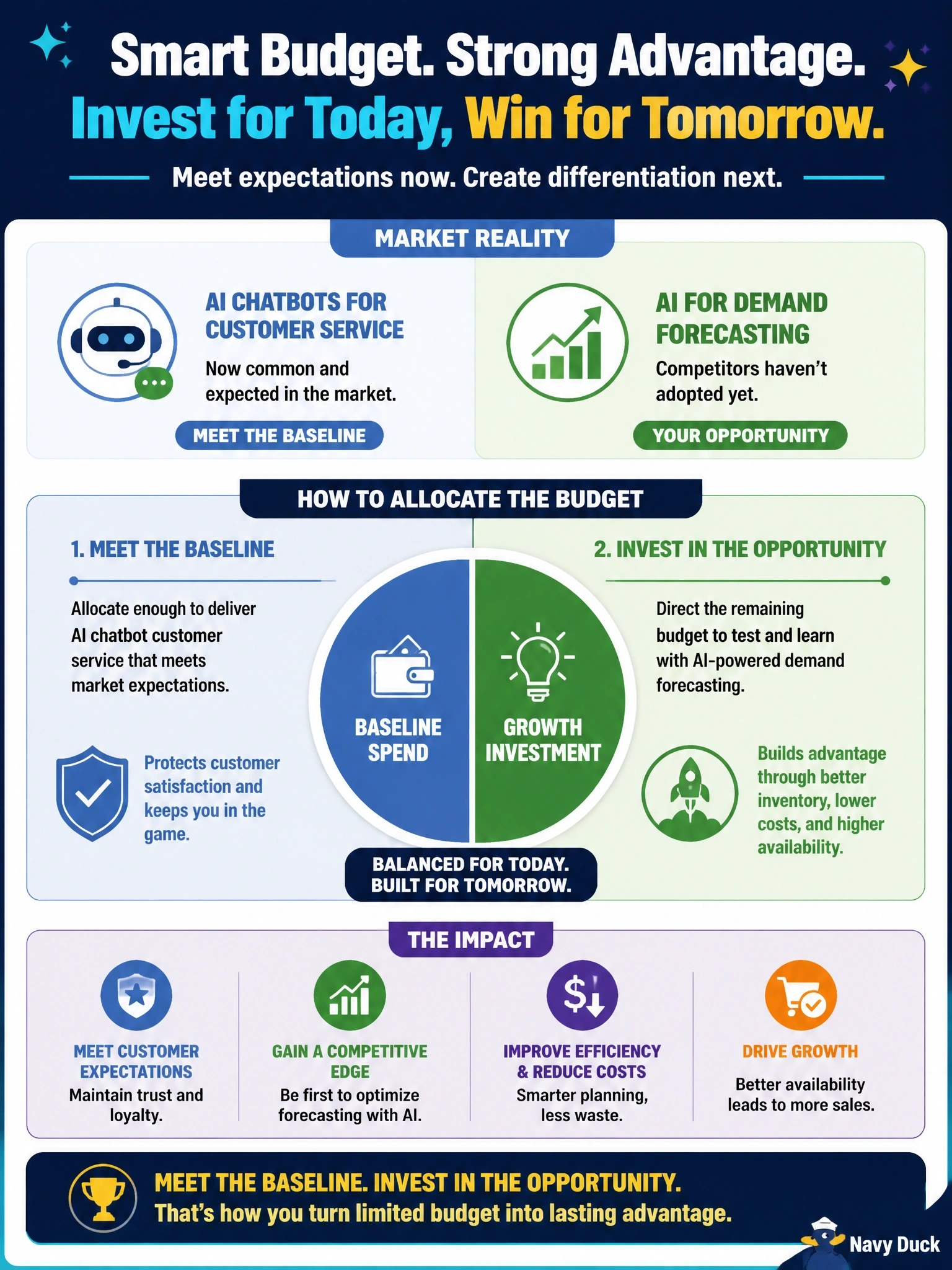
An e-commerce retailer operates in a market where AI-driven customer service chatbots are now common and expected, but its competitors have not yet adopted AI for supply chain demand forecasting, an area where the retailer sees a potential opportunity. Leadership has limited budget for the coming year. What is the most defensible way to allocate it?
Select an answer to reveal the explanation.
Short Explanation
Think of it like paying rent before you invest in a side hustle: you cover what's now expected of you first, then put what's left toward testing the opportunity nobody else has grabbed yet. That's why the retailer funds enough customer-service AI to stay at par, then puts the rest toward testing demand forecasting.
Full Explanation
With a limited budget, the retailer is really managing two different kinds of exposure at once: a mainstream category where AI has become an expected baseline, and a still-open category where a genuine opportunity exists because competitors haven't moved yet. Funding enough customer-service AI to meet that baseline protects against falling behind where customers now expect it, while directing the remainder toward testing demand forecasting lets the retailer explore the open opportunity without overcommitting to something unproven. Putting the entire budget toward customer-service AI captures none of the forecasting opportunity and treats a merely lower-risk category as if it were the only one worth funding, which leaves real upside on the table. Putting everything toward demand forecasting on the theory that customer-service AI is commoditized and offers no return confuses commoditized with worthless — falling below what customers now expect there would cost the retailer real business, not just miss extra gains. Splitting the budget exactly in half ignores that the two categories differ in maturity and opportunity size, so an even split is really just an arbitrary rule dressed up as fairness. Operational check: fund the baseline expectation first, then treat whatever remains as an exploration budget for the open opportunity, sized to what you can afford to test rather than an even split.