
A retail chain competes in a segment where AI-driven personalization is now widespread and customers increasingly expect it, but the chain also operates in a niche category where almost no competitor has adopted AI at all. How should leadership calibrate investment across these two parts of the business?
Select an answer to reveal the explanation.
Short Explanation
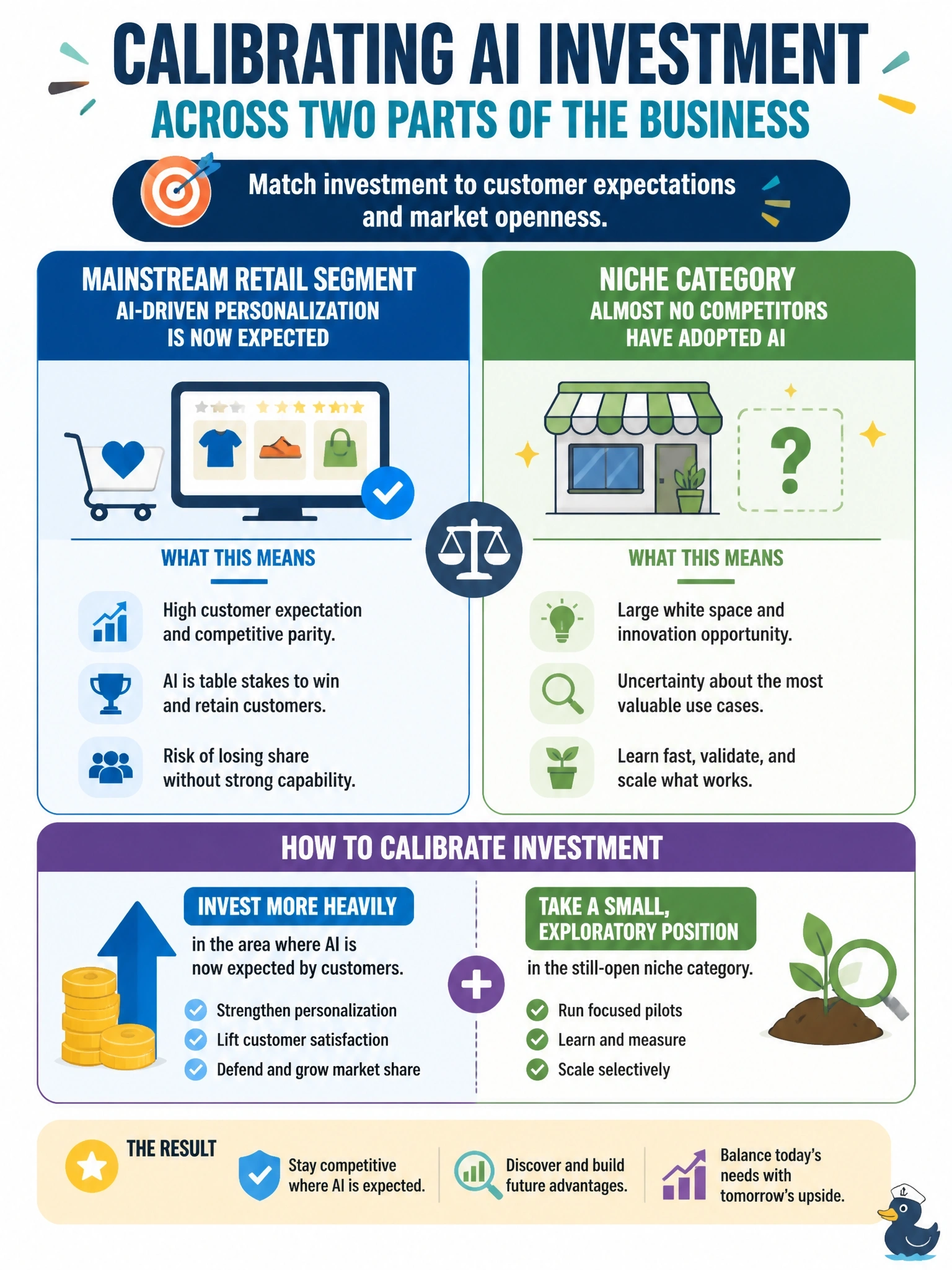
Think of your AI budget like watering a garden: you water the plants that are already growing to keep them healthy, and you give the untested seeds just a little water to see what sprouts. Where customers already expect AI, falling behind erodes your position fast, so that gets the bigger share. The still-open niche category gets a smaller, exploratory bet because you don't yet know if it'll pay off.
Full Explanation
The right call weighs two different maturity levels within the same business. In the mainstream segment, AI-driven personalization has become table stakes, so meaningful investment there protects market share against competitors already meeting that expectation. In the still-open niche category, a smaller, exploratory position lets the company learn what works without overcommitting to an unproven bet. Treating both segments identically ignores that they sit at different points on the maturity curve and face different competitive pressures, which wastes resources by applying a one-size-fits-all rule. Betting everything on the niche category on the assumption that first movers always win overstates the value of being first — a niche can also be niche in its actual AI applicability or return, and an early mover sometimes just absorbs the cost of proving a market that others capture more cheaply later. Walking away from the mainstream segment because it is commoditized misreads what commoditized means: even where a capability is now standard, underinvesting still risks falling below the baseline customers expect, and that gap shows up as lost customers, not just missed upside. Operational check: for each part of the business, ask separately how mature AI adoption is there and how competitors are using it, then size the investment to match — never apply one company-wide number across segments with different dynamics.