
AI adoption in commercial real estate management is still in an early, experimental stage industry-wide, with no dominant approach yet established. A property management firm's leadership is deciding how much to invest in AI this year. What is the most appropriate approach given this level of industry maturity?
Select an answer to reveal the explanation.
Short Explanation
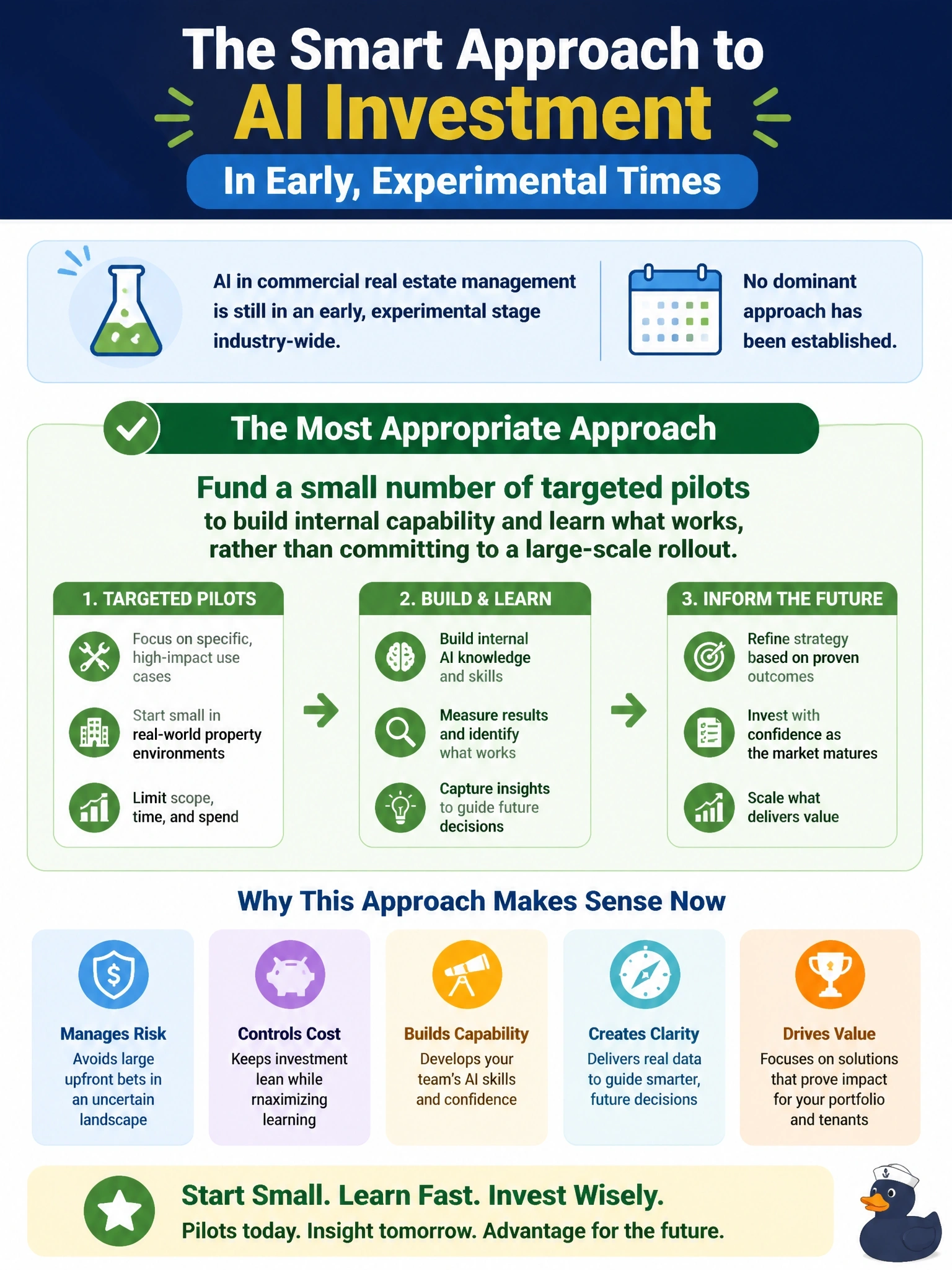
Think of it like this: when nobody in the industry has figured out the winning playbook yet, you don't bet the whole budget on a guess. Funding a handful of targeted pilots lets the firm learn what actually works and build internal capability before scaling, instead of over-committing to an unproven direction.
Full Explanation
In an immature market with no proven approach, the right investment level is one that builds learning and capability without over-committing to an unproven direction. Funding a small number of targeted pilots to build internal capability and learn what works, rather than committing to a large-scale rollout, reflects exactly that calibration, since pilots let the firm gather evidence and adjust before scaling. Committing to the largest AI investment the budget allows because being first to scale always wins in an immature market assumes that scale alone wins even without a validated approach, which risks scaling the wrong thing before it's proven. Delaying any AI spending until a dominant industry approach emerges swings too far the other way, since waiting entirely risks losing the learning advantage that early, small-scale experimentation provides, and by the time an approach is obvious, competitors may already have a head start. Matching whatever the largest national firm is spending ties investment to a competitor's spending level rather than to this firm's own readiness and market conditions, which is a poor basis for calibration regardless of firm size. The principle: investment level should match the market's maturity, meaning modest, learning-oriented spending in immature markets, scaling up as approaches prove out. As a check, ask whether each dollar spent is generating a lesson the firm can act on, not just activity to point to.