
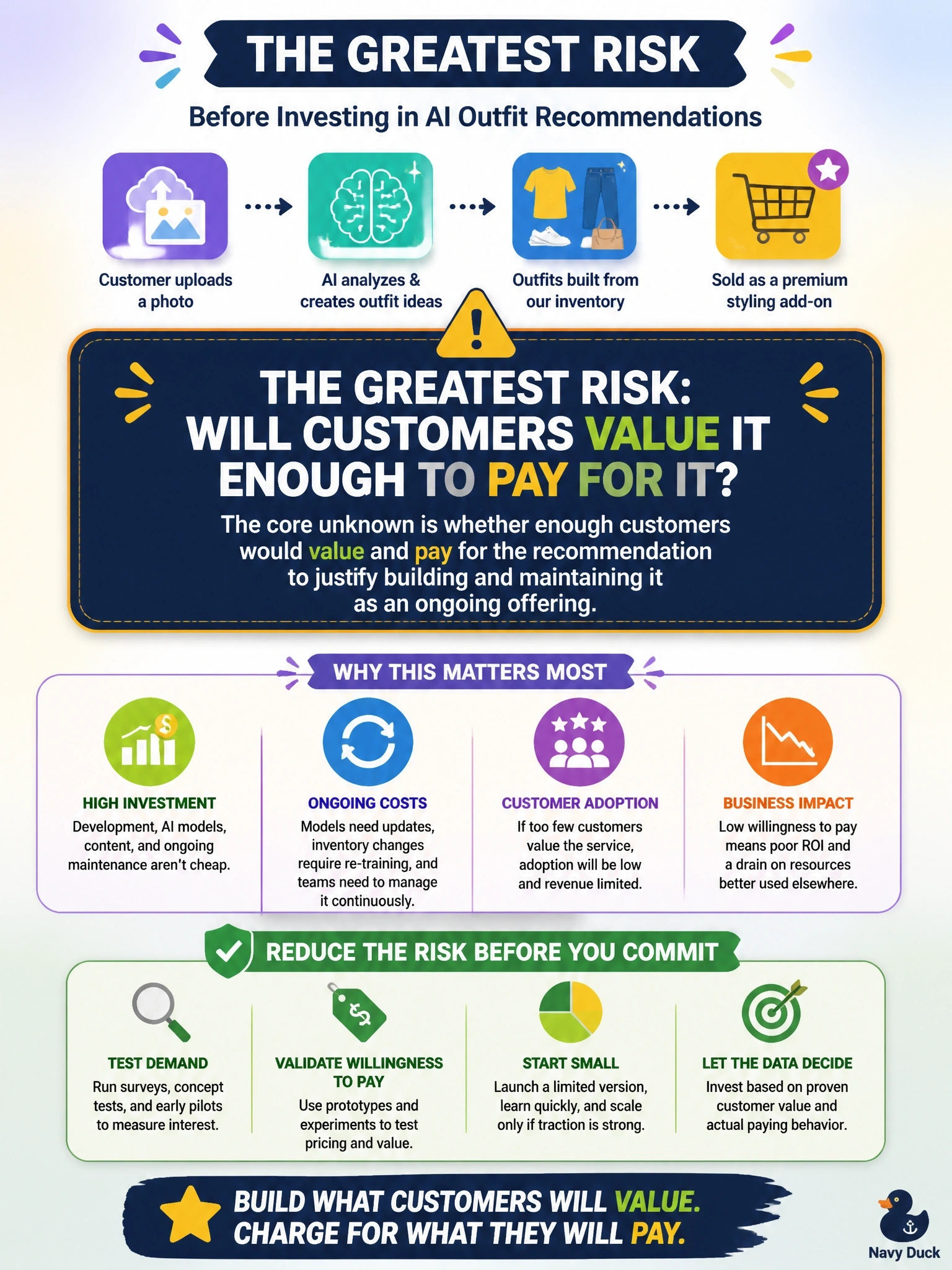
An e-commerce apparel retailer is evaluating an AI opportunity to let customers upload a photo and receive AI-generated outfit recommendations assembled entirely from the retailer's own inventory, sold as a premium styling add-on at checkout. What is the greatest risk leadership should weigh before pursuing this as a business model shift?
Select an answer to reveal the explanation.
Short Explanation
Think of it like this: you can build the slickest AI styling feature in the world, but if customers won't pay for it, it's not a business model, it's an expensive experiment. The real risk to weigh up front is whether enough customers actually value the recommendation enough to pay for it as an ongoing add-on.
Full Explanation
Even a well-designed new offering only transforms the business model if customers actually value it enough to pay, so validating demand is the central risk to evaluate before committing resources. Whether enough customers would pay for the styling recommendation to justify building and maintaining it addresses that risk directly, because it's a market-validation question, and market validation is what determines whether the feature ever becomes real revenue. Whether competitors have used similar marketing wording says nothing about whether this retailer's own customers would pay for the feature; it's a branding-copy concern, not a demand signal. Whether the feature could run on a large language model instead of a smaller one is a technical model-selection question that's out of scope for a business leader and doesn't affect commercial viability either way. Whether the company's logo needs a redesign to accompany the feature is an unrelated branding decision with no bearing on strategic risk. The generalizable lesson: the biggest risk in a business model transformation is usually market validation, meaning whether customers pay, not the underlying technology choice or presentation details, which are secondary once demand is confirmed. As a check, leadership should be able to point to evidence such as pilot data, surveys, or willingness-to-pay signals before scaling the feature, not just confidence that it's technically buildable.