
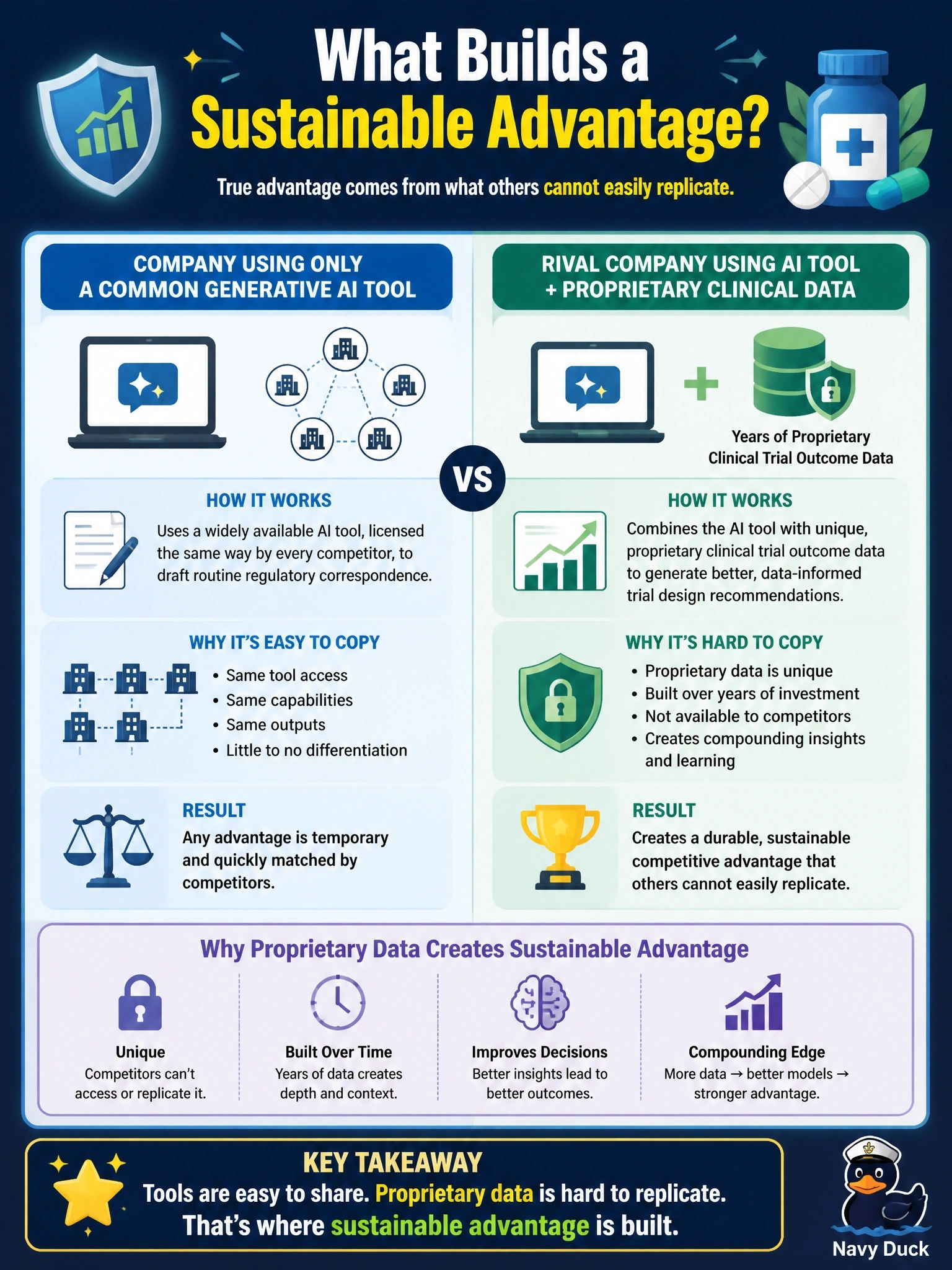
A pharmaceutical company adopts a widely available generative AI tool, licensed the same way by every competitor, to draft routine regulatory correspondence. A rival company adopts a similar tool but combines it with years of the company's own proprietary clinical trial outcome data to improve trial design recommendations. Which company is more likely to have built a sustainable competitive advantage, and why?
Select an answer to reveal the explanation.
Short Explanation
When everyone at the table has the exact same tool, nobody wins with it for long, and that's your tell here. The rival company's edge doesn't come from owning a generative AI tool at all — it comes from feeding that tool decades of proprietary clinical trial data nobody else can copy, and that data, not the software, is what makes the advantage stick for them.
Full Explanation
A sustainable AI advantage comes from something a competitor cannot simply buy off the shelf. Pairing a generative AI tool with years of proprietary clinical trial data does exactly that, because the historical results took years to accumulate and can't be quickly replicated, which is what makes the resulting improvement in trial design durable. Using a generic, identically licensed tool for routine correspondence is easy for any competitor to replicate, so it produces only a temporary or marginal gain no matter how early it was adopted. The idea that using a widely available tool reduces switching costs and adoption risk confuses a low barrier to entry with competitive strength; a low switching cost cuts both ways, since rivals can switch to the same tool just as easily. The claim that generative AI simply cannot create meaningful advantage in regulated industries overstates the case, since regulated industries can absolutely benefit from AI when it's paired with defensible assets like proprietary data. Early adoption alone doesn't create a lasting edge if the underlying tool is commoditized and available to every competitor on the same terms. The principle: sustainable advantage comes from proprietary data, workflow integration, or accumulated learning, not from tool access alone. As a check, ask whether a well-funded competitor could replicate the capability just by licensing the same software; if yes, the advantage is temporary.