
A commercial property management company is comparing itself to competitors that use AI to flag lease renewal risk earlier. The company's leadership wants to assess whether this is a genuine competitive advantage or a feature that is easy for anyone to add. What should they check?
Select an answer to reveal the explanation.
Short Explanation
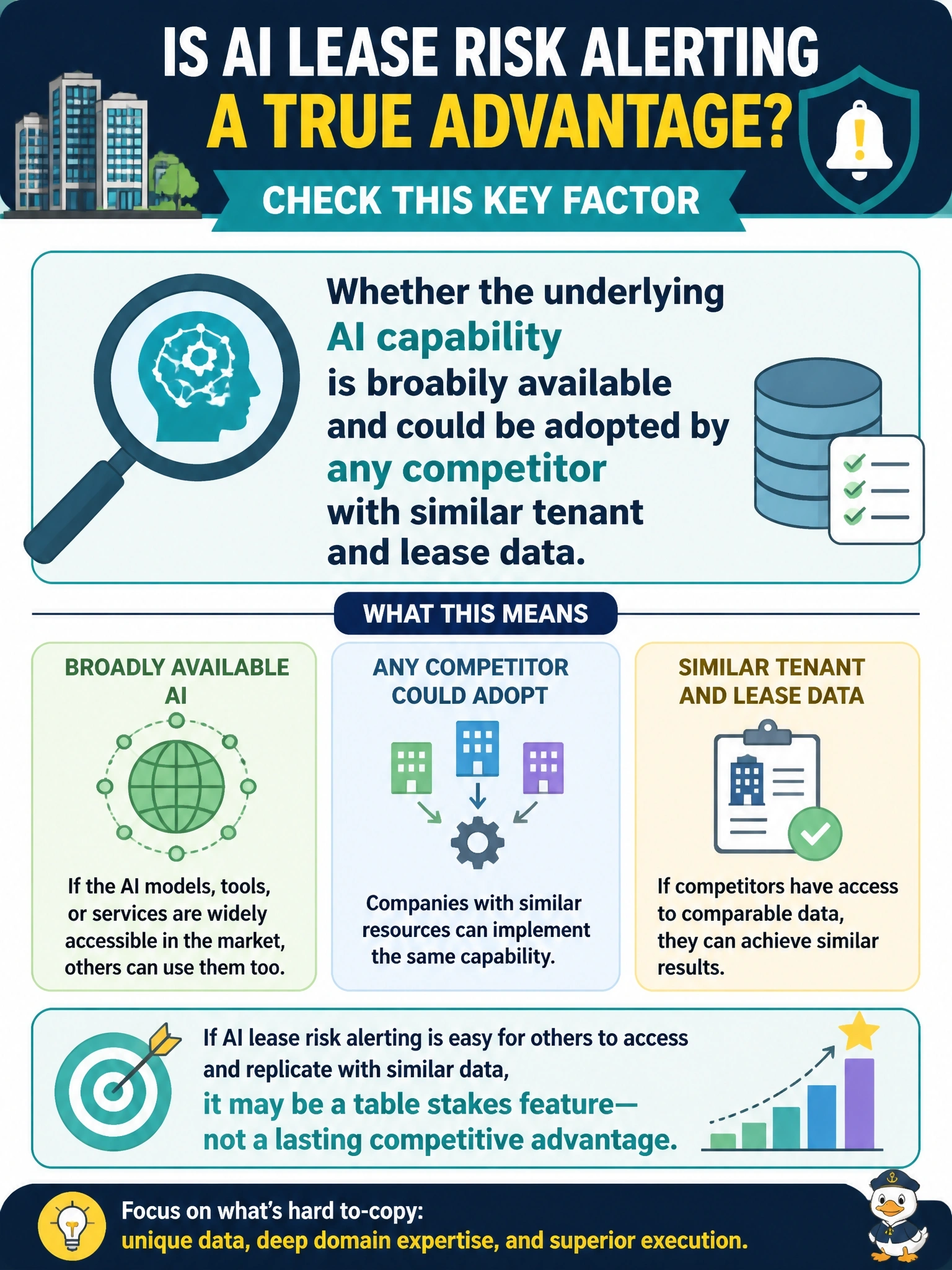
A restaurant's new online ordering system looks impressive — until every restaurant on the block adds the same feature within a year. Ask the same question about any rival's AI advantage: could a competitor with data like your own copy it just as easily, regardless of how polished or heavily marketed it looks?
Full Explanation
Whether the underlying AI capability is broadly available and could be adopted by any competitor with similar tenant and lease data gets at the real question: if any rival with comparable data can pick up the same capability, it's a catch-up feature to match, not a durable edge to fear or envy. Whether the competitor's tool has a more polished, modern interface is a surface-level difference — a nicer screen doesn't tell you anything about whether the underlying lease-risk capability itself is hard to replicate. Whether the competitor's marketing materials simply use the phrase "AI-powered" without technical detail is even less informative — a label says nothing about the substance or availability of what's actually running underneath it. Whether the competitor is charging tenants more because of the new feature is a separate pricing decision, unrelated to whether the capability itself represents a genuine, defensible advantage. The underlying principle: judge whether an AI feature is a real competitive edge by how easily competitors with similar data and resources could replicate it — not by its interface polish, its marketing language, or how it's priced. A useful operational check: could the company build or buy the same capability with the lease and tenant data it already has? If yes, it's table stakes, not an advantage.