
A specialty biotech firm competes against much larger pharmaceutical companies that have dedicated AI research teams. The biotech firm's leadership is assessing whether AI adoption can create a competitive advantage despite the resource gap. Which line of analysis best supports that assessment?
Select an answer to reveal the explanation.
Short Explanation
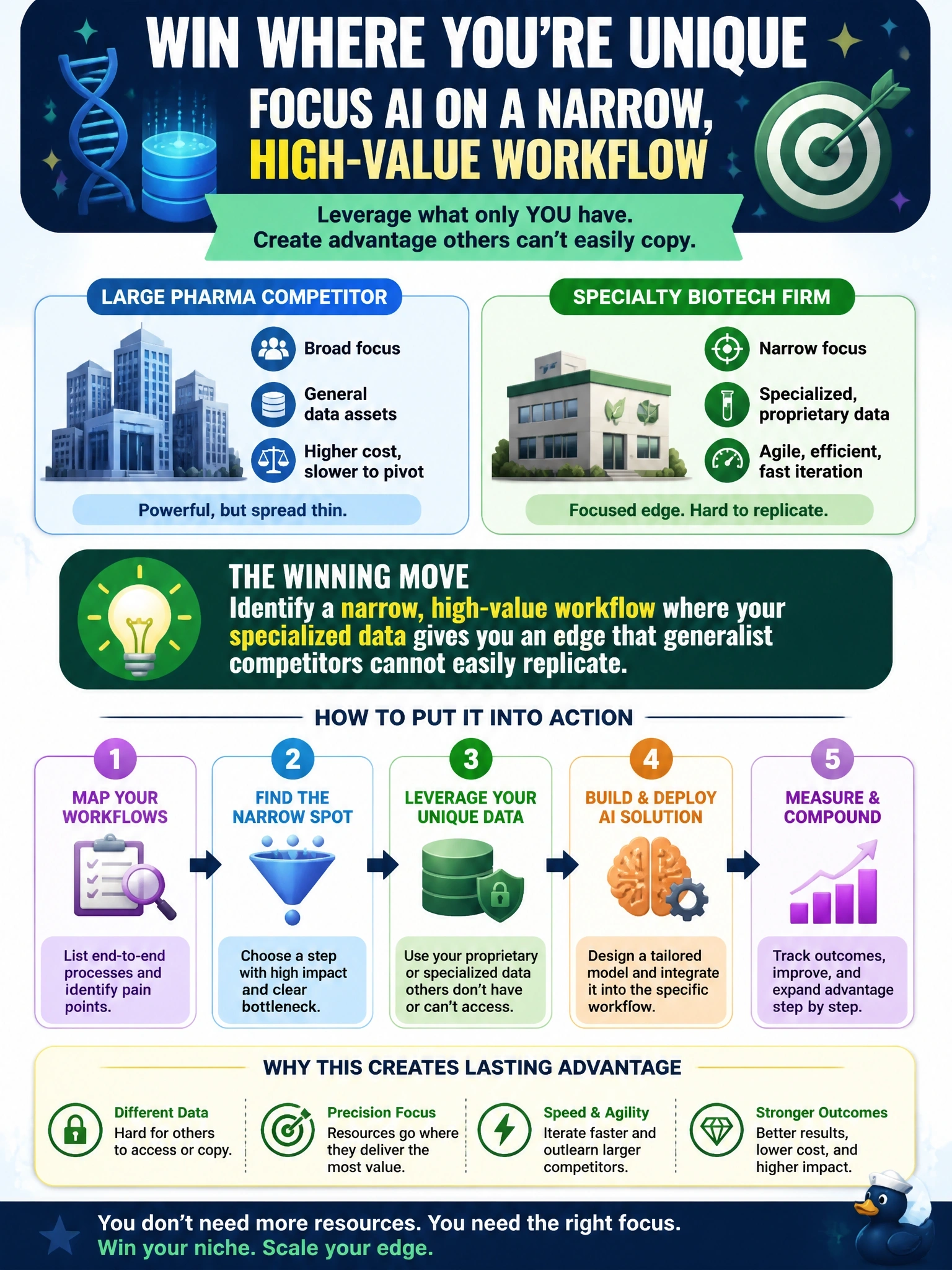
Think of it like a small shop competing with a big-box store: you don't try to out-stock them, you out-know your customers in one specific area they can't easily copy. A biotech firm's edge comes from finding a narrow, high-value workflow where its specialized data beats a generalist competitor's size.
Full Explanation
Identifying a narrow, high-value workflow where the firm's specialized data creates a real edge is how a smaller competitor wins — it looks for an asymmetry a larger, generalist rival can't easily replicate, rather than trying to match its resources head-on. Concluding that AI adoption isn't worthwhile because the firm can't match larger competitors' R&D budgets gives up prematurely; a resource gap rules out broad, expensive plays, but it doesn't eliminate the possibility of a focused, defensible advantage. Adopting the same broad, enterprise-scale roadmap a much larger competitor published for its own investors spreads a smaller firm's limited resources far too thin across initiatives sized for a different kind of organization. Pursuing every AI use case that shows up in industry press, hoping volume eventually surfaces a winner, wastes scarce resources chasing unvalidated ideas instead of committing to one that's likely to work. The principle: smaller competitors win with AI by finding a narrow area of genuine differentiation, not by chasing parity, imitating scale, or spreading bets. A practical check: can the firm name the specific proprietary data asset behind its chosen workflow? If not, it hasn't found its edge yet.